
Building an email list sounds straightforward until you actually try it. The real challenges aren’t technical — they’re getting the right people to sign up in the first place, and eventually building a list that generates income. A lead magnet is supposed to solve the first problem. Most don’t.
That explains why it’s called a lead magnet: it’s a free resource you offer in exchange for an email (a lead). The concept is simple, but don’t confuse simple with easy. Turning that list into income means nothing if no one’s opening your emails.
I’ve made this mistake myself. My first lead magnet was an eBook I built in Canva. I got one subscriber. He never opened a single email. I unsubscribed him. Two campaigns. Zero signups. The eBook wasn’t bad — the format was just the wrong call, and I didn’t know it at the time.
Since then, I’ve learned that what actually converts in 2026 is pretty clear — it has less to do with how much time you spent designing it and more to do with whether it delivers something specific and immediate.
This post covers what’s converting, why the static formats people have relied on for years are losing ground, and — more importantly — what’s realistic to build based on where you actually are right now.
Why Most Lead Magnets Fail
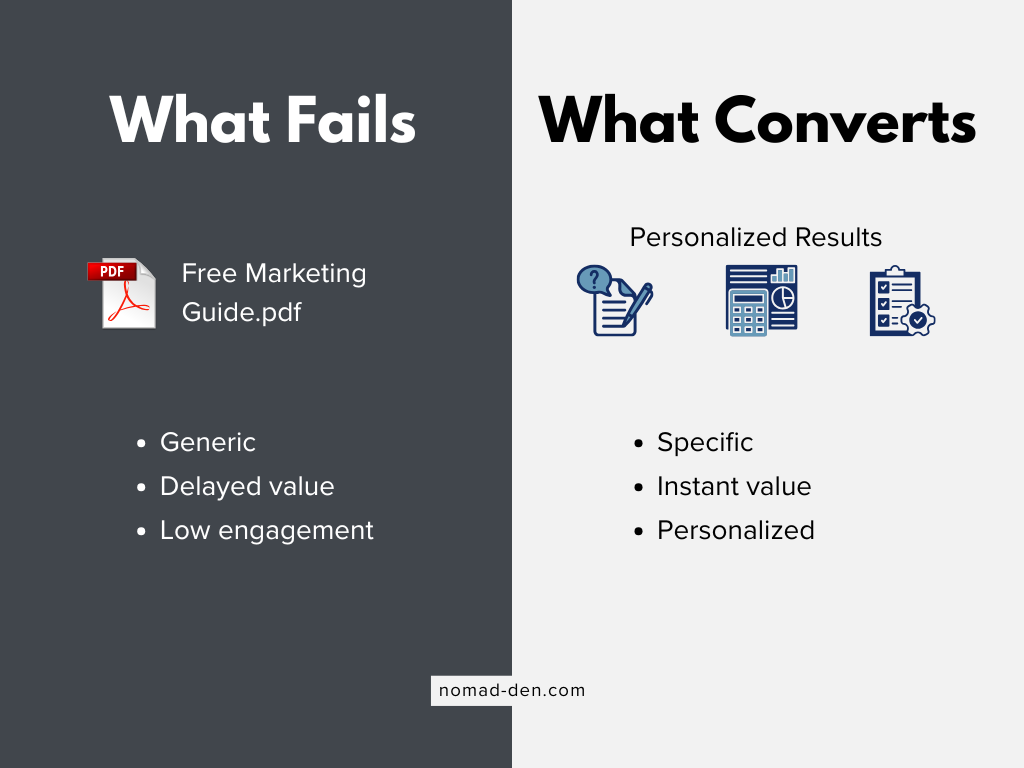
The most common lead magnet is still a PDF: an eBook, a checklist, or a guide. They’re easy to create, easy to offer, and they look useful on the surface. The problem is that most of them never get opened.
Research from multiple tracking studies puts the unopened rate at 60–70% across digital content formats. That’s not a small gap. That’s the majority of people who gave you their email address walking away without ever taking action on what you gave them. The way researchers know this isn’t guesswork: email platforms and gated content tools embed unique tracking links inside the files themselves. If that link is never clicked, the file was never meaningfully read.
Where Most Lead Magnets Go Wrong
The offer feels generic. A free PDF titled “10 Tips for Growing Your Business” could apply to anyone. Which usually means it doesn’t resonate with anyone. People are good at recognizing when something wasn’t made for them specifically.
There’s no immediate payoff. Asking someone to download a 30-page guide and read through it later is asking them to do homework. The formats that convert best in 2026 deliver something useful right now: an answer, a calculation, a result. Not a promise of value after effort.
The follow-up doesn’t match the offer. Even when someone downloads your content, if your email sequence doesn’t connect to what they just asked for, you’ve already lost them. A lead magnet isn’t just a list-builder. It’s the first step in a conversation. If the second step doesn’t follow logically, the conversation ends.
None of this means lead magnets don’t work. They do, when the format is right and the offer is specific. That’s what the rest of this post is about.
What’s Actually Converting in 2026
Not all lead magnets are created equal. The data is pretty consistent on this: interactive formats are outperforming static ones by a significant margin. Here’s what’s working, ranked by conversion performance:
Quizzes — The Top Performer
The numbers on quizzes are hard to argue with. According to data from over 80 million leads tracked by Interact, the average conversion rate for a lead generation quiz is 40.1%. Compare that to a typical PDF, which converts at 3–10%, and the gap speaks for itself.
Why do they work? Because a quiz gives every person a different result based on their answers. That personalization makes handing over an email feel like a fair trade. You’re not asking for access to generic content, you’re offering a specific answer to a specific question they already have.
The quizzes converting best right now are the ones that answer something your audience is genuinely asking about themselves, not personality tests for the sake of it, but diagnostic tools that feel relevant.
Calculators — Highest Revenue Impact
Calculators don’t just capture emails. They move people closer to a decision. When someone runs the numbers and sees the math, the pitch becomes real.
A calculator lead magnet is an interactive tool that gives someone a personalized number based on their inputs. Think cost estimates, ROI projections, or risk scores; they enter their information, get an instant result, and you get a lead.
Interactive calculators average an 8.3% conversion rate in B2B contexts — lower than quizzes, but the leads tend to be higher intent. They also collect useful data automatically: budget ranges, business size, pain points. That makes your follow-up emails far more targeted.
Cheat Sheets and Content Upgrades — The Best Starting Point
This is the most realistic option for where most people are when they’re first building a list.
A cheat sheet is a tightly scoped, one-page resource tied directly to a post someone is already reading. It doesn’t need to be long. It needs to be specific. Research shows micro-niche cheat sheets under 500 words outperform longer formats by 29% in opt-in rate across tech, finance, and health verticals — and when matched directly to the article content, conversion rates can reach 34–40%.
The logic is simple: if someone is already reading your post on VPN setup, and you offer a one-page “VPN Quick-Start Checklist” right there in the content, the offer couldn’t be more relevant. That’s the highest-relevance moment you’ll ever get with that reader.
This is where I’d start. Low production time, high relevance, easy to test.
Webinars — The Trust Builder
Webinars convert well for a clear reason that is different from the formats above. They’re not about instant gratification, they’re about depth. An hour of someone showing up, talking through a topic in real time, and answering questions builds a level of trust that a PDF simply can’t.
They’re also harder to fake. AI can generate a checklist. It can’t replicate you explaining something live.
The trade-off is production effort, since webinars require more setup to work, including hosting. For most people starting out, they’re a longer-term play, something to add once you have an audience worth showing up for. But they’re worth putting on your roadmap.
Templates and Swipe Files — The Shortcut Play
Templates work because they let people skip the learning curve entirely. Instead of explaining how to write something, you hand them the thing already written. They plug in their details and move on.
Examples include a social media caption template, an email sequence outline, or an SEO audit checklist in Google Sheets. All are high-value, low-cost to produce, and easy to understand at a glance.
The logic is the same as the cheat sheet: deliver something useful immediately, with no homework required.
The Shift Behind All of It
There’s a clear reason interactive formats are pulling ahead, and it comes down to one distinction: personalization.
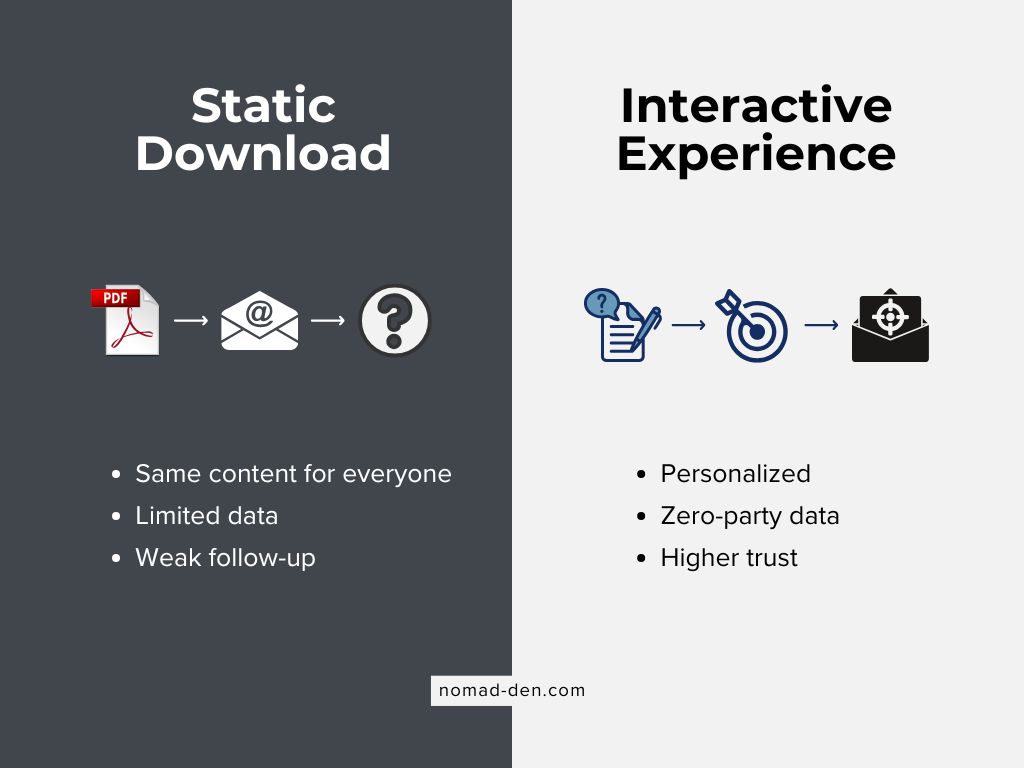
A PDF gives everyone the same thing. However, a quiz or a calculator gives each person something based on their specific answers. That distinction matters more than it used to, because people have gotten better at recognizing when content wasn’t made for them.
There’s also another angle worth understanding: the data you collect from interactive formats is far more useful than what a static download gives you. Every answer someone submits in a quiz or calculator is information they’re choosing to share with you: their situation, their goals, their problem. Marketers call this zero-party data.
It’s accurate, compliant with privacy regulations, and tells you exactly how to follow up. Compare that to a PDF download, where all you get is an email address and a guess, leaving you with far less to work with when determining your next move.
The other factor is trust. Interactive tools deliver a result on the spot. That immediate value, before you’ve asked for anything beyond an email, is what makes the exchange feel worth it. The lead magnet isn’t just building your list. It’s establishing that you actually know what you’re talking about.
What to Build First (Based on Where You Are)
The honest answer here is that your lead magnet should match your current stage, not your eventual ambition.
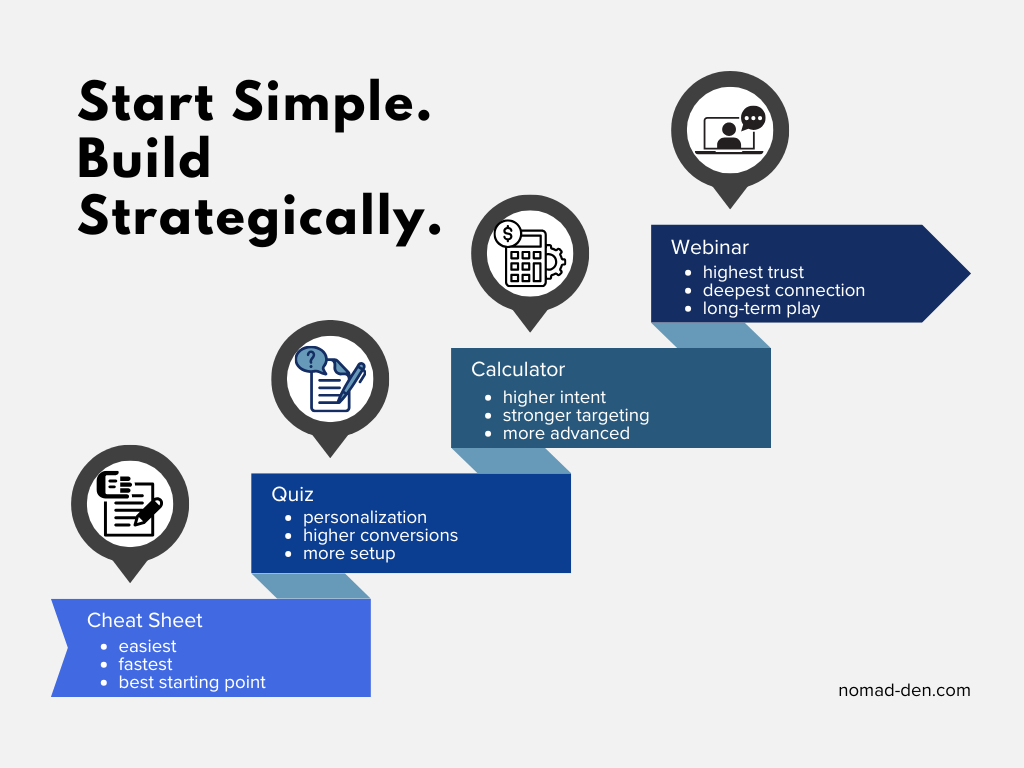
Low traffic (just starting out): Start with a cheat sheet or content upgrade tied to your best-performing post. It’s the lowest lift, the highest relevance, and it doesn’t require any new tools. One page, one topic, one post to attach it to.
Growing traffic: A quiz makes sense here. You have enough visitors to test it meaningfully, and the conversion rate difference is significant enough to justify the setup time. Tools like Interact or Typeform make it more accessible than it sounds.
Established audience: Calculators and webinars become viable. The production investment pays off when there’s already an audience to deliver it to.
Most content about lead magnets skips this part and jumps straight to “here are 10 ideas.” But the best lead magnet is the one you can actually build and test right now, not the one that looks best on paper.
Start simple. See what resonates. Build from there.
Before You Build One, Read This
The Bottom Line
Lead magnets haven’t stopped working. The formats that stopped working are the ones that never truly respected the reader’s time in the first place.
The shift is simple: people want something useful now, not a file they’ll open someday. Interactive tools, cheat sheets, and quizzes all deliver that when they’re built around something specific.
You don’t need to launch with the most sophisticated option. You need to launch with something specific, relevant, and honest about what it does. Ultimately, everything comes down to testing: pick one format, build it around one post or one problem, and see what happens.
What to Read Next

White Hat vs. Black Hat SEO (and the Gray Area In Between)
SEO tactics fall into three categories: white hat, black hat, and a shrinking grey area…
Keyword Research for Beginners: How to Find What People Are Searching For
Keyword research in 2026 isn’t about ranking on Google anymore. It’s about understanding what a…
How to Use Social Media Scheduling Tools to Grow Without Being Online 24/7
There’s a version of social media growth that gets sold constantly: post more, post everywhere,…

How to Validate a Business Idea Before Wasting Months Building It
When you come up with an idea for an online business, you’re anxious to make…
Digital Marketing Analytics for Beginners: Stop Guessing, Start Tracking
When I first launched Nomad Den, I was publishing posts, building out a network of…
SEO Tools for Beginners (Free + Paid): The Only Stack You Need (2026)
As long as people are searching for information online, SEO (search engine optimization) will remain…