
Some links in this post may be affiliate links. I may earn a commission at no extra cost to you.
Table of Contents
- Who Owns NordVPN
- The Audit Record: What Six No-Logs Engagements Actually Proves
- The 2018 Breach and What Changed Because of It
- Standout Features for Business Use
- NordVPN Pricing: What You’ll Actually Pay For
- How NordVPN Compares
- Who NordVPN Isn’t the Best Fit For
- FAQs
- Conclusion
- Continue Reading: Related Posts
NordVPN is the VPN provider most affiliate marketers default to recommending, but the research behind that reputation is more mixed than the marketing suggests. This review is built from NordVPN’s own technical documentation and audit disclosures, cross-referenced against independent testing and reporting, with every claim linked to its source. No stat here comes from a provider’s own claims without an independent source to back it up.
For anyone running an online business, a VPN isn’t just about privacy on principle. It’s the layer between you and whatever network you’re connected to when you’re logging into a client’s dashboard, moving payment information, or handling anything you wouldn’t want exposed on public WiFi. That makes the provider you choose a real business decision, not just a personal preference.
Who Owns NordVPN
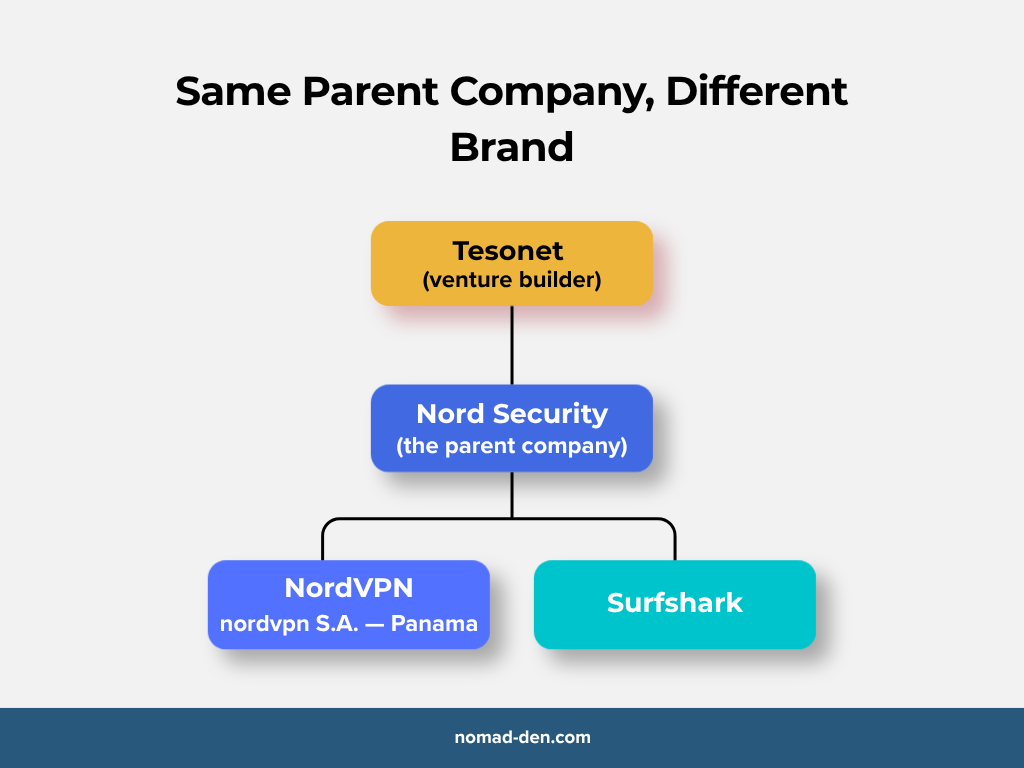
NordVPN is operated by nordvpn S.A., registered in Panama, under parent company Nord Security, which traces back to a Lithuanian startup incubator called Tesonet. The ownership chain gets reported inconsistently across review sites, so it’s laid out more clearly below.
NordVPN → nordvpn S.A. (Panama) → Nord Security (Lithuania/Netherlands) → Tesonet (Lithuania)
NordVPN states it operates under Panama’s legal framework, which sits outside international intelligence-sharing agreements and carries no mandatory data-retention law. This is a common reason privacy companies register there even while day-to-day operations run through offices in Amsterdam and NordVPN’s own headquarters in Vilnius, Lithuania, per PCWorld.
The part that very few NordVPN reviews mention: Nord Security and Surfshark aren’t technically competitors. They merged in 2022, and Surfshark founder Vytautas Kaziukonis has confirmed the ties go back further, describing Surfshark as having operated inside the Tesonet ecosystem for its first two years, per TechRadar. If you’ve read a “NordVPN vs. Surfshark” comparison that treated them as fully separate options, that framing is now incomplete.
If you’ve read a “NordVPN vs. Surfshark” comparison that treated them as fully separate options, that framing is now incomplete. They’re siblings.
The Audit Record: What Six No-Logs Engagements Actually Proves
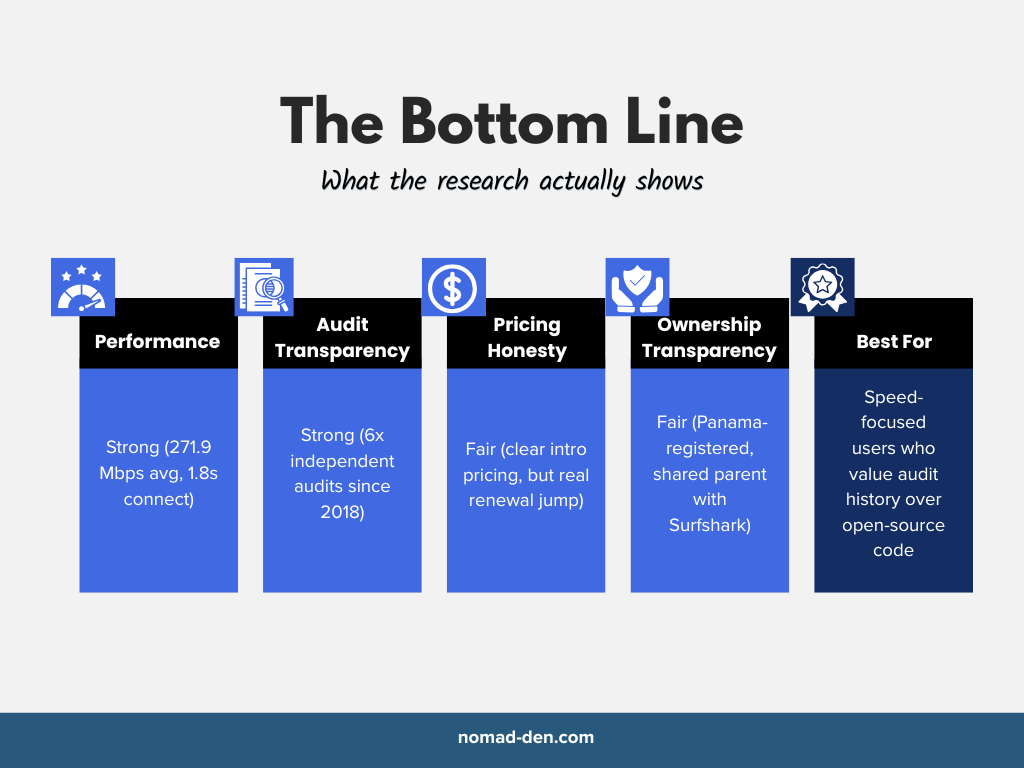
NordVPN has undergone six independent no-logs assurance engagements since 2018, most recently completed by Deloitte Lithuania in December 2025. According to NordVPN’s own summary of the sixth engagement, the assessment ran from November 10 to December 12, 2025, following the ISAE 3000 (Revised) standard set by the International Auditing and Assurance Standards Board, the same framework used in every prior engagement.
Deloitte’s practitioners interviewed NordVPN employees directly and inspected server infrastructure, configurations, and deployment processes as part of the review. A prior audit history summary from privacy researcher Edward Kiledjian confirms the full sequence: PwC conducted the first two engagements in 2018 and 2020, and Deloitte has handled it annually since 2022 though 2025.
Here’s the distinction to understand before treating “audited” as a settled answer: this is a no-logs configuration assurance engagement, not a public, independently reproducible security audit. NordVPN states the full report isn’t published because of its technical nature, and it’s only available to logged-in customers.
That doesn’t make the audits meaningless. Six repeated engagements by two of the four largest global accounting firms is a real, unusual pattern in an industry where most providers make no-logs claims with no verification at all. It’s just a narrower claim than “an independent third party confirmed NordVPN is secure”, and the two shouldn’t be conflated.
The 2018 Breach and What Changed Because of It
One NordVPN server was compromised in March 2018, and the company didn’t disclose it until October 2019, a delay that remains the most-cited criticism of the service. According to NordVPN’s own official response, the breach traced back to an insecure remote management system left active by a third-party data center provider in Finland, one NordVPN says it wasn’t aware existed.
The data center provider deleted the exposed account on March 20, 2018, cutting off further access, but NordVPN states it wasn’t notified of the incident until April 13, 2019, more than a year later, and shredded the affected server the same day it found out. ITPro’s coverage of the disclosure confirms NordVPN’s position that no user credentials were intercepted, since the affected server held no activity logs and NordVPN’s applications don’t transmit user credentials for authentication in a way that could be captured this way.
What matters for a 2026 buying decision is what changed afterward. NordVPN’s response included migrating its entire server network to RAM-only infrastructure that wipes data on every reboot, adding a bug bounty program through HackerOne, which pays outside security researchers to find and report vulnerabilities, That’s a legitimate remediation path, not just a PR response, and it’s the direct reason RAM-only servers and yearly audits are now standard features of the service rather than marketing extras.
Standout Features for Business Use
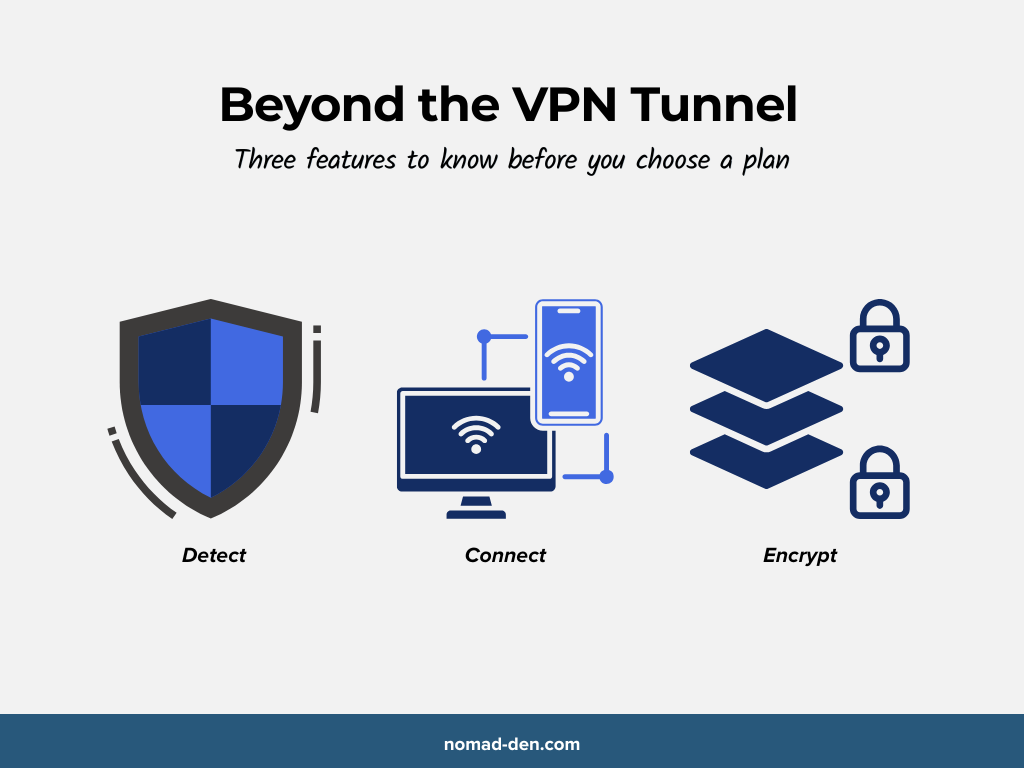
Beyond the VPN tunnel itself, three features stand out for anyone running client work, payments, or sensitive files through their connection: real-time threat scanning, secure access between your own devices, and extra encryption layers when you need them.
Next-Gen Antivirus (formerly Threat Protection Pro)
Scans downloads for malware and blocks phishing sites, scam pages, and malicious ads in real time, running independently of whether the VPN connection itself is active. It’s built to catch threats before they reach the device rather than just scanning files after the fact, and is available on the Complete and Prime plans, but is not included on the Basic plan.
Independently verified: West Coast Labs awarded NordVPN’s next-gen antivirus its AAA certification, the platform’s highest rating, following malware detection and remediation testing completed July 1, 2026.
Meshnet
A free, built-in feature that creates encrypted peer-to-peer connections between your own devices, letting you access files or route traffic between them without a separate VLAN setup. It is useful for accessing a home device, printer, or NAS remotely while traveling and is included on every plan, including Basic.
Specialty Servers
Double VPN routes traffic through two encrypted servers instead of one, and Onion Over VPN combines VPN encryption with Tor-network routing for an added privacy layer. Both options trade connection speed for additional encryption layers. They are available across the current server network alongside standard and obfuscated servers.
NordVPN Pricing: What You’ll Actually Pay For
NordVPN’s current pricing depends on plan and subscription length. Here’s the official structure from NordVPN’s plans and pricing page, current as of its most recent update:
- Basic: 30-day money-back guarantee, secure fast VPN, standard Threat Protection (ad/malware blocking, active only while connected)
- Complete: Everything included in Basic, plus
- Email, phone, credit card, and national ID/SSN monitoring
- Scam call protection
- Anti-malware & browsing protection
- Ad & tracker blocker
- NordPass password manager
- 1 TB cloud storage
- Prime: Everything included in Complete, plus
- Coveron Identity theft insurance up to $1M
- Cyber extortion insurance up to $100k (Additional terms apply)
Basic
Complete
Prime
Pricing shown reflects pricing per month for the 2-year plan. Check NordVPN’s live pricing page for current figures before you commit.
Pricing shown reflects the introductory rate for your first term. Like most subscription services, NordVPN’s rates increase at renewal, so it’s worth checking the current rate on their pricing page before a multi-year term ends.
On refunds: every plan carries a 30-day money-back guarantee, but NordVPN’s own FAQ is explicit that canceling alone doesn’t trigger a refund. You have to actively request it within the 30-day window, after which the support team processes it. That’s a minor extra step, not a hidden catch, but it’s exactly the kind of detail that turns into a support complaint when nobody mentions it upfront.
How NordVPN Compares
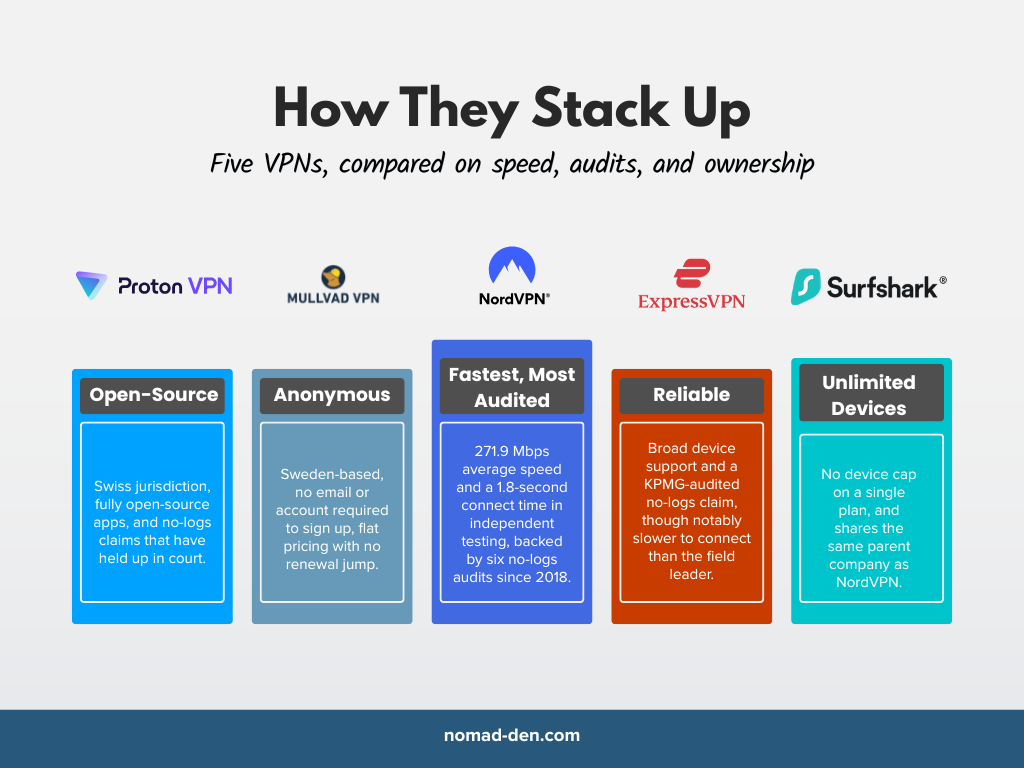
NordVPN topped Artifact Security’s 2026 VPN Performance World Tour, an independent, reproducible test run across five global regions, earning the only Platinum award in the evaluation with an overall score of 91. On Windows, NordVPN led average download speed at 271.9 Mbps and peaked at 568.4 Mbps on its fastest route, outperforming ExpressVPN, Surfshark, Mullvad, and ProtonVPN under identical test conditions. Full methodology and per-run data are available through Artifact Security’s report.
| NordVPN | ExpressVPN | Surfshark | ProtonVPN | Mulvad | |
|---|---|---|---|---|---|
| Jurisdiction | Panama | British Virgin Islands | Netherlands | Switzerland | Sweden |
| Audit history | 6x (PwC/Deloitte, 2018-2025) | KPMG, 2023 | First public audit, late 2025 | Open-source, independently reviewed | Multiple, ongoing (Cure53, Assured, 2024-2025) |
| Avg. download speed | 271.9 Mbps | 257.4 Mbps | 208.7 Mbps | 165.2 Mbps | 192.0 Mbps |
| Time to connect | 1.8s | 14.6s | 2.9s | 2.9s | 2.5s |
| Device limit | 10 | 14 | Unlimited | 10 | 5 |
| Notable ownership | Nord Security | Kape Technologies | Nord Security | Proton AG (nonprofit-linked) | Amagicom AB |
Sources: Artifact Security, VPN Performance World Tour 2026 (device limits, speed, time to connect), ownership and jurisdiction detail.
All five tested providers, including NordVPN, passed every leak test in Artifact Security’s evaluation, covering IP, DNS, IPv6, WebRTC, server-switch, and split-tunneling isolation. That makes leak resistance a baseline every serious provider clears in 2026, not a NordVPN-specific edge. The real differentiators lie elsewhere in this table.
The ProtonVPN comparison matters most for anyone who treats jurisdiction as a top priority. Independent 2026 rankings position ProtonVPN as the strongest choice for privacy-first users, citing its Swiss jurisdiction, fully open-source apps (meaning the code itself is public and independently inspectable), and no-logs claims that have held up in court, not just in a commissioned audit.
NordVPN doesn’t offer open-source apps, which is a real trade-off for anyone who’s already moved toward privacy-first, independently verifiable tools elsewhere in their stack.
Who NordVPN Isn’t the Best Fit For
NordVPN is a strong general-purpose choice, but it isn’t the right fit for everyone, and pretending otherwise is how affiliate reviews lose credibility.
If open-source, independently verifiable code matters more to you than speed or feature count, ProtonVPN‘s Swiss jurisdiction and court-tested privacy claims are the stronger match.
For anonymity, with no email or account at all required as the priority during signup, that’s Mullvad‘s territory, not NordVPN’s.
If your household runs more than 10 devices and unlimited connections matter more than the audit cadence difference, Surfshark is your best choice, with the caveat that it’s now under the same corporate umbrella as NordVPN rather than a fully independent alternative.
NordVPN backs that combination of speed and audit history with real-time threat protection built into the same app, independently AAA-certified, not just bundled in as an afterthought. Get protected with NordVPN’s next-gen antivirus.
FAQs
Conclusion
NordVPN’s case rests on a real pattern of accountability: six independent no-logs engagements since 2018, a documented remediation path after its one publicly known breach, and consistent top-tier placement in 2026 independent speed testing. None of that makes it the automatic right answer for everyone. The ownership overlap with Surfshark, the gap between “audited” and “publicly verifiable,” and the renewal pricing structure are all details worth knowing before you commit, not fine print to discover later.
Continue Reading: Related Posts
Private Browsers and Search Engines Worth Switching To
Google Chrome accounts for roughly 69% of the world’s web page views, and Google handles…

When to Start Outsourcing: How to Vet Your First Virtual Assistant (or Freelancer)
Outsourcing makes sense the moment a task is both teachable and consistently the thing standing…

17 Cybersecurity Terms Every Online Business Should Know (Part 2)
Cybersecurity terms for online business owners cover the threats, compliance requirements, and protective habits that…

Affiliate Marketing Scams: How to Spot Them (and Protect Your Own)
Affiliate marketing is a legitimate, commission-based business model, not a scam, that predates the internet…
Digital Nomad Visas in 2026: Requirements, Costs, and How to Apply Safely
A digital nomad visa is a temporary residency permit that lets you legally live in…
What Is a VPN? How It Works, What It Protects, and What It Doesn’t
A VPN, or virtual private network, is a service that encrypts your internet connection and…