
Some links in this post may be affiliate links. I may earn a commission at no extra cost to you.
Table of Contents
Outsourcing makes sense the moment a task is both teachable and consistently the thing standing between you and publishing. For most solopreneurs, that point arrives well before it feels comfortable. Vetting whoever you hire matters just as much as the timing does. The person you bring on will access accounts, passwords, and/or customer data at some point, and how you screen and grant them access determines whether that delegation helps your business or exposes it’s vulnerabilities.
The freelance economy isn’t small or shrinking, either. Thirty-nine percent of U.S. workers freelanced in some form in 2026, up four percent from the year before, according to Upwork’s Future Workforce Index. That growth works both for you and against you: a larger talent pool to hire from, and more room for someone to fake their way into your business.
How I Knew I Was Hitting a Ceiling
As of the original publication of this post, I have not outsourced anything yet, which is part of why I’m writing this now instead of after the fact. But the signs that I may need to soon have been showing up recently. Content marketing/repurposing and technical SEO maintenance are the two tasks I keep pushing to the bottom of the list every month, not because they don’t matter, but because writing new content always takes priority.
That’s usually the tell. When a task is consistently losing to something else on your list, it’s not a priority problem. It’s a capacity problem, and no amount of scheduling improvement will fix it.
The other sign is simpler: I can already name exactly what I’d hand off first, in order, without much hesitation. Truth is, I have already been preparing for it. When you can list your first few delegation candidates without agonizing over it, you already know the answer. You’re just waiting for permission to act on it.
Automate Before You Delegate
Before handing a task to another person, I consider whether I can manage the task more efficiently with a tool instead. Building any kind of business involves money management. If something is repetitive and follows the same steps every time, that’s a job that can be automated, which would be a less expensive and more efficient use of resources than delegating it.
Weigh your task first and decide if it can be automated with a tool or needs more control and oversight. For example, outsourcing is for tasks that require judgment, experience, and expertise. Skipping this step is how solopreneurs end up paying someone to do what a five-dollar automation would have handled.
How to Know What to Outsource First
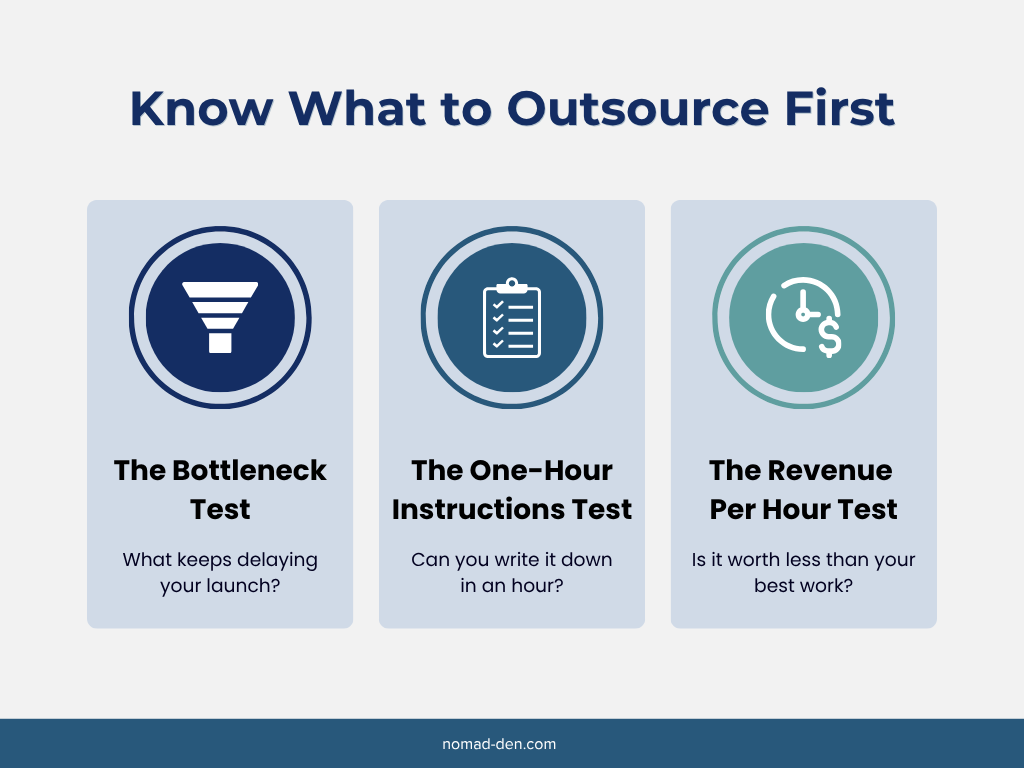
I use three questions to sort my own list, and I’d recommend the same three regardless of what kind of online business you’re running.
The Bottleneck Test
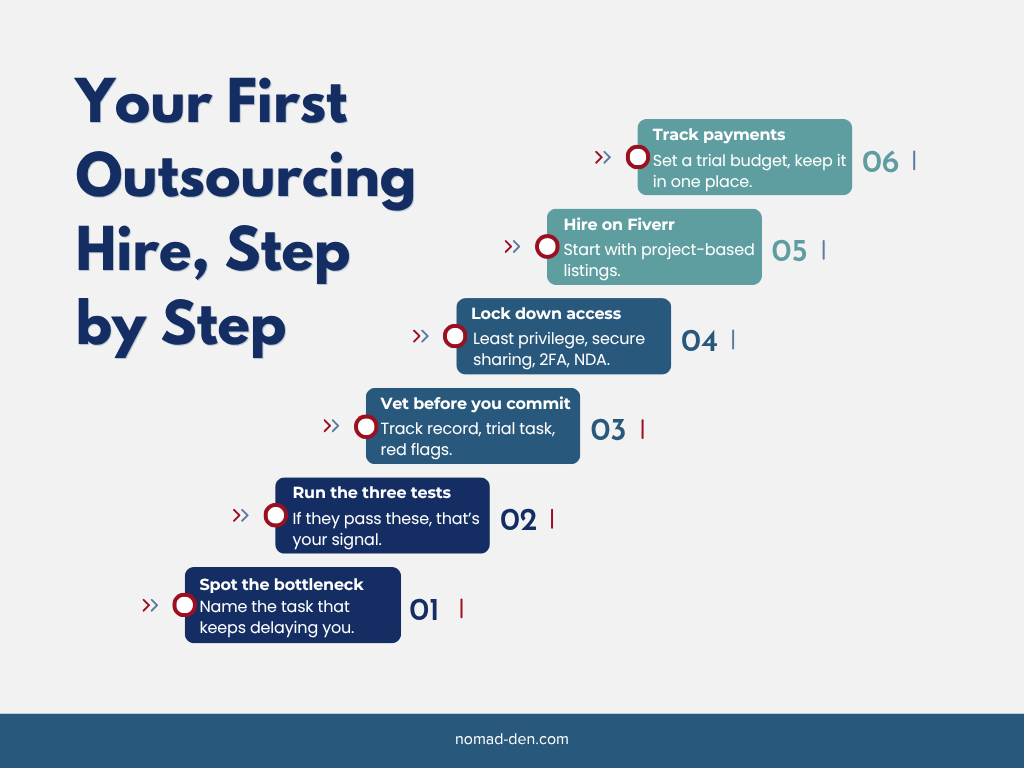
Whatever task most consistently delays you from publishing or shipping is your first candidate. Not the task you dislike most. The one that actually slows your progress.
The One-Hour Instructions Test
Teachable here doesn’t mean someone needs to learn the underlying skill from scratch, it means you can write down how your business specifically handles the task in about an hour. If you can put your exact process into clear instructions that quickly, it’s ready to outsource. If explaining it would take a week because it depends on judgment only you have, it’s not ready yet, no matter how much you want it off your plate.
The Revenue Per Hour Test
If it costs less to delegate a task than what you’d earn spending that hour on the work only you can do, that’s your sign to hand it off. This is the test that stops solopreneurs from outsourcing the wrong things first, like delegating strategy while still doing their own invoicing.
This is the same logic behind comparative advantage, an idea first presented by economist David Ricardo, his 1817 On the Principles of Political Economy and Taxation. It’s not about who’s better at a task in absolute terms. It’s about where your time creates the most relative value, and letting go of everything else, even work you could technically do well yourself.
Running My Own List Through the Rules
My personal list that passes through those three questions to outsource includes design and content creation, content marketing, accounting, technical SEO, and coding.
Design and content creation would be among the earliest for me. I do my best and keep it simple, but I am not a designer. Graphic images for social media, YouTube, and blog posts, can all fit the same design language. Hiring someone that specializes in this would free up time for me to work on projects more specialized for my needs and skills. If something goes wrong, the cost of a mistake is low. This is also common with outsourcing to freelancers or VAs. You may not find the right fit the first time.
Content marketing ranks close behind. It’s teachable once the core content exists, and it’s another task that competes directly with writing time.
Accounting is next, and is a separate case, that requires more careful handling. Bookkeeping is one of the more common skills entrepreneurs at all levels hire specialists for, but it requires financial account access. That access raises the stakes on vetting and access control before anything else. It’s teachable, but not something you’d extend to just anyone.
Technical SEO ranks lower on my list as a first hire, not because it isn’t valuable, but because it’s better suited to a defined project with a specialist than an ongoing task for a general VA. I’d bring this in later, scoped tightly, rather than as an early recurring role.
Coding is the last in my immediate list, for a couple of reasons. It requires the most judgment, the highest trust, and the most access to things that would be hard to undo if something went wrong. That’s a later hire, once I’ve built the vetting habits on lower-stakes work first.
How I’d Vet Someone Before They Touch Anything
Before Nomad Den, I spent years as a licensed real estate appraiser and acquisition manager. Appraisal work is built around verification, but not the kind people assume: it’s mostly public record research, cross-checking comparable sales, ownership, and property details against county assessor and MLS data rather than taking someone’s claims at face value.
As an acquisition manager, I submitted dozens of offers a month, and nothing became real until a contract was signed. That habit, verifying a claim against the record before treating it as fact, is the instinct I use now when deciding who gets access to any part of my business.
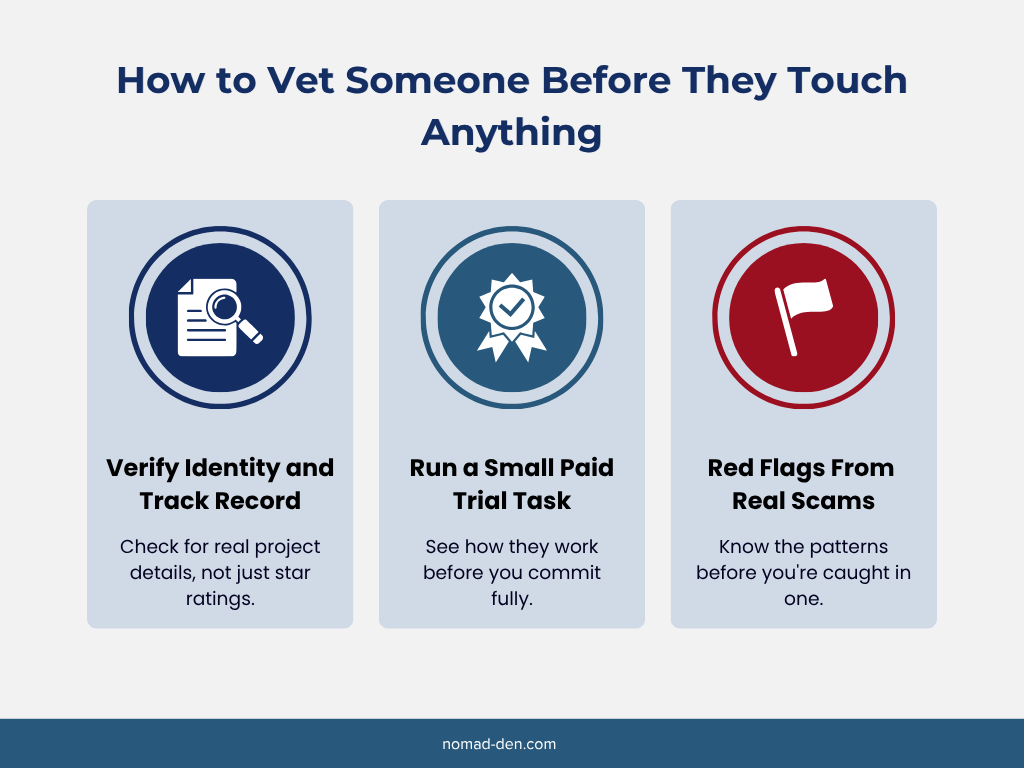
Verify Identity and Track Record
Ratings are important, but they only tell part of the story. Reviews that mention specific project details are worth more than empty platitudes or star ratings without comments at all, and I’ll cross-check testimonials across platforms rather than trusting one profile by itself. If someone can’t or won’t point me to real past work, that’s information on its own.
Run a Small Paid Trial Task
Before any real access changes hands, I’d start with a small, paid trial task that reflects the actual work, not a test unrelated to what I’d need done. It tells you more about how someone communicates and follows direction than any résumé does.
Red Flags From Real Scams
A few patterns show up repeatedly in virtual assistant and freelancer scams: reviews that read generically instead of describing real project details, refusal to provide references, and pressure to skip the trial task and jump straight to full access. Any one of these is worth pausing on, and more than one is a reason to walk away. A different kind of scam shows up on the job-seeking side too, worth knowing if you ever end up on the other side of this relationship.
Locking Down Access Before You Commit
None of this works without protecting what you’re actually handing over. A few things worth locking down before anyone gets real access, not after.
Least Privilege Access Only
Give access to exactly what the task requires, nothing more. A person editing Pinterest pins doesn’t need access to your email or your analytics dashboard.
Share Credentials Securely
Passwords never go through email or chat. A password manager like NordPass lets you share specific logins without ever revealing the actual password to the other person, and access can be revoked instantly if the working relationship ends. Get NordPass before you hand over your first login.

Require 2FA and a Simple NDA
Two-factor authentication should not be negotiable for anything shared. A short NDA, even a simple one, sets expectations before work begins rather than after something goes wrong.
Where to Actually Find Them
Fiverr is where I’d start for a first hire. Project-based listings make it easier to see someone’s specific work before committing to an ongoing relationship. Take a look at Fiverr when you’re ready, that’s where I’d start.
Paying and Tracking Without It Becoming a Mess
A tool like Wave keeps invoicing and payments in one place rather than scattered across platforms and bank transfers. Setting a trial budget cap before work begins keeps a first hire low-risk on both sides while you’re still building trust.
FAQs
Final Thoughts
I haven’t hired anyone yet, and if you’re reading this while still doing everything yourself, that puts us in the same place. The difference between outsourcing that helps your business and outsourcing that exposes it isn’t timing. It’s whether you vet the person and lock down access before you hand anything over, not after something goes wrong. Start with the task that’s actually costing you the most, not the one that feels most urgent today.
Some links in this post may be affiliate links. I may earn a commission at no extra cost to you. Learn more here.
Related Posts
Private Browsers and Search Engines Worth Switching To
Google Chrome accounts for roughly 69% of the world’s web page views, and Google handles…

How to Validate a Business Idea Before Wasting Months Building It
When you come up with an idea for an online business, you’re anxious to make…

6 Affiliate Niches That Last (And Beginners Can Start Today)
Most people pick an affiliate niche based on what’s trending right now. While that may…
Digital Marketing Guide: Where to Start and How It Works
Digital marketing is the promotion of products or services using digital channels such as search…

Content Creation vs Content Marketing: What’s the Difference?
Content creation is producing content. Content marketing is strategically using the content you produced to…

The Only Free Tools You Need to Launch (Before You Upgrade)
Having a limited budget — or the discipline to stick to one — is actually…