
Some links in this post may be affiliate links. I may earn a commission at no extra cost to you.
Table of Contents
ClickBank is a digital marketplace where product creators list offers and affiliates earn commissions by driving sales through unique tracking links. If you’re new to affiliate marketing, ClickBank is one of the easiest platforms for beginners to learn on, especially if you’re looking for a simple way to earn your first commission. ClickBank’s marketplace gives you access to proven digital products and clear tracking tools.
Like most affiliate networks, ClickBank is free to join. They earn money from successful sales, not from signups. That’s standard across the industry, and it means there’s no cost to create an account or explore the marketplace.
Unlike some of their competitors, ClickBank also has a low barrier to entry. While certain networks require minimum traffic, prior sales, or visible authority in their niche (established social media accounts, for example), ClickBank lets you get started immediately with little to no investment or experience.
Why Choose ClickBank?
ClickBank stands out for a few reasons that matter most when you’re starting out. Commission rates on digital products typically run 50–75%, which is significantly higher than what you’d find on Amazon Associates or most physical-product networks. The barrier to entry is also lower than most alternatives: no traffic requirements, no prior sales history, no proof of authority. You create an account and start exploring the marketplace the same day.
The longer-term case is just as strong. Top affiliates scale into six- and seven-figure earnings using paid ads, email marketing, and funnel optimization, and the same marketplace tools available to them are available to you from day one. Gravity scores, refund rates, and performance metrics mean you’re not guessing about which products are worth promoting. With thousands of digital products across dozens of niches, finding something that aligns with your content or audience is more a matter of filtering than searching.
ClickBank also will not shut down your account for inactivity. Many networks require ongoing sales or a steady stream of traffic to stay approved; ClickBank doesn’t. You can pause, return later, and pick up right where you left off.
How to Create a ClickBank Account
Setting up a free ClickBank account is straightforward. Go to ClickBank.com, click the blue “Start Here” button in the top-right corner, and you’ll be guided through a short onboarding sequence. Here’s what to expect:
- Quick onboarding questions: ClickBank will ask a few simple questions about your experience level and goals. They’re not a test, they’re just used to customize your dashboard recommendations.
- Account creation form: You’ll enter your basic details (name, email, password, country). Once submitted, your main account is created.
- Payment information (optional now, required later): You can skip this during signup, but you’ll need to enter it before ClickBank can pay you commissions. They support direct deposit and other secure payment options.
- Dashboard introduction: After setup, you’ll be taken to your dashboard, where you can access the Marketplace, reporting, training materials, and other tools.
Where to Find the ClickBank Marketplace
In order to find the Marketplace, simply log in to your account, and refer to the navigation menu pictured below. Once you’re in, the Marketplace is your next stop.
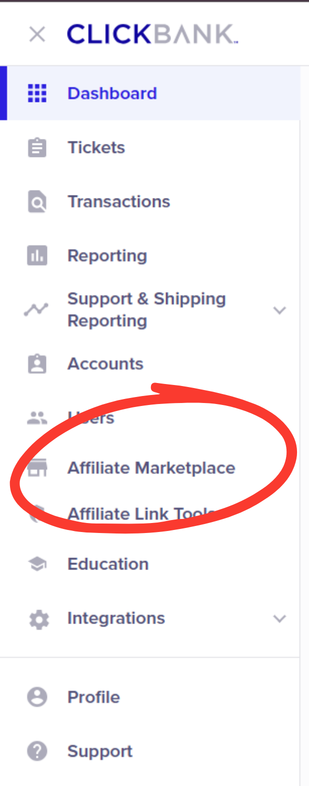
Once your account is created, this is the main ClickBank dashboard menu you’ll use to access the Marketplace, reporting tools, and account settings.
Understanding ClickBank Terms
These measurements are essential to identifying strong, reliable products, and avoiding the ones that aren’t worth your time. The terms below are what you’ll see inside the Marketplace, broken into three categories: what you earn, how products perform, and how your links are tracked.
Commission Metrics
- Avg %/Sale: Commission percentage. A high rate is good, but conversion rate matters more than the commission number alone.
- Initial $/Conversion: Average first payout per sale, before any upsells or recurring commissions.
- Recurring Billings: Products with subscription payments. You earn monthly commissions as long as the customer stays active. This is why subscription-based offers often outperform one-time payment products.
- EPC (Earnings Per Click): The average amount affiliates earn per click, not per sale. Higher EPC usually signals a strong offer.
Performance Indicators
- CVR Score: Percentage of clicks that turn into an initial sale through your affiliate link.
- Gravity Score (GRV): Number of affiliates who’ve recently earned commissions from a product. High = strong demand, but also more competition. Calculated over a 12-week period.
- Rank: ClickBank’s internal ranking of top-performing products. Higher rank generally means high sales volume.
Tracking Tools
- TID / Tracking IDs: Custom tags you can attach to your links to track where sales come from (Pinterest, TikTok, email, etc.).
- Affiliate Link (formerly called “HopLink”): ClickBank’s unique tracking link for each product. Older tutorials may refer to this as a HopLink, but inside the ClickBank Dashboard you’ll now see options to Create, Encode, or Decode your affiliate link instead.
Many of these terms are universal across the affiliate industry, while others, like Gravity Score, are specific to ClickBank. Now that you know how to read the Marketplace, let’s break down how to separate reliable products from the ones you should probably skip.
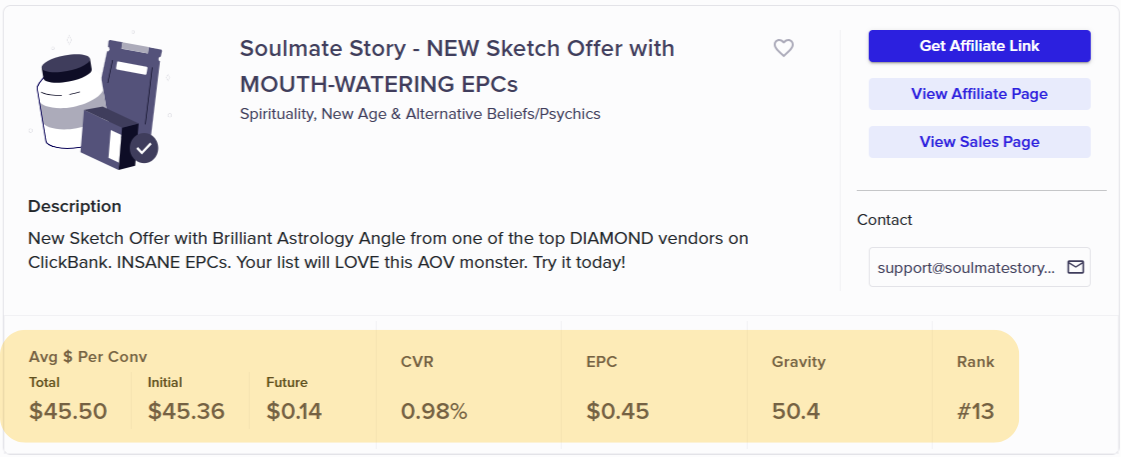
The highlighted area shows the key metrics that matter when evaluating a ClickBank offer — your quick way to judge demand, payouts, and competition at a glance.
How to Choose the Right Products to Promote
ClickBank has thousands of products, more than many of their competitors, but quantity doesn’t equal quality. Before choosing something to promote, make sure it’s worth your time and aligns with your audience. Use these five rules to evaluate offers:
Rule 1: Avoid Saturated “Make Money Online” Offers
The “make money online” niche is broad and (unfortunately) full of low-quality offers. Many look flashy but convert poorly or attract the wrong audience. Beginners get pulled into these all the time. Don’t waste your time.
See Rule 5 below for a clear list of red flags you should avoid.
Rule 2: Choose Evergreen Categories
Evergreen niches maintain demand regardless of trends, news cycles, or algorithm changes, which matters more than it sounds when you’re building content around affiliate offers. A post promoting a health supplement or personal finance tool can generate clicks and commissions two years after it’s published. A post chasing a trending product often can’t. These categories have proven staying power:
- Health & fitness
- Nutrition (often tied to health & fitness, but can be separate)
- Wealth/investing/finance
- Relationships & dating
- Travel
- Personal development
Once you understand how ClickBank works, choosing the right product becomes much easier because you can quickly filter offers by niche, commission, and performance data.
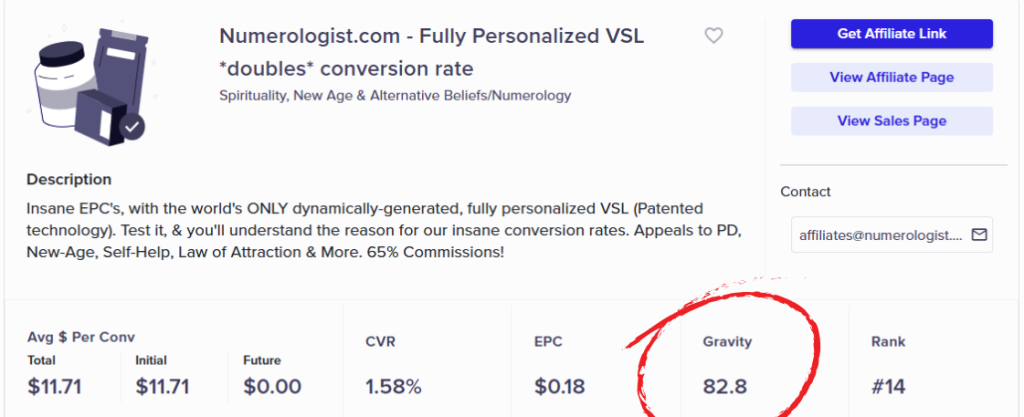
Rule 3: Look for a Gravity Score Between 20–80
Gravity is a key indicator of how successful a product is.
- Too low = no demand
- Too high (200+) = high competition
Beginners should stick to this “sweet spot” range until they gain more experience to compete in crowded fields.
Rule 4: Promote Products With Recurring Commissions
Subscription-based offers create long-term revenue. A single customer can generate income for months, even years, without extra effort. As long as the customer remains active, many vendors will continue to reward you with recurring commissions (terms vary by offer). These often outperform one-time-payment products.
Rule 5: Always Check the Product Page
Never promote something you haven’t inspected yourself. What you’re looking for is straightforward: a clean, professional landing page, a clear offer you can explain in one sentence, and messaging that sells benefits without leaning on hype or inflated claims.
If the page feels off in any way, move on to the next one. There are plenty of solid products out there, so don’t waste your time on those that don’t feel or look right. These are some signs of a product you should avoid:
- Overhyped claims — if it seems to good to be true, it just might be
- Poor design — unprofessional or outdated visuals
- No testimonials or social proof — no reviews, case studies, or credible endorsements
- No clear value proposition — if you can’t explain it, you can’t sell it
Filtering out weak or questionable offers protects your time, your money, and your reputation. Ultimately, successful sales rely on one thing: your audience’s ability to know, like, and trust you.
How to Get Your Affiliate Link
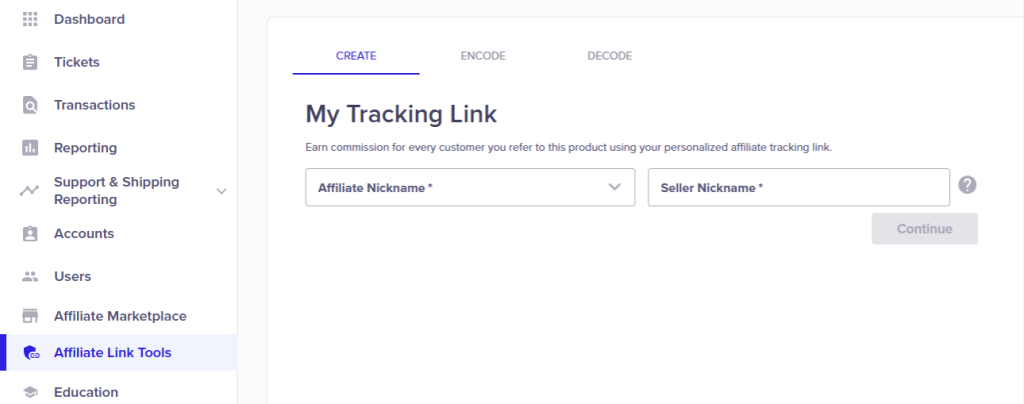
Once you’ve chosen a product, there are two ways to generate your affiliate link inside ClickBank, directly from the product listing, or through the Affiliate Link Tools tab in your dashboard.
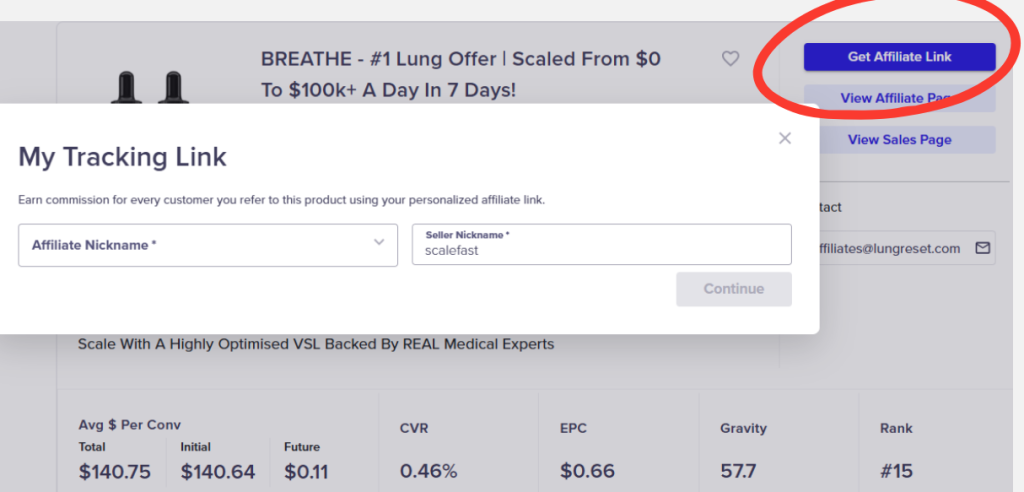
- Click the blue “Get Affiliate Link” button at the top-right of the product listing. From there, insert your affiliate nickname (the seller nickname will be prepopulated from here).
- The other method is inside the Affiliate Link Tools tab of your Dashboard.
A. Under the “Create” tab, enter your Affiliate Nickname and the Seller Nickname of the product to generate a fresh affiliate link.
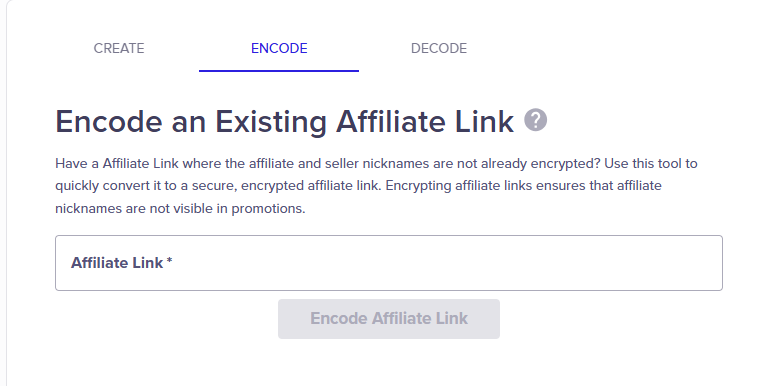
- B. Under the “Encode” tab, you can encrypt an existing affiliate link so the affiliate and seller nicknames aren’t visible, a cleaner and more secure option.
How to Promote ClickBank Offers (Best Practices)
Promotion of your ClickBank opportunities (and affiliate marketing in general) is a subset of content creation and content marketing (yes, they are separate). With SEO evolving into Search Everywhere Optimization, creating content in multiple formats across different platforms increases your exposure and drives more traffic to your offers. There are two main destinations to send your leads:
Build a Website Dedicated to Your Niche
Purchasing a domain and web hosting gives you a home base for your content. Your website can host:
- Educational content — blog posts, guides, comparisons, and reviews
- Email capture — newsletters, lead magnets, and value-driven follow-ups
- Your product recommendations — organized in a way that supports your niche (tools pages, resources pages, etc.)
A site helps establish authority and lets you build long-term, compounding traffic through SEO. If you’re not ready to invest in hosting yet, you can still get started by building on Systeme.io, an all-in-one marketing platform, with a free plan and no trial period
Build Landing Pages for Your Product(s)
A landing page is not a full website, it’s a single-purpose page (or funnel) built to promote one offer. These work best when:
- You want to focus attention on one product
- You’re running ads or short-form content
- You need a clean, simple path to the click
Landing pages convert well because they remove distractions and highlight only what matters for that specific offer. To learn how to start promoting offers without building a full website, you can learn the essentials in this guide.
If you’re starting on a small budget, Hosting.com is one of the fastest and most affordable hosting services available, with excellent customer service. Though as with most hosts, check the renewal rate before committing to a shorter term.


Additional Resources
While ClickBank is one of the easiest platforms to start affiliate marketing (even on a tight budget), there are resources that can help you shorten the learning curve and scale faster.
- ClickBank Platinum: $250,000+ in sales in a single year
- ClickBank Diamond: $5M+ annually
Most beginners won’t reach those levels quickly, but the strategies taught by high-earning affiliates can significantly increase your chances of long-term success. These education programs are well-established and offer more structured guidance from experienced coaches:
Spark by ClickBank
ClickBank’s own education platform, Spark teaches the fundamentals of choosing offers, creating content, understanding analytics, and building simple funnels.
- Getting Started with ClickBank — A free, official mini-course that walks beginners through creating your account, navigating the marketplace, and generating your first affiliate link.
Visit ClickBank to explore their marketplace, resources, and beginner training.
Commission Hero
Created by Robby Blanchard, one of ClickBank’s highest-earning affiliates, Commission Hero is a premium program centered on running paid ads for ClickBank offers and is one of the longest-standing and most trusted ClickBank training systems. Inside, you learn a proven framework for creating profitable campaigns with Facebook ads.

Frequently Asked Questions (FAQs)
Conclusion
ClickBank remains one of the simplest platforms for anyone learning how to start affiliate marketing and earn commissions online. The real advantage comes from focusing on long-term fundamentals, evergreen categories, quality products, and clear tracking, rather than chasing flashy shortcuts.
If you’re new to affiliate marketing or ClickBank, take things one step at a time: set up your account, explore the marketplace, and test a few offers that genuinely fit your niche. As you grow, you can expand into better tools, more structured funnels, and deeper content strategies.
The posts below are the logical next steps. Start with whichever matches where you’re stuck.
Some links in this post may be affiliate links. I may earn a commission at no extra cost to you. Learn more here.
Continue Reading: Related Posts

Affiliate Marketing Scams: How to Spot Them (and Protect Your Own)
Affiliate marketing is a legitimate, commission-based business model, not a scam, that predates the internet…
Affiliate Marketing Networks Compared: Which Ones Are Actually Worth Joining?
An affiliate network is a middleman platform that connects you to multiple merchants or vendors…

6 Affiliate Niches That Last (And Beginners Can Start Today)
Most people pick an affiliate niche based on what’s trending right now. While that may…
How to Start Affiliate Marketing For Less Than $50 (Beginner Guide)
Affiliate marketing is one of the most affordable and accessible ways to start earning income…
17 Affiliate Marketing Terms Beginners Need to Know
Affiliate marketing terms are the core vocabulary that explains how the business model works, including…
How Amazon Associates Actually Works: A Beginner’s Guide
Amazon has evolved into the world’s leading marketplace since its founding in the mid-’90s, commanding…