
Some links in this post may be affiliate links. I may earn a commission at no extra cost to you.
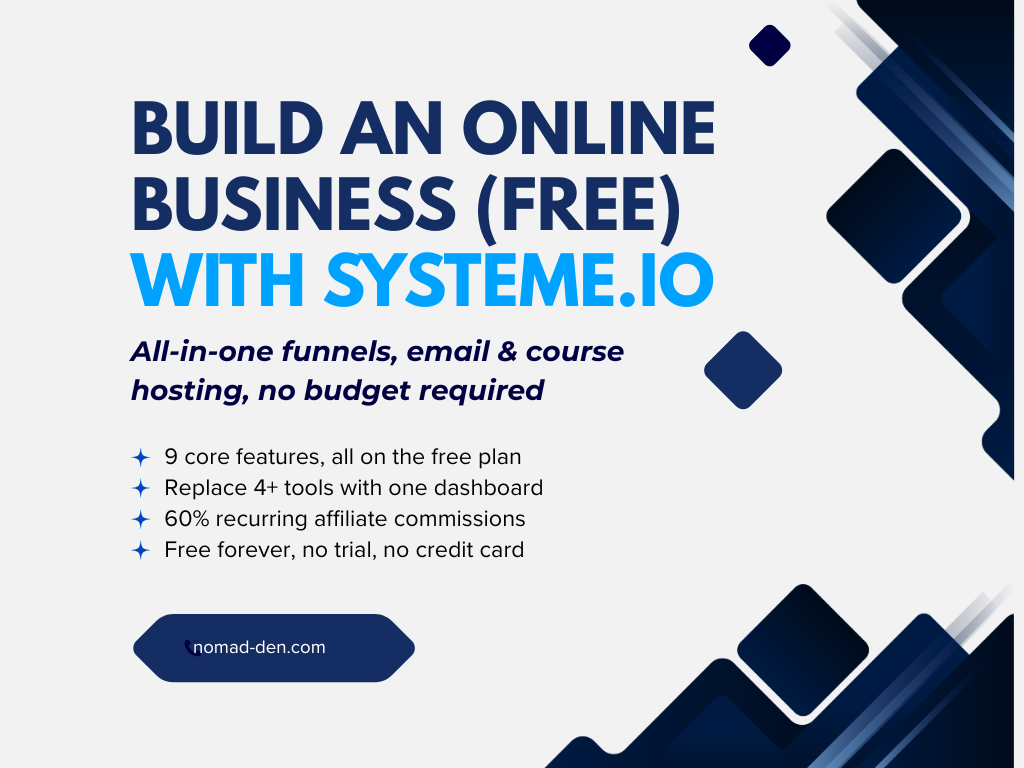
Systeme.io is a free all-in-one marketing platform that consolidates the tools most online entrepreneurs need into a single dashboard: email marketing, funnels, automation, course hosting, and more. For anyone starting out without a budget, it removes the primary excuse for not beginning.
Most people who want to start an online business hit the same wall early: the tools cost money they don’t have yet, and the free options feel like compromises. Having built my first online business foundation on this platform before migrating to WordPress, I can tell you it largely delivers.
Free doesn’t mean without cost. You will always invest time, and time is the one resource you can’t get back. The real question isn’t whether Systeme.io is free; it’s whether the time investment pays off. That’s what this post actually answers.
What You Get With Systeme.io
Systeme.io offers a wide range of powerful features (even on the free plan), including everything from sales funnels to automation workflows. While the platform also includes a blogging tool, it’s not one I personally recommend, as it lacks many standard SEO features that are essential for long-term content visibility. Below, I’ve highlighted nine of its most valuable tools, each chosen for its ability to replace or consolidate other software in your stack and help streamline your business from the start.
Email Marketing
You can build opt-in forms, set up automated sequences, and segment your list without touching a third-party tool. It won’t replace a dedicated platform like GetResponse at scale, but for getting your first list off the ground, it’s more than sufficient. Weighing Systeme.io’s email tools against a dedicated platform? See the full comparison in Email Essentials.
Sales Funnels
The drag-and-drop funnel builder is genuinely one of Systeme.io’s strongest features. Templates are available, customization is straightforward, and you can connect a funnel to a product or email sequence without needing a developer. The funnel builder also includes built-in A/B testing for headlines, layouts, and CTAs, so there’s no separate tool required.
If you’ve never built a funnel before, this is a low-friction place to learn how they work, and if you want the strategy behind why modern funnels are built this way, Funnels 101 breaks down how the model evolved.
Website Builder
Functional, but limited compared to WordPress. You can connect a custom domain and build basic pages, which is enough to establish a presence. If you’re serious about long-term content and SEO, you’ll likely outgrow this, but as a starting point, it works. When you’re ready to make that move, my WordPress setup guide walks through the full process.
Online Course Hosting
One of the more underrated features on the free plan. You can host a structured course, drip content to students, and manage access, all without paying for a platform like Teachable or Thinkific. For anyone planning to launch a digital product early, this is a meaningful advantage.
Affiliate Program Management
Systeme.io lets you build and manage your own affiliate program directly within the platform. If you’re planning to recruit others to promote your products, this removes the need for a separate tracking tool at the start.
Marketing Automation
The automation builder uses if/then logic: tag a contact, trigger a sequence, move someone through a funnel based on their behavior. It’s not as sophisticated as dedicated tools, but it covers the core workflows most beginners actually need.
Product Selling
Both digital and physical products are supported, with integrated checkout and payment processor connections. The setup is straightforward, and you don’t need a separate e-commerce tool to start selling. If you’re still deciding which path fits your business, my breakdown of digital vs. physical products covers the platforms and tradeoffs for each.
Webinar Hosting
Available on paid plans, starting at the Webinar tier. You can run both live and pre-recorded sessions, with registration pages and follow-up sequences built in. For anyone using webinars to launch a course or high-ticket offer, this is one of the features that makes the jump from free worthwhile.
CRM & Contacts Management
Tagging and segmentation are dependable at the free tier. You can organize contacts meaningfully without needing a dedicated CRM tool alongside it.
Want to explore more? See the full list of Systeme.io’s features here.
Connecting Systeme.io to the Tools You Already Use
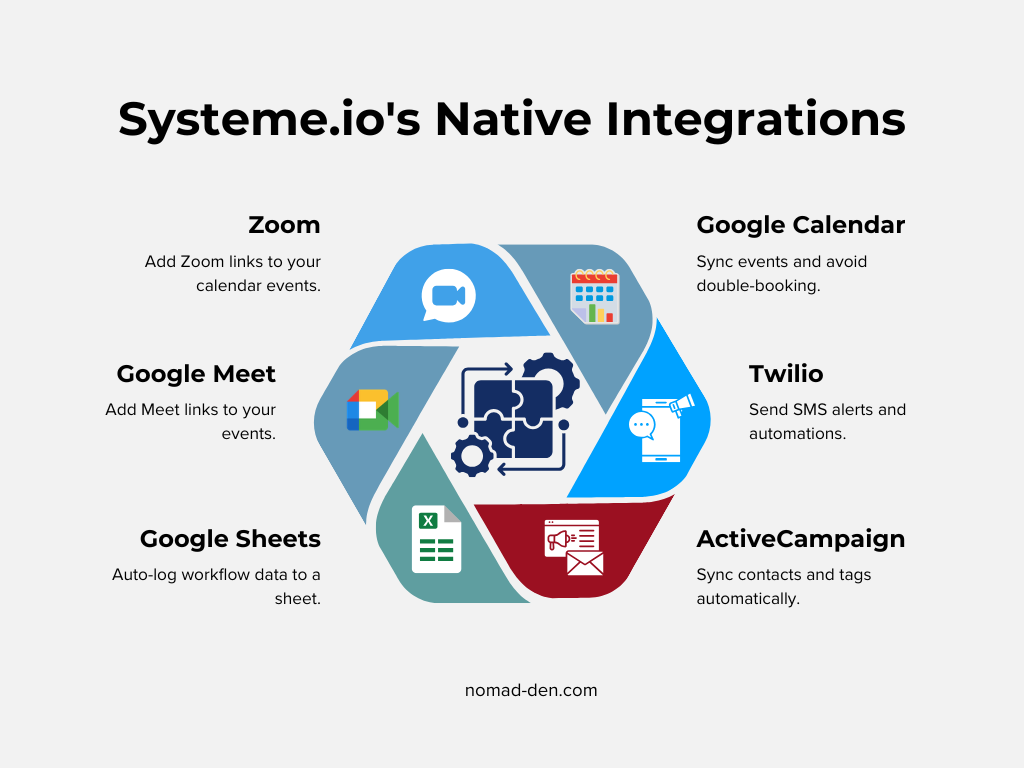
Systeme.io connects with external tools through API integration, webhooks, and third-party automation platforms, giving you room to expand without being locked into a single ecosystem.
The most practical entry point for most beginners is Zapier, which acts as a bridge between Systeme.io and thousands of other applications. If you want to connect your funnel to a Google Sheet, trigger a Slack notification when someone opts in, or sync data with a CRM, Zapier handles it without writing a single line of code.
For more advanced setups, Systeme.io’s public API allows direct integration with external platforms, and webhooks add another layer by automatically pushing data to another tool the moment a specific action occurs, like a purchase or a new subscriber. These are features you’ll grow into, not ones you need on day one.
Additional Tools to Enhance Systeme.io
As your business scales, you may find yourself outgrowing certain native features. That’s normal and expected. Some tools worth knowing about for that stage:
- GetResponse: A dedicated email marketing platform with deeper automation, advanced segmentation, and more robust analytics than Systeme.io’s native tools. A natural upgrade path if email becomes a core growth channel.
- ClickFunnels: A premium funnel builder with a larger template library and more sophisticated split-testing capabilities. A logical next step when you’re ready to invest in conversion optimization at scale.
- HubSpot: Full-scale CRM for managing leads and client relationships, particularly relevant for service-based businesses.
- Mangools: SEO research suite covering keyword tracking, SERP analysis, and backlink data. Unrelated to Systeme.io specifically, but useful as your content operation grows alongside your funnel work. See the full walkthrough of Mangools’ toolset here.
- Shopify: The go-to for physical product sales at volume. Pairing it with Systeme.io funnels is a viable hybrid strategy.
- Stripe & PayPal: Both integrate directly with Systeme.io for payment processing. Stripe is generally the cleaner integration of the two.
- Zapier: Connect Systeme.io with over 2,000 other tools (like Trello, Calendly, or Google Sheets) without coding, enabling automated workflows across platforms.
- Slack: Central hub for team communication and real-time notifications, especially useful when paired with webhooks or Zapier for lead alerts and activity tracking.
Most of these integrations are things you won’t need until you’ve already gotten traction on the platform itself. Start with what Systeme.io gives you natively, and add tools when a specific gap appears, not before. Curious about building your own custom integrations? Check out Systeme.io’s Public API guide.
With features like funnel building, email marketing, and automation, Systeme.io provides a strong foundation for your online business. Plus, with the free option, you can access these tools without any upfront cost, making it an ideal choice for beginners on a budget.
Now, let’s dive into how Systeme.io helps you host and manage your own products, whether digital or physical.

Hosting Your Own Products
Systeme.io supports both digital and physical product hosting directly within the platform, which removes the need for a separate e-commerce tool when you’re starting out. For digital products (ebooks, templates, courses, downloadables), the setup is straightforward and capable at the free tier. Physical product support exists but is basic.
If physical goods are your primary focus, you’ll hit limitations quickly and something like Shopify will serve you better. For most online entrepreneurs starting with digital products, it’s more than adequate.
You can build a structured course, drip content to students on a schedule, and manage access, all without paying for a dedicated platform. For anyone planning to launch a digital product as an early income stream, this is one of the more underrated advantages of sticking with Systeme.io as you scale.
Systeme.io tracks key metrics including transactions, subscriptions, and affiliate performance in a single dashboard. It won’t replace a dedicated analytics tool as your operation grows, but for the early stage it gives you enough visibility to know what’s working. If you want the fuller picture beyond what’s built in, my beginner’s guide to digital marketing analytics breaks down what to track and where.
Pricing Plans
Whether you’re just starting out or ready to scale, Systeme.io offers a tiered pricing structure to match your goals and budget. Here’s a closer look at each plan:
- Free Plan: Access essential tools like email marketing, funnels, and course hosting with no time limits or upfront costs, ideal for beginners building on a tight budget.
- Startup Plan: Unlock advanced automations, integrations, and custom domains to help your business grow faster as you gain traction.
- Webinar Plan: Perfect for those who want to host live or evergreen webinars. Includes webinar funnels, unlimited file storage, and more space for your digital events.
- Unlimited Plan: Get full access to all features with no usage limits, including unlimited contacts, automation rules, and 1-on-1 support, great for scaling businesses.
Start now for free, without a trial period.

Systeme.io also offers two free months when you choose annual billing, saving you money in the long-run if you’re ready to commit to a paid plan.
Ease of Use and Community Support
Systeme.io’s interface is straightforward enough that most people can learn themselves without a tutorial. The dashboard centralizes everything: funnels, contacts, products, automations, so you’re not jumping between tools to manage a single workflow. Training resources are built into the platform, and there’s an active user community you can lean on if you run into walls.
Why Systeme.io is the Smart Choice
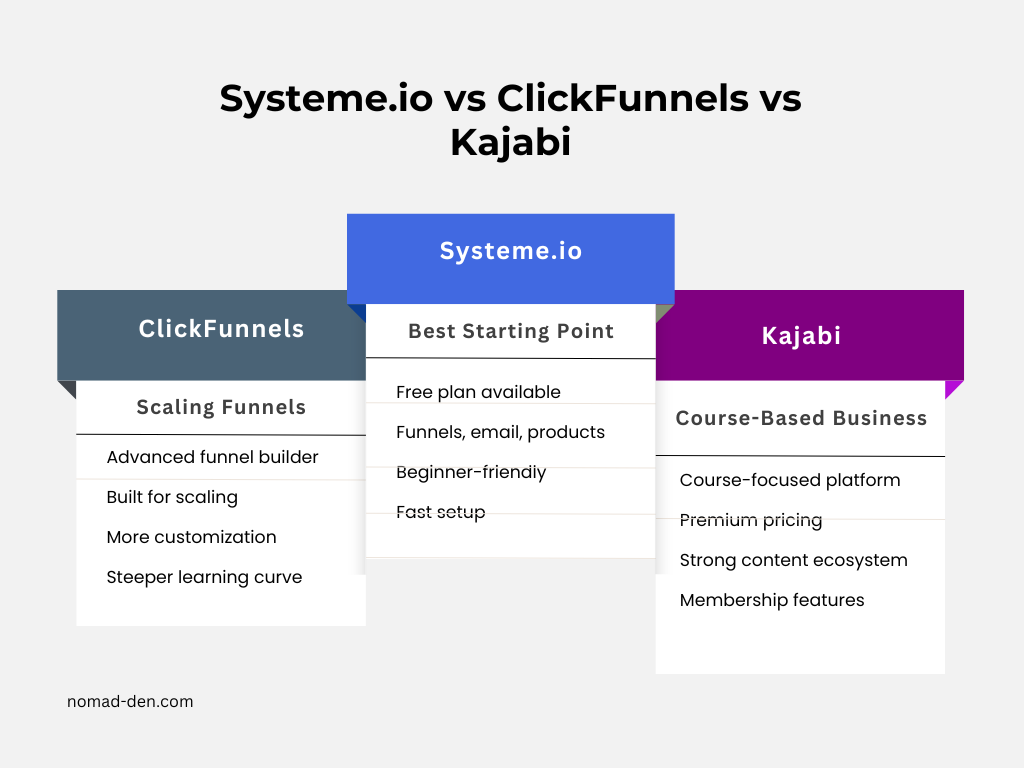
Systeme.io earns its place as a starting platform not because it’s free, but because it’s functional at the free tier in ways most competitors aren’t. The real comparison isn’t between free and paid, it’s between Systeme.io and what you’d be paying for elsewhere at the same stage.
ClickFunnels, for example, is a more powerful funnel builder with a broader set of features, as well as a larger template library. But it comes with a learning curve and a price point that assumes you’re already generating revenue. It’s not a beginner tool, it’s a scaling tool. If you’re not yet at the stage where you need what ClickFunnels offers, you’re paying for capability you can’t fully utilize yet.
Kajabi sits in a similar position: a premium, course-first platform built for creators selling high-ticket programs, memberships, and coaching at scale. The course player, community features, and marketing automation are genuinely more polished than what Systeme.io offers, but that polish comes with a price tag that starts well above where most beginners are financially. It’s a platform to grow into, not start on. If your business is going to be built primarily around a signature course down the line, Kajabi is worth keeping on your radar for later.
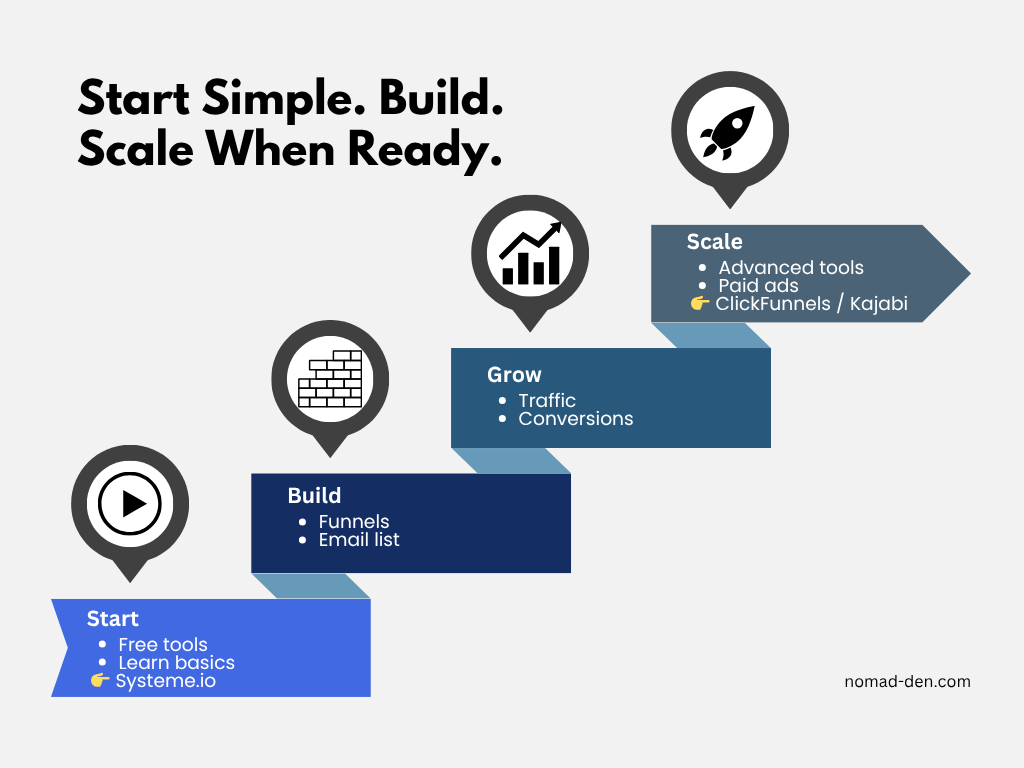
Systeme.io’s strength is that it removes the financial barrier at exactly the moment when most people need that barrier removed. You can build a funnel, grow an email list, host a course, and manage an affiliate program without spending anything. When you’re ready to branch out, the tools above are there. But the foundation you build here is real, transferable experience.
There are features within Systeme.io I haven’t fully explored yet, and I want to be upfront about that. What I can speak to is what I’ve built with it and where I found its ceiling. Like any free tool, Systeme.io has real limitations, and you get what you pay for. But for the early stage of an online business, I haven’t found a more complete free starting point.
Join the Systeme.io Affiliate Program
Something that often gets overlooked in reviews like this: Systeme.io runs its own affiliate program, and it’s one of the more generous ones in this space, with a 60% recurring commissions on referrals. If you’re already using the platform and recommending it to others, there’s no reason not to sign up.
The program is free to join, the tracking is built directly into the platform, and the commission structure is competitive with tools that charge separately for affiliate management. Attribution locks in the moment someone signs up through your link, even on the free plan, and it never expires — so if a referral upgrades to a paid plan months or even years later, you still earn the commission. That kind of permanent attribution is rare among affiliate programs, most rely on short cookie windows that expire long before someone actually converts.
If building an income stream around tools you already use and believe in is part of your strategy, and it should be, this is one to set up early. Learn more about the Systeme.io affiliate program here.
FAQs
Summary
Systeme.io won’t be the last tool you use, and it doesn’t need to be. For most people starting out with a limited budget and no appetite for stitching together five different platforms, it’s one of the strongest, most complete free starting points available. Build something real on it first. When you outgrow it, you’ll know exactly what you need next, and that clarity is worth more than jumping to the “better” tool too early.
Some links in this post may be affiliate links. I may earn a commission at no extra cost to you. Learn more here.
Continue Reading Related Posts
How to Use Social Media Scheduling Tools to Grow Without Being Online 24/7
There’s a version of social media growth that gets sold constantly: post more, post everywhere,…
SEO Tools for Beginners (Free + Paid): The Only Stack You Need (2026)
As long as people are searching for information online, SEO (search engine optimization) will remain…
Digital Marketing Guide: Where to Start and How It Works
Digital marketing is the promotion of products or services using digital channels such as search…
Top 5 Tools Every Online Business Owner Needs
Most online businesses are built on five foundational tool categories: a domain and hosting, a…
Email Marketing Essentials: Platforms, Automation, and List Hygiene
Email marketing means sending targeted messages directly to people who’ve opted in to hear from…
Mangools Review: Is It the Best SEO Tool for Beginners?
Search Engine Optimization (SEO) is the most effective organic method for connecting with your audience,…