
Some links in this post may be affiliate links. I may earn a commission at no extra cost to you.
Email marketing means sending targeted messages directly to people who’ve opted in to hear from you, and it remains one of the highest-return channels in digital marketing today. According to recent industry benchmarks, businesses see an average return of $36 for every $1 spent on email, outperforming paid search and social ads by a wide margin. This guide covers the platforms worth considering, how automation multiplies your results, and the list hygiene habits that keep your emails landing in inboxes instead of spam folders.
What is Email Marketing?
Email marketing is one of the oldest forms of digital marketing, and also one of the most durable. Gary Thuerk sent the first mass commercial email back in 1978, and the channel has only grown more effective since. It’s highly scalable, customizable, and remains one of the best tools available for building direct relationships with an audience, all while giving you clear performance data to see what’s working and what isn’t.
This guide covers the platforms worth considering, how automation multiplies your results, and the list hygiene habits that keep your emails landing in inboxes instead of spam folders. Plus, it allows you to track performance, giving you valuable insights into what’s working and where you can improve.
Why Email Marketing Matters
Implementing email marketing into your business strategy is a no-brainer, given its cost-effectiveness and the ability to track measurable results. Collecting data is crucial for making informed decisions, allowing you to tailor your approach based on your customers’ or potential customers’ actions. This not only helps your business grow but also enables you to introduce products and services that genuinely interest them.
- Trust builds through consistency; a subscriber who receives useful, honest emails on a predictable cadence learns to trust your brand faster than one who only sees you in a crowded social feed.
- Customer Experience: Building strong relationships with customers enables businesses to offer a more personalized and engaging experience. 86% of customers are willing to pay more for a better experience, according to PwC research, underscoring how much perception shapes purchasing decisions.
- Customer Satisfaction compounds through email in a way other channels can’t match: a subscriber who consistently gets useful, well-timed emails builds satisfaction with every open, long before they ever buy again.
- Loyalty grows fastest with the audience you already reached once. A welcome sequence or a well-timed re-engagement email keeps you top of mind without asking someone to seek you out again.
- Communication stays direct and uninterrupted with email; unlike a social post that an algorithm decides who sees, an email lands in front of the exact person you sent it to, every time.
- Networking happens automatically at scale with email; every subscriber who forwards a newsletter or replies to an email is a warm introduction you didn’t have to chase down at an event.
Together, these six factors are why email consistently outperforms channels that depend on someone else’s algorithm to reach your audience. The next step is putting them into practice.
The Power of Email Marketing
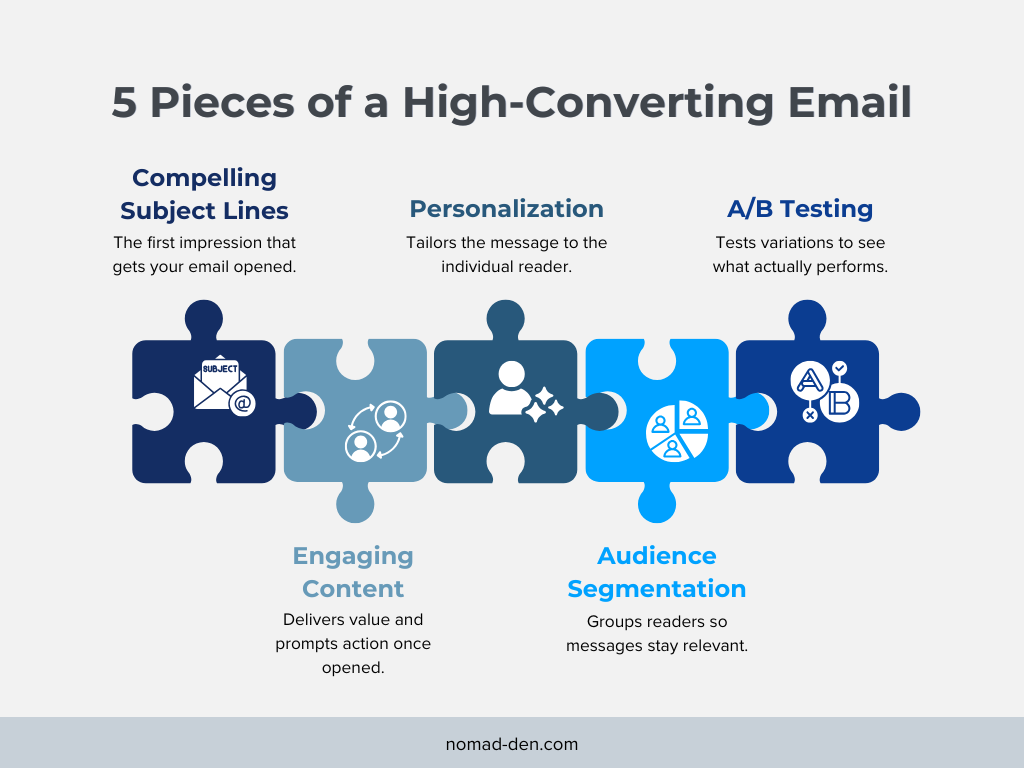
Email marketing is a powerful tool because it allows you to tailor your engagement based on the six benefits mentioned above. By creating a personalized experience for each customer, you can achieve higher conversions, encourage repeat business, and get closer to that $36-per-$1 return we mentioned earlier. To make the most of your email marketing efforts, it’s crucial to focus on the following key elements to achieve these results.
- Compelling Subject Lines are the first thing your subscriber sees when they open their inbox. Keep them clear, concise, and intriguing, personalization, urgency, and curiosity are effective tactics to increase open rates.
- Engaging Content should deliver value and inspire action, once your email is opened. Focus on personalized messages and strong calls-to-action (CTAs) to keep your audience engaged and encourage the next step.
- Personalization matters across every element of your email marketing, from subject lines to content. By tailoring your emails to your audience’s needs and behaviors, you can significantly boost engagement and conversions.
- Audience Segmentation allows you to tailor messages to specific groups, increasing relevance and boosting engagement, helping to drive conversions.
- A/B Testing involves sending two versions of an email with slight variations, like subject lines or CTAs, to see which performs better. This helps refine your emails for better engagement and conversions.
Layer these five elements together, and you have the foundation of every high-performing email campaign. The next piece is automation, which lets you apply them at scale without manual effort. If any of the terminology here feels unfamiliar, this glossary of email marketing terms breaks down the vocabulary in plain language.
Automations Essentials
Automation lets you streamline and personalize your email marketing by triggering sequences based on customer behaviors or predefined rules. Here are the concepts behind most automated email systems:
- Workflows are the entire email journey, triggered by a specific action like a sign-up or purchase.
- Welcome emails introduce new subscribers, while drip campaigns nurture leads over time.
- Triggers activate automated emails based on actions like an abandoned cart or browsing behavior.
- Automation rules segment your audience automatically based on the triggers and actions you define.
A/B testing and segmentation work hand-in-hand with these automations, refining which messages or triggers resonate most effectively with different groups.
Overview of Email Marketing Tools
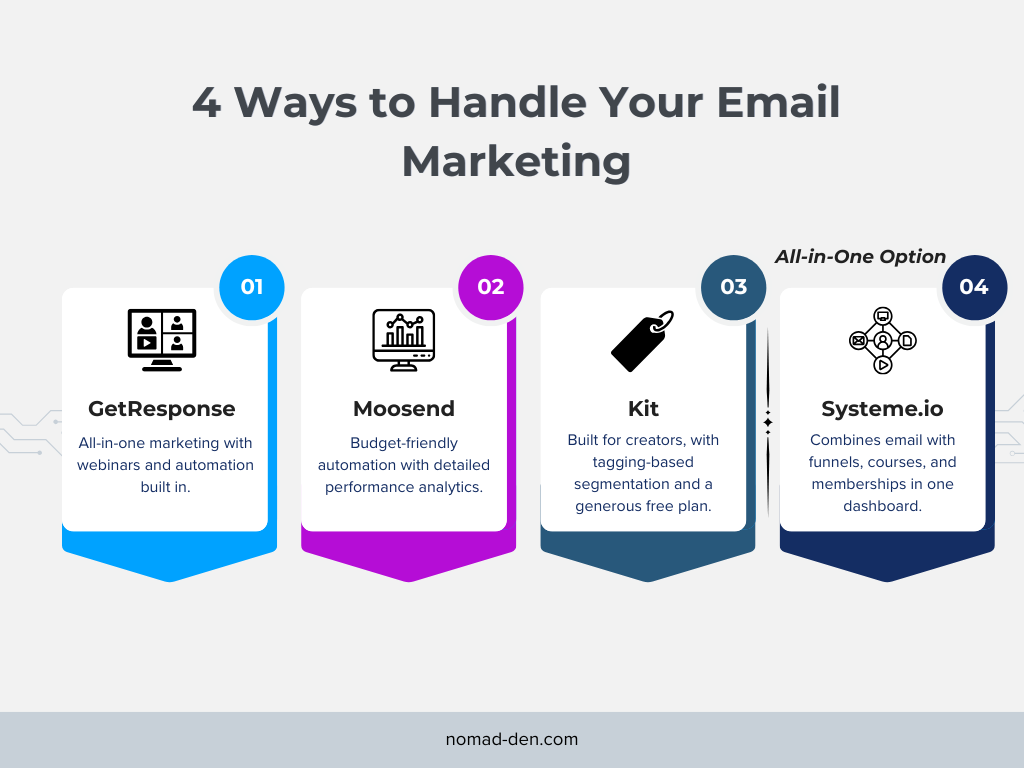
Choosing the right tools for your email marketing strategy matters. Fortunately, many platforms have free trials so you can learn their features, tools, and pricing before you commit. GetResponse is the platform covered from hands-on use; Moosend and Kit are covered based on their documented feature sets and verified user feedback. We’ll cover three highly rated and well-recognized platforms for email marketing, as well as two additional suggestions for more streamlined options.
GetResponse
GetResponse stands out with comprehensive email marketing capabilities, including automation workflows, landing pages, and webinar hosting. It also offers advanced segmentation and A/B testing, making it a strong fit for more complex campaigns. It’s best suited for businesses that want an all-in-one marketing platform, especially if webinars and landing pages are part of the plan. Start a 30-day free trial with GetResponse to see how it fits your strategy.
Pros:
- Comprehensive Features: Includes advanced tools like webinars, landing pages, and automation workflows.
- Scalable: Suitable for businesses of all sizes, from small startups to large enterprises.
- A/B Testing: Offers robust testing features to optimize campaigns.
Cons:
- Pricing: Can be more expensive than some competitors, especially for advanced features.
- Learning Curve: The extensive features may require time to fully master.

Moosend
Moosend is a budget-friendly email marketing platform known for its automation features, customizable templates, and detailed analytics. It offers easy-to-use drag-and-drop editors and solid segmentation options, making it a versatile tool for marketers who want strong automation without the higher price tag of some competitors. It’s an excellent choice for businesses of all sizes that need a straightforward, cost-effective solution for automating email campaigns and analyzing performance. See how Moosend can fit your email marketing.
Pros:
- Automation: Powerful automation features that simplify campaign management.
- Cost-Effective: Offers affordable pricing plans, making it accessible for businesses of all sizes.
- User-Friendly: Intuitive interface that’s easy to navigate.
Cons:
- Limited Integrations: Fewer third-party integrations compared to some competitors.
- Design Flexibility: Customization options for templates may be somewhat limited.
Ownership Changes: Moosend has changed hands twice since 2021 (Sitecore, then Constant Contact in 2025). It’s continued operating under its own branding so far, but it’s worth keeping an eye on for anyone prioritizing long-term platform stability.
Kit (formerly ConvertKit)
Kit is designed for creators, offering intuitive tools for building email lists, automating workflows, and creating landing pages. If you’re still working on getting people onto that list in the first place, here’s what’s actually converting into signups in 2026. Its focus on simple automation and tagging makes it ideal for creators, bloggers, and small businesses looking for ease of use. This is a strong fit for content creators who want easy-to-use automation and list management without overwhelming complexity. Get started with Kit to unlock simple tools for growing your audience, automating your workflows, and engaging your community.
Pros:
- Ease of Use: Designed with creators in mind, Kit is user-friendly and straightforward.
- Tagging & Segmentation: Advanced tagging helps tailor your email content based on subscriber behavior.
- Automations: Strong workflow automations make it simple to nurture leads over time.
Cons:
- Limited Templates: Fewer design options compared to competitors like Moosend and GetResponse.
- Pricing: Slightly more expensive at lower tiers compared to other platforms.
Pricing reflects publicly listed rates at the time of writing and is subject to change. Always confirm current pricing directly on each platform’s site before committing.
| Platform | Best For | Free Plan | Starting Price (annual) |
|---|---|---|---|
| GetResponse | All-in-one marketing with webinars | 14-day full-feature trial, then a limited permanent free plan | $15.58/mo. |
| Moosend | Budget-conscious automation | 30-day full-feature trial, no permanent free plan afterward | $7/mo. |
| Kit | Creators and bloggers | Free up to 10,000 subscribers | $33/mo. |
Kit’s free plan is permanent and unusually generous for list size, while GetResponse and Moosend both require a paid plan (or trial) to access core features long-term. Kit’s paid tier is priced per feature access rather than gradually scaling with contacts, so the jump from free to paid can feel steeper even though its free tier goes further than the other two.
Beyond Email: Systeme.io as an All-in-One Alternative
If you’d rather combine email into a broader system instead of running it as a standalone platform, Systeme.io includes email marketing alongside funnels, course hosting, and membership tools, all in one free-to-start dashboard. It’s a strong fit for solopreneurs who’d rather manage one platform than stitch several tools together. See the full breakdown of what Systeme.io includes, or create your free account here to start building.
Maintenance and Making Decisions
Maintaining a healthy email list improves your sender reputation and deliverability, which means you’re more likely to get your emails to your subscribers’ inboxes. The following are the top seven methods for optimum email list hygiene.
- Use email verification tools: Authenticate email addresses during signup.
- Remove inactive subscribers: This can happen for a number of reasons. Don’t stress, it’s not always about your content.
- Enable double opt-in: This requires a higher commitment, making subscribers more likely to stay engaged.
- Segment your audience: Target emails based on specific criteria.
- Delete hard bounces: Clean up incorrect or inactive emails.
- Send re-engagement campaigns: Reconnect with dormant subscribers.
- Make unsubscribing easy: Offer clear and simple opt-out options.
A healthy list isn’t a one-time setup, it’s an ongoing habit. The platforms and automations above only work as well as the list you’re sending them to.

FAQs
Conclusion
Choosing the right email marketing tool isn’t about finding the “best” platform. It’s about finding the one that fits where you are right now. Your budget, your technical comfort level, and the role email plays in your business today all matter more than any list of features.
Start with a tool you’ll actually use, and learn how it works. Build consistency before complexity. As your audience and goals evolve, your tools can evolve with you. The right email platform should support your growth, not complicate it. Strong systems compound over time. Email is one of them.
Some links in this post may be affiliate links. I may earn a commission at no extra cost to you. Learn more here.
Continue Reading Related Posts
Best Free Tools for Content Creators (and What They Really Cost)
The best free tools for content creators cover four main jobs: planning what to make,…
How to Use Social Media Scheduling Tools to Grow Without Being Online 24/7
There’s a version of social media growth that gets sold constantly: post more, post everywhere,…
SEO Tools for Beginners (Free + Paid): The Only Stack You Need (2026)
As long as people are searching for information online, SEO (search engine optimization) will remain…
Digital Marketing Guide: Where to Start and How It Works
Digital marketing is the promotion of products or services using digital channels such as search…
Top 5 Tools Every Online Business Owner Needs
Most online businesses are built on five foundational tool categories: a domain and hosting, a…
Build an Online Business (Free) With Systeme.io
Systeme.io is a free all-in-one marketing platform that consolidates the tools most online entrepreneurs need…