
Some links in this post may be affiliate links. I may earn a commission at no extra cost to you.
Table of Contents
- Why SEO Matters
- What is SEO?
- Keyword Research
- On-Page SEO
- Off-Page SEO
- Technical SEO
- Search Engine Results Page (SERP)
- SiteProfiler: A Complete Website Audit
- Mangools vs Ahrefs: Which Should You Choose?
- Playing the Long Game
- Why Choose Mangools for SEO?
- My Mangools SEO Certification Experience
- FAQs
- Conclusion
- Continue Reading Related Posts
Search Engine Optimization (SEO) is the most effective organic method for connecting with your audience, and it starts with understanding what they’re already searching for. As Ashley Liddell of Deviation put it, SEO has evolved into “Search Everywhere Optimization,” with platforms like YouTube, Bing, Amazon, and TikTok offering additional ways to reach an audience. Google still dominates, accounting for roughly 90% of search engine traffic globally, so this guide focuses on optimizing for Google using Mangools’ suite of tools.
Mangools is often listed among the best SEO tools for beginners, thanks to its intuitive interface and built-in features for keyword research, rank tracking, and backlink analysis. It keeps costs low without sacrificing the tools needed to guide effective keyword research and grow organic traffic.
Why SEO Matters
SEO enables you to attract your target audience by optimizing for what they’re already searching for. That starts with driving traffic and capturing leads without relying on paid ads, but the real value compounds from there: higher rankings increase visibility, which improves engagement as users spend longer on well-optimized pages, and consistent visibility builds the kind of trust and credibility a paid ad never earns on its own. The result is a cost-effective, long-term growth strategy rather than a channel you have to keep paying to access.
Mangools offers a FREE SEO browser extension to streamline the functionality of their suite of tools. Click here to download. While it works best with an active Mangools account, it’s not required to get started.
What is SEO?
SEO (Search Engine Optimization) is not a single strategy, it’s a collection of interconnected practices that work together to improve your site’s rankings and attract your target audience. If any of the terminology here feels unfamiliar, this rundown of 17 essential SEO terms breaks each one down in plain language.
Think of it as a long-term commitment: consistent effort, regular refinement, and staying current with evolving methods keep your website relevant, valuable, and competitive in a landscape that never stops changing. With the right approach and tools, like Mangools, you can build a strong foundation to achieve sustainable growth through SEO.
Keyword Research
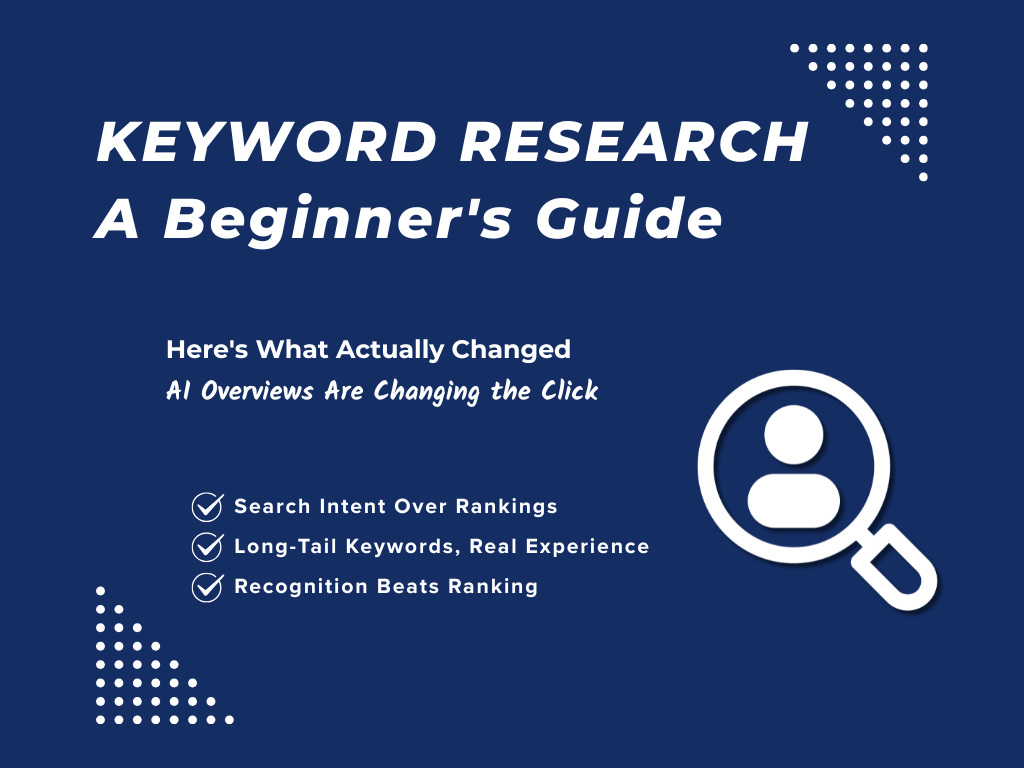
Keyword research is one of the most essential components of SEO, but what actually counts as a good keyword has changed. For the current thinking on search intent, long-tail strategy, and how AI Overviews are reshaping what “ranking” even means, here’s a full breakdown of keyword research in 2026.
Once you understand the concepts, KWFinder remains one of the best keyword research tools for putting them into practice, surfacing long-tail opportunities and letting you run keyword analysis directly against your competitors. Enter a keyword below to see how it ranks:
On-Page SEO
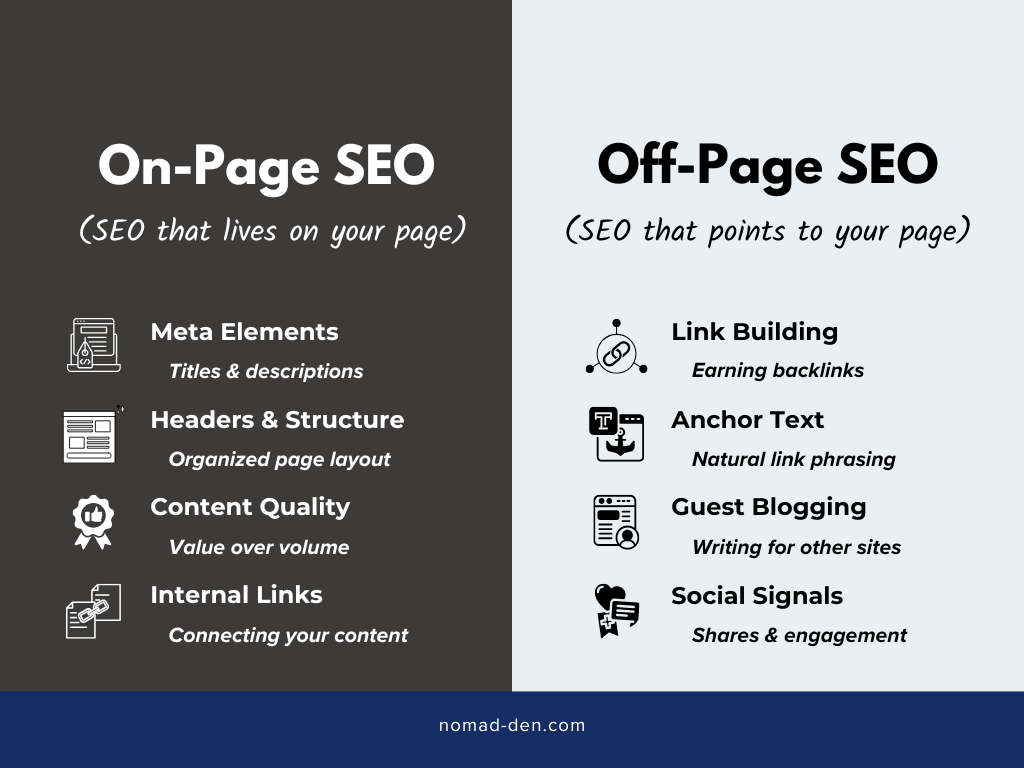
On-Page SEO focuses on optimizing the content and structure of your website to improve visibility in search results. Key on-page SEO factors, like crafting keyword-rich meta titles and improving URL structure, make it easier for search engines to understand your content and rank it effectively. Here are the core components of On-Page SEO:
- Meta Elements: Write concise, keyword-rich titles and meta descriptions to improve click-through rates.
- URL Structure: Use short, descriptive URLs that are easy to read and remember.
- Headers (H1, H2, H3): Use clear headings to improve readability for users and search engines.
- Image Optimization: Reduce file sizes and use descriptive alt text for faster loading and accessibility.
- Internal Links: Connect related pages on your site to improve navigation and share link equity.
- Content Quality: Focus on valuable, keyword-optimized content that aligns with user intent. Google rewards useful, engaging content over keyword-stuffed pages.
Once your on-page foundation is solid, the next step is building authority beyond your own site.
Off-Page SEO
Off-Page SEO builds your website’s authority and reputation through signals that happen outside your own site. These strategies go beyond your content to build trust and relevance in the eyes of search engines. Below are the most effective ways to strengthen that trust.
- Link Building: Earn quality backlinks from relevant websites to boost credibility.
- Anchor Text: Use descriptive, natural anchor text in your backlinks. Avoid overusing keywords to maintain a balanced profile.
- Social Media: Share content to increase engagement and brand visibility.
- Guest Blogging: Write for reputable sites to earn backlinks and showcase expertise.
- Content Marketing: Create high-value resources like guides and infographics to attract natural backlinks.
- Off-Site Signals: Factors like positive reviews, social shares, and adherence to Google’s Quality Rater Guidelines enhance your off-site reputation.
LinkMiner is Mangools’ backlink tool, and while it’s simpler than Ahrefs, it’s well-suited for focused link prospecting. I’ll admit link building itself is the one area of SEO I haven’t put into practice yet, so consider this a starting point rather than a firsthand account. Try LinkMiner to start building backlinks and strengthening your off-page SEO.
Technical SEO
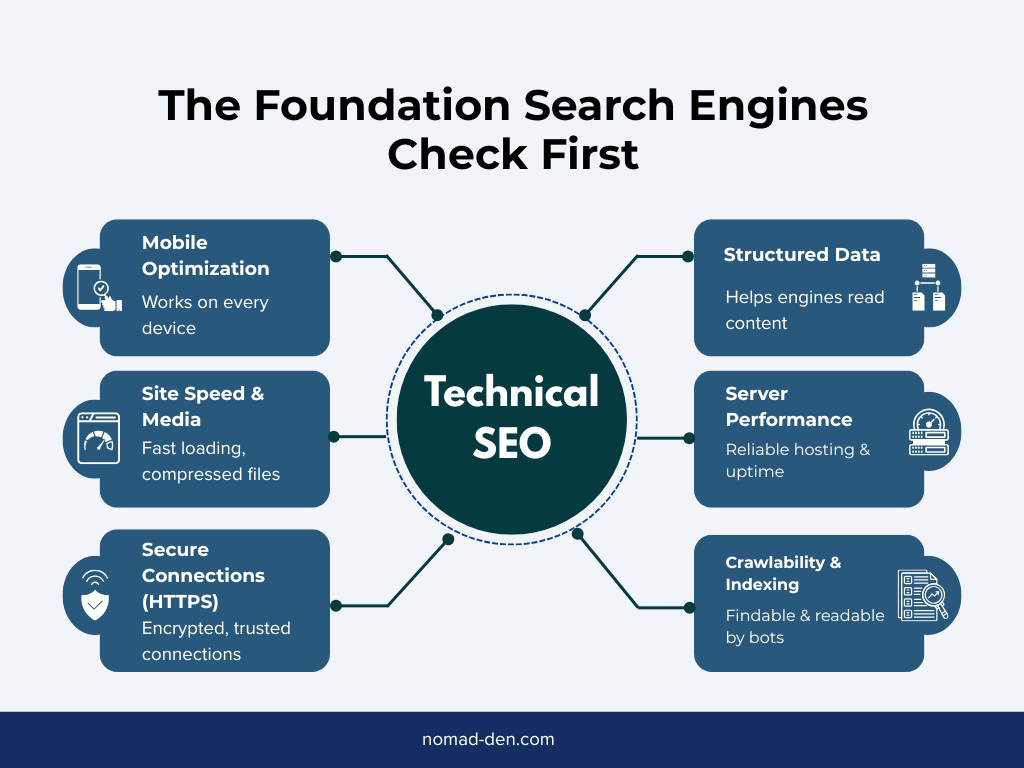
Technical SEO ensures your website functions smoothly while meeting search engine requirements. Factors like mobile-friendliness, fast loading times, and secure connections (“https”) directly affect both user experience and search rankings. Below are common issues that can impact your site’s performance and how to address them:
- Mobile Optimization: Ensure your website is responsive and performs well on mobile devices to meet modern user expectations and ranking factors.
- Site Speed: Optimize your website to load quickly, reducing bounce rates and improving user experience.
- Secure Connections (HTTPS): Use an SSL certificate to provide a secure connection and improve trustworthiness.
- Server Performance: Choose a reliable hosting provider to ensure your server can handle traffic efficiently without slowdowns.
- Structured Data: Implement schema markup to help search engines better understand and rank your content.
- Large Media Files: Compress images and videos to reduce load times without sacrificing quality.
Optimizing your website’s performance starts with a reliable hosting plan. Not sure which provider fits your setup? Here’s a full breakdown of the top hosting providers compared. For fast, secure, and dependable hosting, try Hosting.com, they offer WordPress-optimized plans, free website migration, and a money-back guarantee.


Learn why fast web hosting matters for SEO, conversions, and customer retention in our full Hosting.com review and speed guide.
Search Engine Results Page (SERP)
Before you write a single word, it helps to know exactly what you’re competing against. That’s what the SERP tools in this suite are built for, seeing the current landscape clearly enough to make an informed call, rather than guessing at what “good content” looks like for a given keyword.
SERPChecker: Scout the Competition
SERPChecker analyzes the competitive landscape for your target keywords, showing you exactly who you’re up against before you commit to writing. Instead of guessing what your audience wants, you can see who’s already ranking, spot the gaps in their content, and position your brand as a stronger alternative. That visibility comes with real upside: reaching an audience that’s already searching for what you offer, uncovering the trends and customer needs your competitors are responding to, and creating content that fills the gaps they’ve left behind.
Learn how search intent varies globally with Mangools Free Google Location Changer. Test your top keywords across different locations to optimize your strategy for improved results globally. Click here to try it now!
Competitive keywords aren’t free wins, though. They often demand strong content and can carry a high cost-per-click if you ever run paid ads alongside them, so your content needs to genuinely outperform what’s already ranking, not just match it. Staying focused on keywords that actually align with your brand, and tracking performance regularly so you can adjust based on real results, keeps the strategy from becoming guesswork.
Ready to take your SEO strategy further? Use SERPChecker to analyze the competitive landscape, identify new opportunities, and strategically target the keywords that matter most for your business.
SERPWatcher: Track Your Rankings
As mentioned earlier, SEO evolves constantly, a shift often described as Search Everywhere Optimization. Keeping track of how your keywords perform is essential to maintaining and improving your rankings as those changes happen.
This built-in rank checker gives you clear visibility into your keyword performance over time, without the complexity of many other SEO tools, helping you stay ahead of algorithm updates, competitor actions, and shifting user trends. It tracks how your keywords rank and flags changes as they happen, delivers daily updates so you’re never working from stale data, and rolls everything into a simple performance index that shows how your tracked keywords are doing at a glance. For a deeper look at turning this kind of tracking data into an actual strategy, here’s a beginner’s guide to digital marketing analytics.
SERPWatcher keeps you ahead of the changes that actually affect your rankings, giving you real-time insight into keyword performance so you can adjust before a drop costs you meaningful traffic.
SiteProfiler: A Complete Website Audit
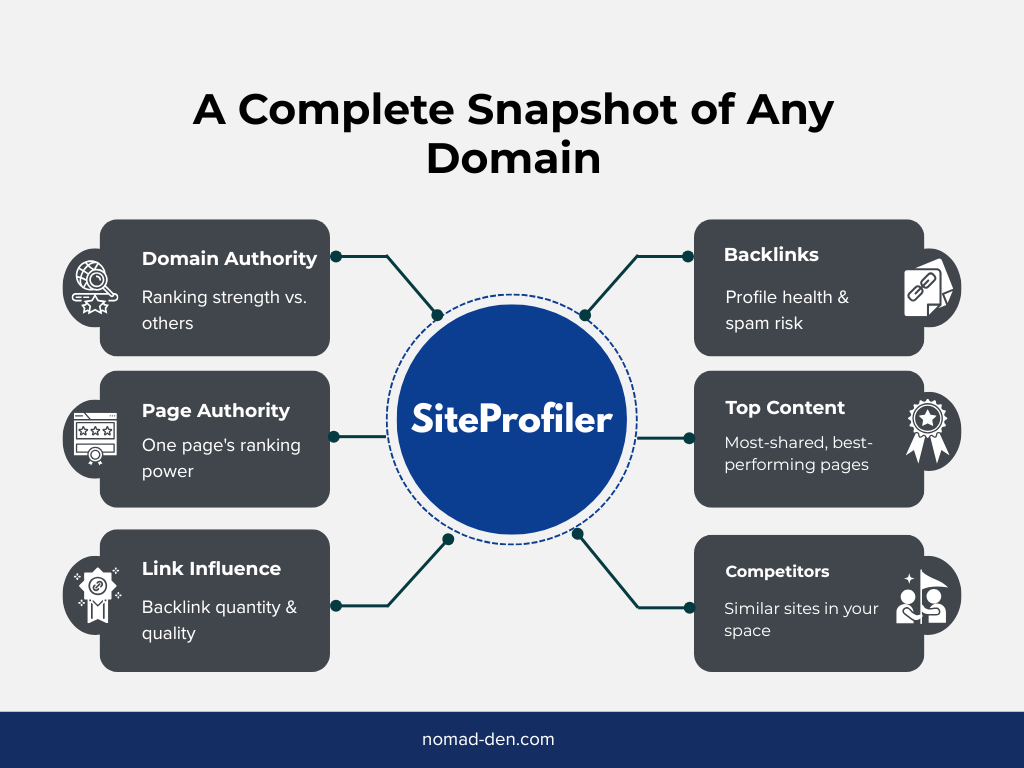
The final tool in Mangools’ SEO suite we’re covering here is SiteProfiler. The purpose of SiteProfiler is in the name: it gives you a profile of a domain (website), meaning it provides you with all the important SEO metrics and website insights on one screen. Within this screen, it will display the following information:
- Domain Authority: How well the domain will rank in the SERP compared to others.
- Page Authority: How well the specific page will rank in the SERP compared to others.
- Citation Flow: Predicts how influential the URL is, based on the quantity of backlinks.
- Trust Flow: Predicts how influential the URL is, based on the quality of backlinks.
- Backlinks: Valuable insights into a backlink profile, including its overall health and potential for spam.
- Top Content: The domain’s most popular URLs based on Facebook shares and referring domains, sortable to match your needs.
- Competitors: A snapshot of potential competitors or similar websites identified by the algorithm.
Gain a comprehensive view of your website’s performance and competitors with SiteProfiler. Evaluate key metrics like authority, link quality, and top content to refine your SEO strategy and drive growth. Note: Use the root domain when entering a website, as most data and metrics are domain-specific.
Mangools vs Ahrefs: Which Should You Choose?
The Mangools vs Ahrefs debate usually comes down to where you are right now, not which tool is objectively better. Ahrefs delivers massive datasets and advanced SEO metrics, but that depth comes with a steeper learning curve and a price tag that assumes you’re already generating revenue from your content, its Lite plan runs $1,290/year, compared to Mangools’ $452.40/year for its basic plan.
Mangools focuses on the essentials, KWFinder, SERPWatcher, and LinkMiner, making it a strong fit for small businesses, solo marketers, and anyone who wants a genuinely usable toolkit without paying for capability they can’t fully use yet.If you outgrow what Mangools offers down the line, that’s a good problem to have, and worth its own comparison when the time comes.
Pricing reflects rates at the time of writing and is subject to change; check each provider’s current plans page for up-to-date numbers.
Playing the Long Game
Not every SEO tactic that works also holds up over time. Some strategies build lasting visibility by genuinely earning it through solid keyword research, content built for the reader rather than the algorithm, and links you’ve actually earned rather than manufactured. Others chase the same rankings through shortcuts that work until they don’t, and a single penalty can undo years of legitimate effort in a single update. If you’re building something meant to last, the shortcuts aren’t worth the risk. Here’s a full breakdown of ethical vs. unethical SEO practices, if you want to see exactly where that line sits.
Need more clarity? Check our SEO and business glossary.
Why Choose Mangools for SEO?
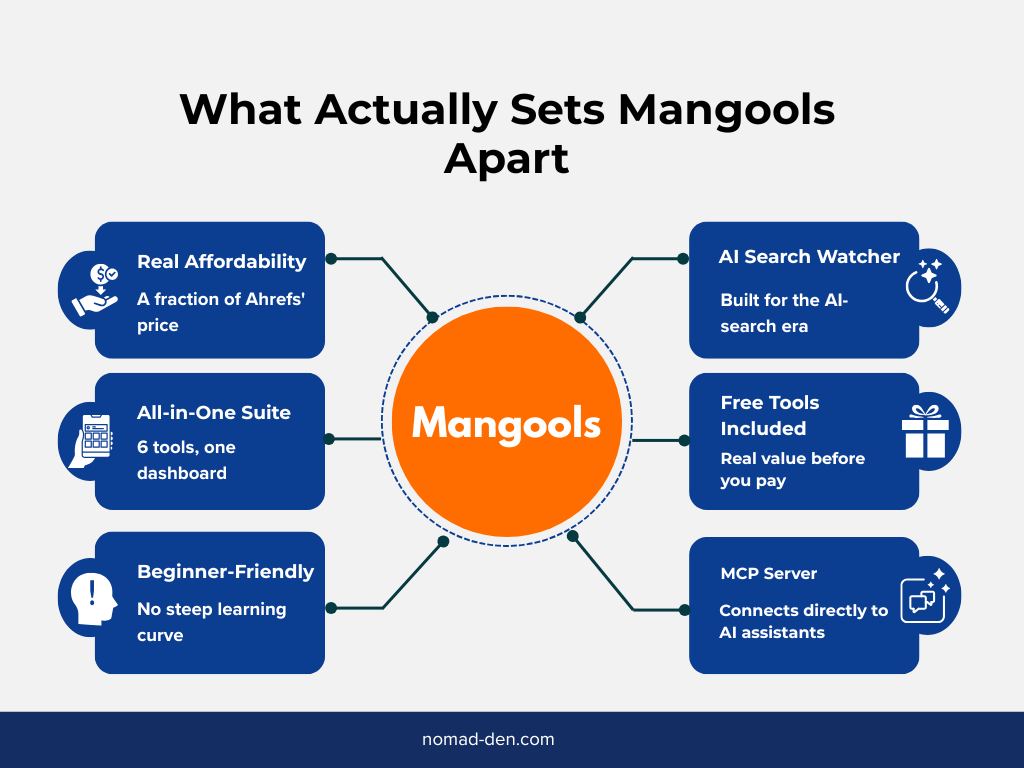
Successful SEO hinges on having the right tools to guide your strategy, and Mangools delivers a powerful, user-friendly suite to help you achieve your goals. It’s accessible for both beginners and more experienced marketers, and the toolset covers what actually matters day to day: KWFinder for keyword research, SERPChecker and SERPWatcher for tracking rankings, LinkMiner for backlink analysis, SiteProfiler for a broader site health check, and now AI Search Watcher for tracking how your brand shows up in AI-generated answers.
AI Search Watcher is the newest addition to the suite, and it’s the clearest sign Mangools is building for where search is actually headed. Instead of just tracking where you rank in Google, it monitors whether AI models are surfacing your brand at all when someone asks a related question, across the platforms increasingly standing in for a traditional search bar. For a site built on being genuinely useful rather than just SEO-optimized, that’s a meaningful thing to have visibility into, not just a checkbox feature.
None of that matters without consistent use, though. Better keyword and ranking data leads to better visibility, a steadier stream of organic traffic, and content more likely to convert once someone finds it, but that only plays out if you’re actually acting on what the tools tell you, not just paying for access to it.
How to Use Mangools for Your Business
Here’s how to put each tool to work:
- KWFinder: Identify low-competition keywords worth targeting for your content
- AI Search Watcher: Monitor whether your brand shows up when people ask AI tools questions related to what you cover
- SERPChecker: Analyze what’s currently ranking for a keyword before you commit to writing about it
- SERPWatcher: Track how your keywords perform over time and catch ranking drops early
- LinkMiner: Evaluate your (or a competitor’s) backlink profile to find realistic link-building opportunities
- SiteProfiler: Get a quick health check on any domain’s authority, backlinks, and top content
Mangools won’t replace the depth of a tool like Ahrefs, but for a site still building its foundation, having one straightforward suite that covers keyword research through link tracking is enough to work with consistently, which matters more than access to a feature you’ll never touch. Try Mangools for yourself with their free plan before committing to anything paid.
Free Mangools Tools You Can Use Today
You don’t need a paid plan to get value from Mangools. A handful of free tools are worth using even if you never upgrade:
- SERP Simulator: See exactly how your title and meta description will actually look in search results before you publish, instead of guessing at character counts
- AI Search Grader: Get a read on how visible your site currently is in AI-generated answers, the free counterpart to what AI Search Watcher tracks over time
- Reddit Threads Finder: Surface relevant Reddit discussions for a topic, useful now that Reddit shows up constantly in both Google results and AI-generated answers
A few more round out the free tier: Share of Search, SERP Volatility Checker, and SERP Location Changer, each useful in more specific situations, but the three above are the ones most beginners will actually reach for regularly.
For anyone already working alongside an AI assistant, Mangools also offers an MCP server (currently in beta), which lets AI assistants like Claude query Mangools data directly during a conversation. It’s a developer-facing feature, not something a beginner needs to set up, but it’s another sign the tool is being built around how people are actually starting to work, not just optimizing for how search worked five years ago.
My Mangools SEO Certification Experience
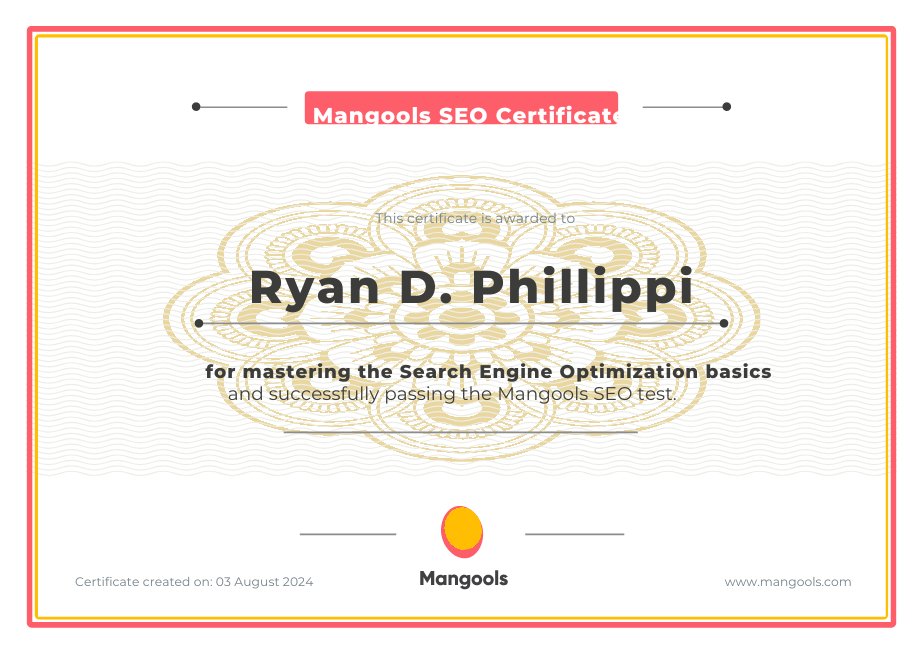
The simplest way to improve your SEO knowledge is to read Mangools Complete SEO Guide for Beginners. This article provides an excellent foundation for learning all the essentials of search engine optimization. Once you complete and pass the test, they’ll provide you with a certificate, like mine above. There’s nothing better than free education! What are you waiting for? Read the post and improve your SEO knowledge today!
FAQs
Conclusion
Mangools isn’t trying to be Ahrefs, and that’s exactly why it works well for a site still building its foundation. The core tools cover what you actually need day to day, keyword research, rank tracking, and backlink checks, without the price tag or learning curve of the bigger suites. If you’re at the stage where a full enterprise platform would be overkill, Mangools is a reasonable place to start and grow into. Take a look at Mangools’ full suite to see if it fits where you’re at.
Some links in this post may be affiliate links. I may earn a commission at no extra cost to you. Learn more here.
Continue Reading Related Posts

White Hat vs. Black Hat SEO (and the Gray Area In Between)
SEO tactics fall into three categories: white hat, black hat, and a shrinking grey area…
Keyword Research for Beginners: How to Find What People Are Searching For
Keyword research in 2026 isn’t about ranking on Google anymore. It’s about understanding what a…

Digital Marketing Analytics for Beginners: Stop Guessing, Start Tracking
When I first launched Nomad Den, I was publishing posts, building out a network of…
SEO Tools for Beginners (Free + Paid): The Only Stack You Need (2026)
As long as people are searching for information online, SEO (search engine optimization) will remain…

Remote Work Skills That Actually Pay (2026)
Working remotely isn’t a backup plan anymore. It’s not something people do when they can’t…
17 SEO Terms Every Beginner Should Know
If you’re new to SEO, the most important terms to understand include keywords, search intent,…