
Some links in this post may be affiliate links. I may earn a commission at no extra cost to you.
E-commerce refers to any transaction made online — buying or selling products, services, or digital goods, regardless of frequency or platform. What began as a novel way to sell products has become a core method of doing business, allowing small and independent sellers to reach far wider audiences than physical stores ever could.
As global internet access expands and platforms make online purchasing easier than ever, e-commerce continues to grow in demand, spanning everything from digital products and subscriptions to physical goods shipped worldwide.
Today’s social platforms, especially those with built-in shopping features, have made it easier than ever for creators to generate income online. For many, however, platform-based selling is often where the journey begins, and ends.
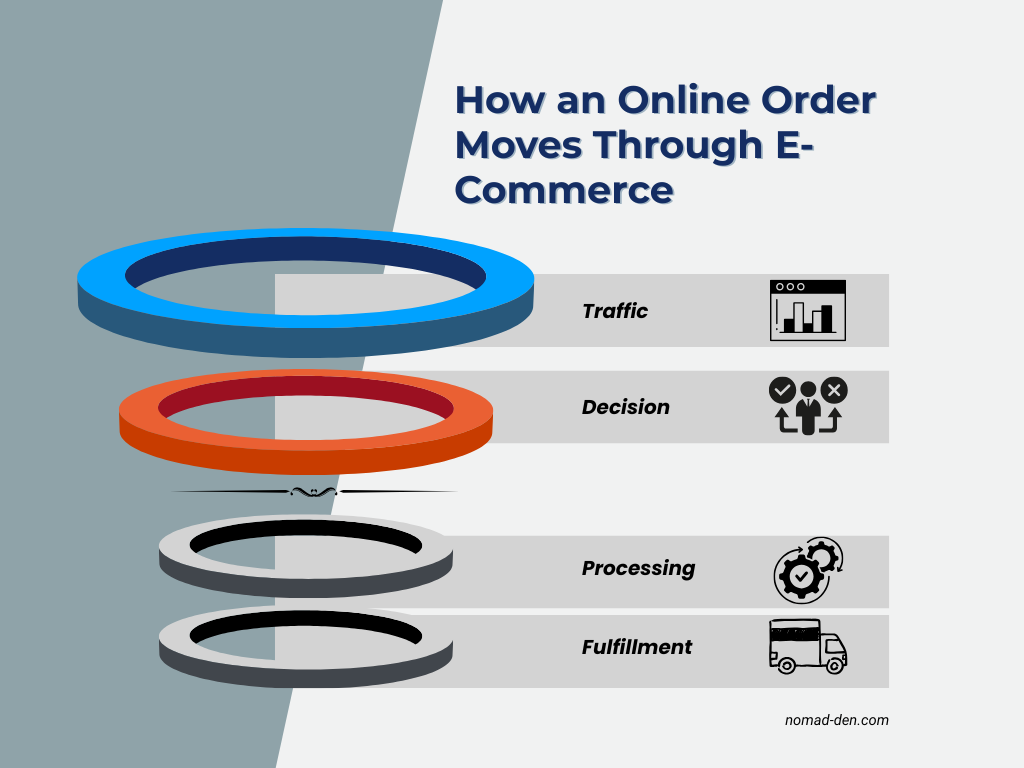
This post is intended to help bridge that gap by introducing the core e-commerce concepts that support sustainable online businesses, for creators who want to move beyond platform dependence and better understand how e-commerce works as a whole — from getting traffic to your store, to converting visitors into customers, to fulfilling orders once a sale is made.
Marketing & Traffic (Getting People In)
E-commerce doesn’t work without traffic. Regardless of the platform you use, people need to discover your storefront before they can buy anything.
This traffic can come from many sources, and most successful online businesses rely on more than one — including content marketing, search engines, paid ads, and referrals. Each channel has its own strengths, limitations, and learning curve, but all share a common goal: attracting the right audience and guiding them toward a specific destination.
The terms below cover how traffic is generated, measured, and directed in e-commerce, providing a foundation for understanding how people find your store and what determines their next action.
SEO (Search Engine Optimization)
SEO is the practice of optimizing content to align with the search intent of your audience, helping it appear in relevant search results. As the internet, smartphones, and apps have expanded, SEO has evolved beyond traditional search engines. Today, buyers often discover content across multiple platforms before making a decision, which makes optimization for visibility everywhere increasingly important.
For a deeper look at why SEO remains one of the most reliable long-term strategies despite the rise of AI search, see SEO Is Dead… Or Is It? Here’s the Truth.
PPC (Pay-Per-Click)
PPC (Pay-Per-Click) is a paid advertising model where you’re charged each time someone clicks your ad, rather than earning traffic organically.
CTR (Click-Through Rate)
The percentage of people who click a link after seeing it. Often used to measure how effective a headline or ad is. For more on tracking metrics like this, see Digital Marketing Analytics for Beginners.
Landing Page
A dedicated page (not a website) designed to guide visitors toward a single action, such as making a purchase or signing up for an email list. Once traffic reaches your storefront, the next challenge is turning attention into action. The following terms focus on what happens after the click: how interest becomes engagement, and how engagement becomes revenue.
Sales & Conversion (Turning Traffic Into Money)
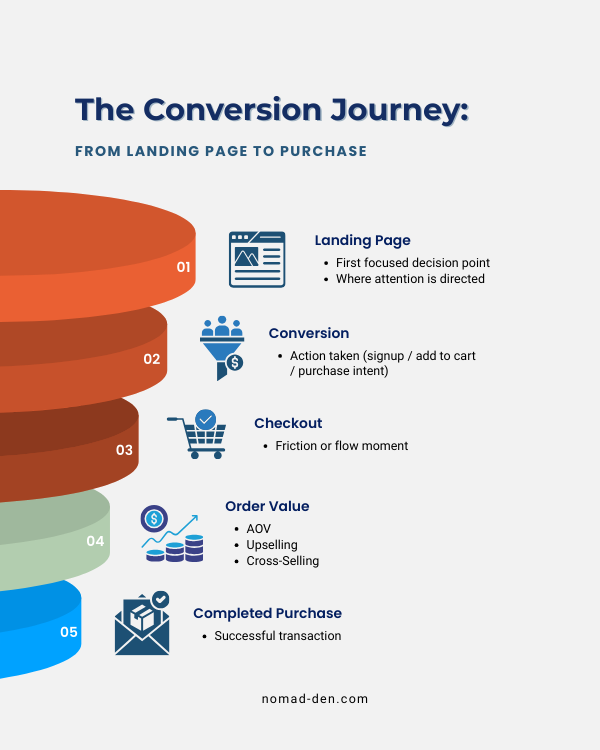
Once you understand how traffic works and where it comes from, the next step is converting attention into action. These terms focus on how e-commerce businesses turn visitors into customers and measure whether their efforts are effective.
Conversion
A conversion occurs when a visitor completes a desired action, such as making a purchase or signing up for an email list. What counts as a conversion depends on your goals: for a store it’s usually a sale, but it can also be a signup, account creation, or download.
Conversion Rate
The percentage of visitors who convert, used to measure how effectively a page or funnel turns traffic into results. A higher conversion rate means more of your existing traffic is turning into the outcome you want, without needing to drive more visitors.
Cart Abandonment
When a customer adds items to their cart but leaves the site without completing the purchase. It’s one of the most common sources of lost revenue in e-commerce, often caused by unexpected shipping costs, complicated checkouts, or visitors who weren’t ready to buy yet.
AOV (Average Order Value)
The average amount spent per order, calculated by dividing total revenue by the number of orders. Increasing AOV through upselling or bundling is often more cost-effective than acquiring new customers.
Upselling
Encouraging customers to purchase a higher-priced version or upgrade of a product they’re already considering. This is one of the most effective ways to increase AOV without finding new customers, since the person buying is already in a purchasing mindset.
Cross-Selling
Suggesting related or complementary products to customers, often during or after checkout. Amazon’s “frequently bought together” feature is a well-known example, but the same principle works for stores of any size.
Together, these concepts explain how e-commerce businesses move from interest to action: measuring what works, identifying friction, and increasing the value of each customer interaction. Once conversions are happening consistently, the next challenge is ensuring that purchases are processed correctly and delivered as expected.
Operations & Fulfillment (Delivering the Product)
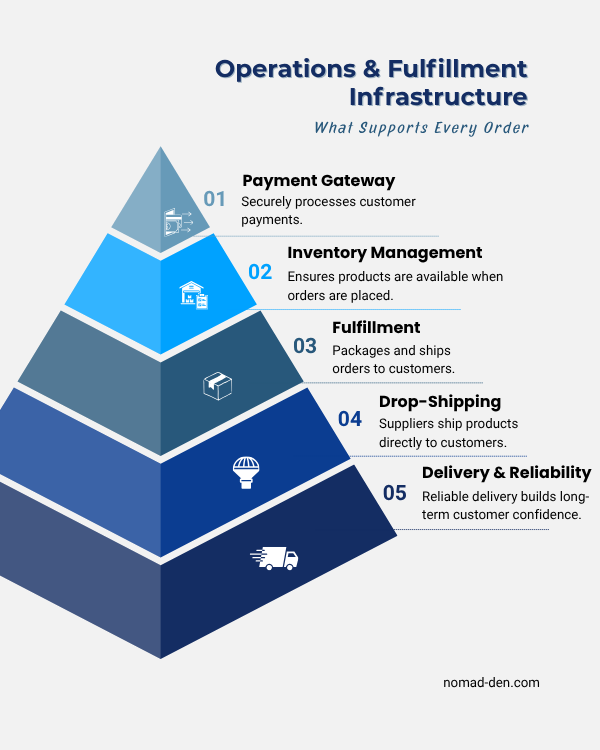
Once a customer decides to buy, the work isn’t over. Operations and fulfillment determine whether orders are processed smoothly, products are delivered as expected, and trust is maintained over time.
Payment Gateway
A secure service that processes online payments by transferring customer payment information between the store and the financial institution. Most e-commerce platforms include one built in, though some businesses choose third-party providers like Stripe or PayPal for more flexibility.
Fulfillment
The process of receiving, packaging, and delivering orders to customers after a purchase is made. Fulfillment can be handled in-house, outsourced to a third-party service, or automated entirely, depending on the size and type of the business.
Inventory Management
The practice of tracking product stock levels to ensure items are available when customers place orders. Poor inventory management can lead to overselling, stockouts, or cash tied up in unsold product, all of which affect customer trust and cash flow.
Drop-shipping
A fulfillment model where the seller doesn’t hold inventory and the supplier ships products directly to the customer. It removes the need for upfront inventory investment, but often comes with lower margins and less control over shipping times and product quality.
A/B Testing
Comparing two versions of a page, offer, or element to determine which performs better based on user behavior. It’s one of the most reliable ways to improve conversion rates over time, and the same principle applies in email marketing, where it’s used to test subject lines, send times, and more.
Together, these terms represent more than individual tactics: they describe a system. From attracting attention to completing a purchase and fulfilling an order, each concept plays a role in moving customers through a clear, repeatable process.
Frequently Asked Questions (FAQs)
Conclusion
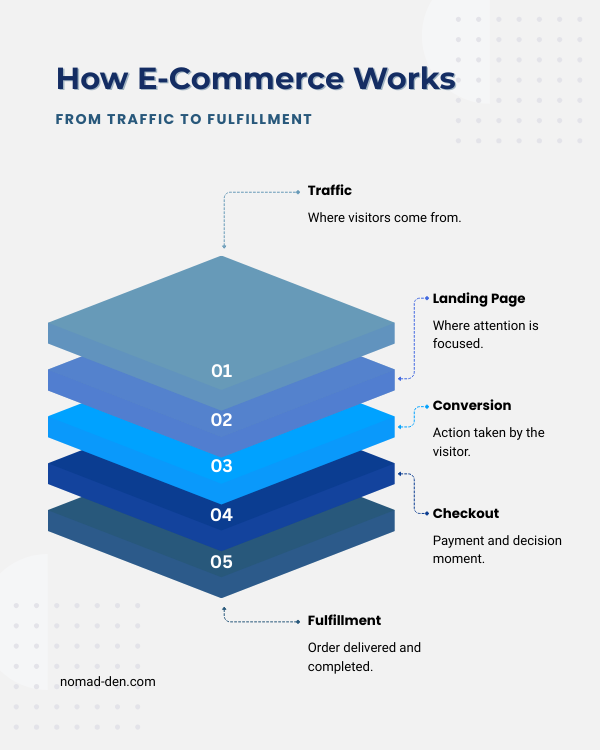
While each term can be understood on its own, e-commerce works best when these pieces are connected. Traffic brings people in, landing pages focus attention, conversions turn interest into action, and fulfillment ensures the experience ends with delivery, not frustration.
For many creators and sellers, platforms make it easy to start, but understanding how these concepts fit together is what makes growth sustainable. Whether you sell through a marketplace, social platform, or your own storefront, these fundamentals form the backbone of any online business.
Use this framework as a reference point. As your business evolves, these terms will show up again and again: guiding decisions, revealing bottlenecks, and helping you move from isolated tactics to a repeatable system.
Some links in this post may be affiliate links. I may earn a commission at no extra cost to you. Learn more here.
Continue Reading Related Posts
Private Browsers and Search Engines Worth Switching To
Google Chrome accounts for roughly 69% of the world’s web page views, and Google handles…
When to Start Outsourcing: How to Vet Your First Virtual Assistant (or Freelancer)
Outsourcing makes sense the moment a task is both teachable and consistently the thing standing…

How to Validate a Business Idea Before Wasting Months Building It
When you come up with an idea for an online business, you’re anxious to make…
6 Affiliate Niches That Last (And Beginners Can Start Today)
Most people pick an affiliate niche based on what’s trending right now. While that may…
Digital Marketing Guide: Where to Start and How It Works
Digital marketing is the promotion of products or services using digital channels such as search…
Content Creation vs Content Marketing: What’s the Difference?
Content creation is producing content. Content marketing is strategically using the content you produced to…