
Some links in this post may be affiliate links. I may earn a commission at no extra cost to you.
A sales funnel is the path a potential customer follows from first hearing about a product to actually buying it. Businesses today generally build around one of three funnel models, each shaped by a different idea of what keeps a customer moving forward. This post breaks down all three, the traditional AIDA-based funnel, the flywheel, and the loop, so you can figure out which one actually fits how your business operates.
The 3 Types of Sales Funnels
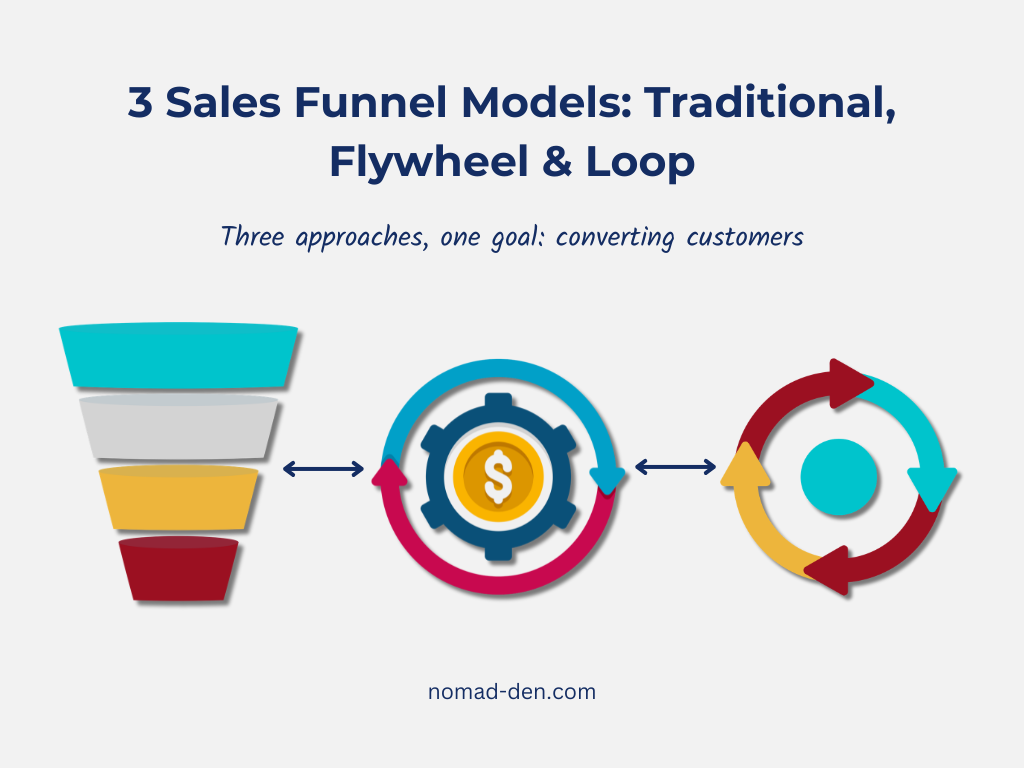
Each model answers the same basic question, how do you turn a stranger into a customer, differently. The traditional funnel treats that as a straight line. The flywheel and loop models both treat it as something closer to a cycle, but for different reasons, as the breakdown below shows.
1. The Traditional Funnel (AIDA Model)
AIDA stands for Awareness, Interest, Desire, and Action, the four stages a customer typically moves through before making a purchase. It’s the oldest and most widely known funnel structure, and it still holds up as a mental model even though most modern strategies build on top of it rather than stopping there.
2. The Flywheel Model: Momentum Through Retention
The flywheel model shifts the focus to customer experience and engagement. Rather than treating customers as the endpoint of a linear sales process, it creates a continuous cycle of growth where satisfied customers become advocates, driving momentum through referrals and repeat business. Amazon exemplifies this model by leveraging exceptional service to build loyalty and long-term relationships. However, it’s important to note that the flywheel isn’t ideal for every business. Learn more about the flywheel model directly from HubSpot, the company that pioneered it.
3. The Loop Model: Continuous Customer Engagement
The loop model acknowledges that modern customer journeys are non-linear. Customers re-enter the buying process at different points, driven by new needs or interactions. By connecting each stage seamlessly and personalizing touchpoints, the loop fosters ongoing engagement, ensuring no opportunity to re-engage is lost. Its adaptability makes it perfect for brands that prioritize flexibility and reactivation.
Finding the Right Sales Model for Your Business
Now that you’ve seen all three funnel models side by side, the right one comes down to how your business actually earns repeat customers. A straightforward AIDA funnel works well for one-time or low-frequency purchases. The flywheel fits businesses built on referrals and word-of-mouth. The loop suits businesses with multiple entry points and ongoing re-engagement opportunities.
Designing the Perfect Landing Page
To attract your ideal audience at the top of the funnel (TOFU), start with in-depth keyword research, the same keywords your landing page should be built around. Mangools offers an affordable, user-friendly suite of SEO tools, making it a great alternative to SEMRush. If you want to see how it stacks up against other options, our breakdown of SEO tools for beginners covers the full lineup.
The next step after choosing the right sales model is to build a sales funnel landing page that aligns with your offer and guides visitors toward action. Landing pages are critical to any sales model’s success: they’re often the first impression potential customers have of your offer. For a detailed list of landing page examples, check out this article from Kit.
Systeme.io makes landing page creation easy with dozens of customizable templates designed to get you started quickly. Sign up for a free plan today (with no obligation to upgrade) and start creating your first landing page with ease!

Explore how you can start and grow your business for free with Systeme.io, check out our full breakdown.
Once you’ve crafted the perfect landing page and captured your audience’s attention, the next step is keeping those leads engaged. This is where email marketing comes in, which is a critical component for nurturing relationships and driving conversions.
Email Marketing: Build Relationships, Drive Results
Email marketing is a cornerstone of online business success for small businesses offering cost-effective solutions. When used effectively, automation ensures the right emails reach the right people at the right time, helping you build relationships that fuel your business’s growth. Crafting excellent email copy is a high-value skill that takes time to master. Fortunately, there are tools and strategies to help you overcome this challenge head-on.
Option 1: Use Pre-Made Templates or AI Tools
Pre-made templates and AI tools streamline email creation for small business email marketing. Platforms like Moosend and Kit (formerly ConvertKit) provide customizable options, including excellent sales funnel tools and email automation funnel features designed to boost engagement and save time.
Option 2: Learn on Your Own
Email copywriting takes real practice to get right. Explore courses, guides, and resources to hone your craft. For an in-depth guide on suggestions for writing compelling copy as a beginner, check out this article from Moosend.

Option 3: Outsource to An Expert
Outsourcing to experts on platforms like Fiverr can save time and ensure high-quality email campaigns. Browse skilled professionals in Fiverr’s marketplace and choose one that fits your needs and budget.

Moosend, Kit, and Fiverr all work well depending on how hands-on you want to be, but if you want a full side-by-side comparison of email platforms before committing to one, Email Essentials breaks down GetResponse, Moosend, and Kit in depth.
Conclusion
Choosing between the traditional funnel, the flywheel, and the loop comes down to how your business actually builds relationships with customers, not which model sounds the most modern. Once you’ve picked a direction, the landing page and email strategies covered here are what turn that framework into real results. Take the time to assess your needs, experiment, and adapt your approach as your business evolves, success comes from understanding your customers, not from any single framework.
The tools covered here all include their own basic tracking, but knowing which stage of your funnel is actually underperforming takes a closer look. Our guide to digital marketing analytics walks through how to go from ‘something isn’t converting’ to knowing exactly where and why.
Some links in this post may be affiliate links. I may earn a commission at no extra cost to you. Learn more here.
Continue Reading Related Posts
White Hat vs. Black Hat SEO (and the Gray Area In Between)
SEO tactics fall into three categories: white hat, black hat, and a shrinking grey area…
Keyword Research for Beginners: How to Find What People Are Searching For
Keyword research in 2026 isn’t about ranking on Google anymore. It’s about understanding what a…
How to Use Social Media Scheduling Tools to Grow Without Being Online 24/7
There’s a version of social media growth that gets sold constantly: post more, post everywhere,…
How to Validate a Business Idea Before Wasting Months Building It
When you come up with an idea for an online business, you’re anxious to make…
Digital Marketing Analytics for Beginners: Stop Guessing, Start Tracking
When I first launched Nomad Den, I was publishing posts, building out a network of…
Lead Magnets That Convert in 2026 (And What to Build First)
Building an email list sounds straightforward until you actually try it. The real challenges aren’t…