
Some links in this post may be affiliate links. I may earn a commission at no extra cost to you.
When you come up with an idea for an online business, you’re anxious to make it happen, to make it reality. The inspiration could have come from anywhere, like something online, on TV, or just a recent experience that stuck with you.
You start by choosing a name, and a domain to go with it. Maybe you even start on a logo. A lot of time goes by, and the excitement is still there, but something is nagging at you in the back of your mind. You have not actually confirmed that anyone wants what you are building.
That nagging feeling has a name: it’s called skipping validation, and it is one of the most common and costly mistakes beginners make in online business.
According to CB Insights, 42% of startups fail not because the founder gave up, not because the product was poorly built, but because they built something nobody wanted. Nearly half. That is not a small number, and it is not just a startup problem. It happens to bloggers, affiliate marketers, course creators, and digital product sellers every single day.
This post is not here to talk you out of your idea. It is here to help you protect it. By the time you finish reading, you will have a clear, step-by-step framework for testing your business idea before you invest serious time, money, or energy into building it. No technical background required. Most of the tools are free.
Let’s get into it.
What Business Idea Validation Actually Is
Before we talk about how to validate an idea, it helps to understand what validation actually means, because most people either overcomplicate it or confuse it with something else.
Business idea validation is the process of testing whether real people will pay for your solution before you build it. That last part matters. Before you build it. Not after you have spent three months on a course, a tool, or a content site. Before.
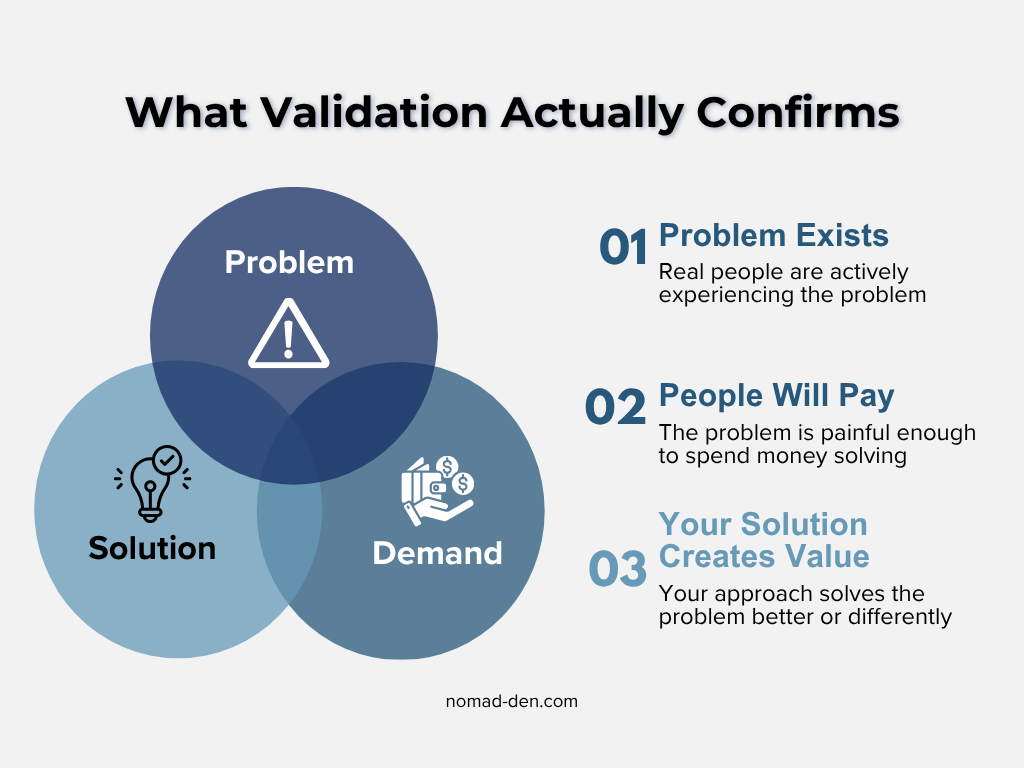
At its core, validation needs to confirm three things:
- The problem exists. Not in theory, not according to your gut, but in reality. Real people are experiencing this problem and actively looking for a way out of it.
- People care enough to pay to solve it. This is where most beginners get tripped up. A problem can exist without people being willing to spend money on a solution. If the problem is not painful enough, your solution is a nice-to-have, not a need-to-have.
- Your approach to solving it creates actual value. There is a difference between a solution that works and a solution people will choose. Validation helps you figure out which one you have before you go all in.
One more thing before we move on: validation is not a one-time checkbox. Every time you consider a new product, niche, or direction, you come back to it. The goal is not to prove you are right, it is to find out what is right before you waste months finding out what is wrong.
Why Beginners Skip It (And What It Costs Them)
Knowing that validation exists and actually doing it are two different things. Most beginners skip it, and it is not because they are lazy or careless. It is because skipping it feels like progress.
There is also the feedback problem: when most beginners do seek input, they ask the wrong people. They ask friends and family, or they post in their own social media circles. Oftentimes their responses will be supportive and encouraging, but that leads to bias, not objective validation.
Compliments are not validation. Commitments are.
The people closest to you are not going to tell you your idea has a problem. That is not dishonesty, that is loyalty, and it will cost you if you mistake it for market research.
Closely related is confirmation bias: once you are emotionally invested in an idea, your brain starts filtering information in its favor. You notice the signals that say go and explain away the ones that say stop. Build a validation process that forces you to look for evidence that you are wrong, not just evidence that you are right.
That discipline is rare. Which is exactly why it works.
The good news is that validating an idea does not have to take long, and most of the tools that help you do it are free. We will get to those shortly.
The 7-Step Validation Framework
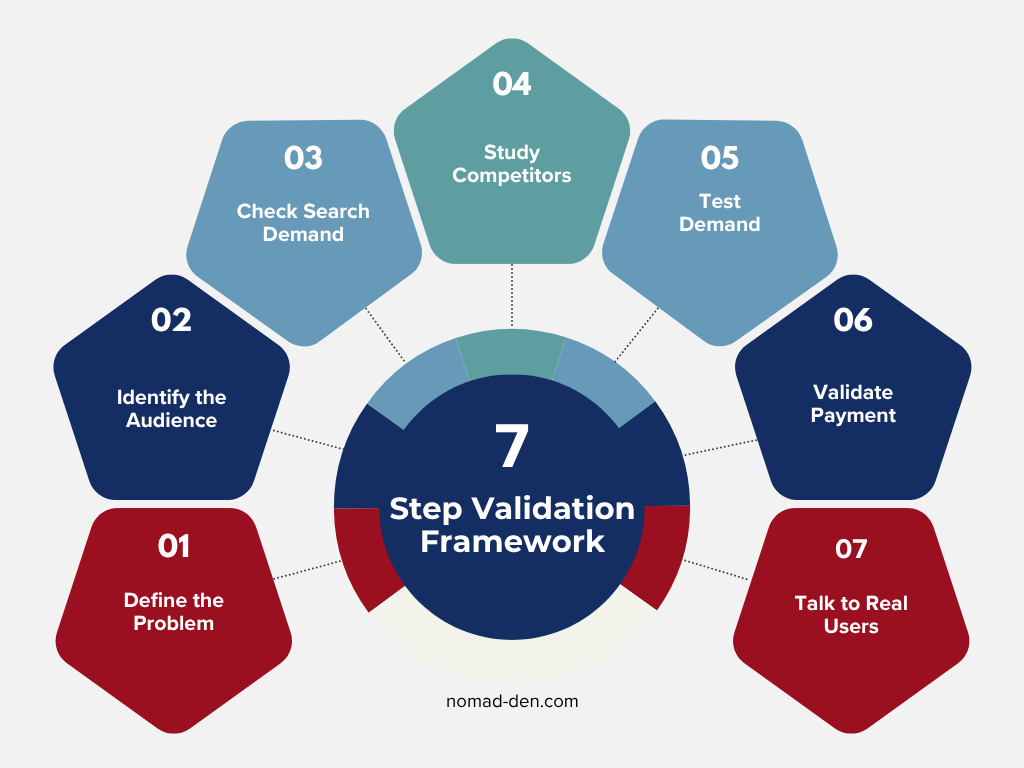
Validation does not have to be complicated or expensive. The following seven steps walk you through the process in order, designed to test your idea before you invest real time or money into it. Most of this costs nothing but attention.
Step 1 — Define the Problem You Are Actually Solving
Vague problems produce vague businesses. Before anything else, get specific about what you are solving and for whom.
Instead of “I want to make money with affiliate marketing,” try something like: “Beginner affiliate marketers do not know how to vet programs before promoting them.” That is a real, specific problem with a searchable, monetizable answer.
Ask yourself two questions before moving forward:
- Are people actively looking for a solution to this problem?
- Or do they not even know they have the problem yet?
The first is a much easier business to build.
Step 2 — Identify Exactly Who Has That Problem
Not everyone is your customer. The more specific your target person, the easier everything else becomes, including content, positioning, and outreach.
“People who want to make money online” is not an audience. “Remote workers looking for a secondary income stream without creating their own products” is closer. Get there before you build anything.
Where do they spend time online? What are they searching for? What frustrates them most about the options they already have? Answer those questions first.
Step 3 — Check Search Demand
If nobody is searching for a solution to your problem, that is data. That is your cue. Use it. Start with free tools like these:
- Google Trends — Is interest in your topic growing, stable, or declining? Check at least five years of data to separate trends from spikes.
- Google Autocomplete and People Also Ask — These reveal the exact language your audience uses, which matters for both content and SEO.
- Google Keyword Planner — Get a baseline on search volume at no cost.
- Reddit and niche forums — Where real frustrations get expressed in real language, unfiltered.
For a deeper look at keyword tools that work at every budget, see the SEO Tools for Beginners post here on Nomad Den.
Step 4 — Study the Competition
Competition is not a threat at this stage. It is confirmation that a market exists.
Zero competitors often means zero market, not a wide open opportunity. If people are already paying for a solution, demand is proven. Your job is to find where existing solutions fall short.
Read competitor reviews, check their comment sections, search their brand name on Reddit. The complaints and gaps you find there are opportunities handed to you for free.
Step 5 — Test Real Demand Before Building
This is where most beginners jump straight to building. There is a better way.
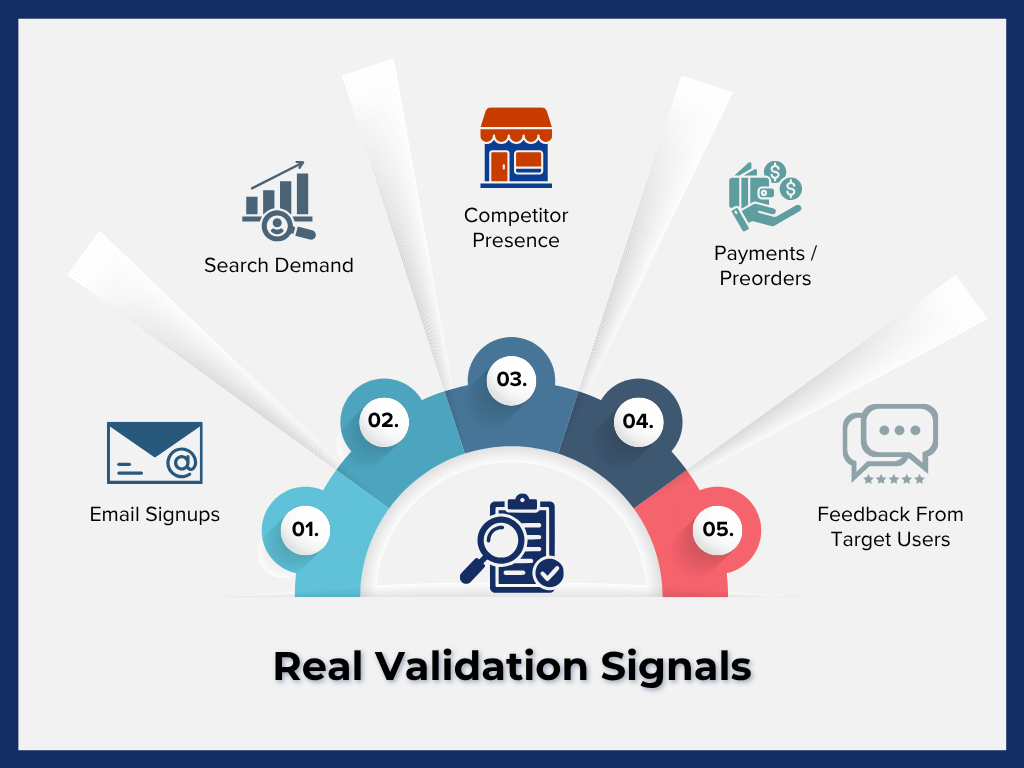
Instead, run a smoke test. Create a simple landing page that describes your solution and includes a clear call to action, typically an email signup or a waitlist. If people sign up, demand is real. If nobody does, the idea needs work before you invest further.
Systeme.io has a free tier that lets you build a landing page and set up email capture in under an hour. No coding, no cost, no excuse not to test first.
Sign-ups are interest. That is a good start. But the real signal comes in the next step.
Step 6 — Validate Willingness to Pay
An email address is not a sale. Getting someone’s contact information confirms curiosity. Getting their payment confirms demand.
Study how competitors price similar products or services. Look at what people are already spending to solve the same problem. Then consider a pre-sell, offering your product at a discount before it is finished in exchange for early access. If people pay, you have real validation.
Stripe and PayPal both integrate with Systeme.io at no cost to start. There is no technical barrier to testing this.
Step 7 — Talk to Real People Outside Your Circle
Before committing, have ten to twenty conversations with people who actually have the problem. Not friends or family, but real strangers from the communities where your audience already exists, like Reddit threads, Facebook groups, niche forums.
Ask about their current workarounds, and what they have already tried and spent money on. Ask how urgent the problem feels. Do not lead the conversation toward your solution, let them tell you what they actually need.
If you find yourself filtering out the negative responses, that is confirmation bias doing its job. Build the discipline to look for reasons your idea might not work. That is what separates founders who build things people want from those who do not.
Applying This to Online Business Models
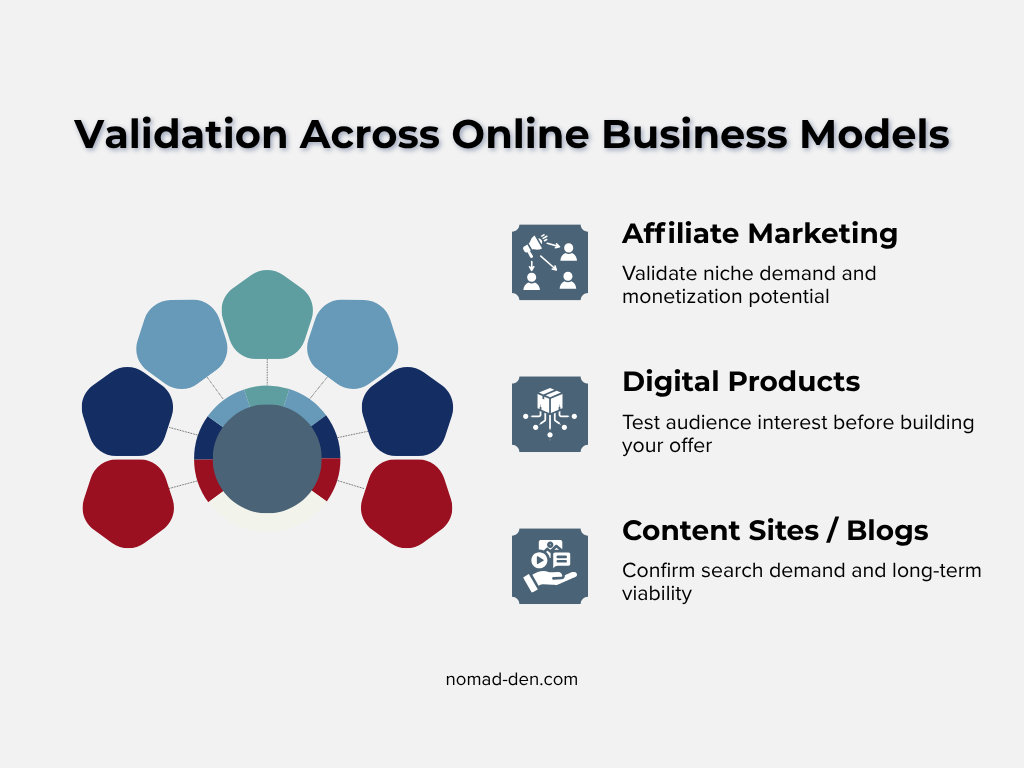
The framework above works for any business. Here is how it translates to each model:
Affiliate marketing
Does your niche have programs worth promoting? Check ClickBank, ShareASale, and CJ before committing to a content direction. A niche with no affiliate programs is significantly harder to monetize.
Learn more about how to find and promote quality products on ClickBank here.
Digital products
Is anyone already selling something similar? Good. That proves demand. Use a landing page and a waitlist to test your specific angle before spending weeks building a course, guide, or template.
Content sites and blogs
Do your target keywords have real search volume? Are competitors in the space monetizing successfully? Those two questions tell you whether the niche is worth your time before you publish a single post.
A blog without a monetizable niche is a hobby. There is nothing wrong with hobbies, but know which one you are building.
Common Mistakes to Avoid:
- Building before testing demand
- Asking friends and family for market feedback
- Running a survey and ignoring the results
- Staying attached to the idea when early signals say pivot
- Confusing activity with validation: writing, designing, and posting are not proof of demand
- Testing a secondary assumption while ignoring the riskiest one
- Treating validation as a one-time step rather than an ongoing practice
Free Tools to Start With Today
| Tool | Purpose |
|---|---|
| Google Trends | Demand & trend validation |
| Google Keyword Planner | Search volume baseline |
| Reddit / niche forums | Real problem discovery in real language |
| Systeme.io | Landing page + email capture for smoke testing |
| ClickBank Marketplace | Affiliate niche validation |
| Mangools | Keyword and competitor research |
Systeme.io and Mangools both offer free tiers with limitations. Paid plans unlock fuller functionality. The free versions are enough to get started.
FAQs
Conclusion
Most people build first and find out later. Validation flips that order. It costs a little time upfront and saves you months on the back end. Your idea deserves more than a gut feeling. Give it the evidence it needs before you invest everything into it.
Some links in this post may be affiliate links. I may earn a commission at no extra cost to you. Learn more here.
Continue Reading Related Posts

6 Affiliate Niches That Last (And Beginners Can Start Today)
Most people pick an affiliate niche based on what’s trending right now. While that may…
Digital Marketing Guide: Where to Start and How It Works
Digital marketing is the promotion of products or services using digital channels such as search…

Content Creation vs Content Marketing: What’s the Difference?
Content creation is producing content. Content marketing is strategically using the content you produced to…
The Only Free Tools You Need to Launch (Before You Upgrade)
Having a limited budget — or the discipline to stick to one — is actually…

Beginner’s Guide to Selling Digital Products (Low-Cost)
One of the most practical ways to earn income online, whether you’re starting a side…
Online Business Foundations: 15 Core Terms
If you’ve watched enough online business content, you’ve heard the familiar advice: “pick a niche…