Table of Contents
- What Counts as a “Material Connection” Under FTC Rules
- The FTC’s “Clear and Conspicuous” Standard
- Affiliate Disclosure vs. Disclaimer (They’re Not the Same Thing)
- Where to Place Your Disclosure
- Platform Rules Stack on Top of the FTC
- The FTC Reviews Rule Most Affiliate Content Hasn’t Caught Up To
- What Happens If You Don’t Disclose
- A Disclosure Statement You Can Adapt
- Why This Post Doesn’t Have an Affiliate Disclosure
- FAQs
- Conclusion
- Continue Reading: Related Posts
An affiliate disclosure is a plain, unmissable statement telling your readers that you earn a commission when they buy through your links, and the Federal Trade Commission requires it whenever that relationship could change how someone weighs your recommendation. That is the entire rule in one sentence. The part that trips people up isn’t whether to have a disclosure, almost every site has one somewhere, it’s whether that disclosure actually does its job: sitting where a reader will see it before they click, written in language they’ll understand, without hedging or burying it in legal phrasing.
This post walks through what the FTC actually requires, what counts as a “material connection,” where your disclosure needs to live, and what happens to sites that get it wrong.
What Counts as a “Material Connection” Under FTC Rules
A material connection is any relationship between you and a brand that could influence how honestly you’re recommending its product, and it has to be disclosed if a reader wouldn’t already expect it. The FTC’s Endorsement Guides (16 CFR Part 255) define this broadly on purpose. It covers a commission on a sale, a free or discounted product sent for review, an employment or ownership stake in the company, and personal or family relationships with the brand. The common thread is simple: if knowing about the relationship would change how much weight a reader gives your opinion, it needs to be disclosed.
The dollar amount doesn’t matter. The FTC has been direct about this: whether you earned $10 or $10,000 from a link, saying you were “paid” is enough, you don’t need to itemize the commission. The one exception is ownership or employment. If you’re a co-owner or employee of the company you’re recommending, “paid” understates the relationship, and the disclosure needs to say so directly.
The FTC’s “Clear and Conspicuous” Standard
“Clear and conspicuous” means a disclosure a reader can’t miss and doesn’t have to work to understand, not one that’s technically present but easy to scroll past. The FTC’s own rule language gives a useful test case: a review site that ranks products can disclose that it receives affiliate payments and still be compliant, but if those payments are what actually determine the rankings, no disclosure fixes that, because the deception is in the ranking itself, not just the missing label.
For a blog, “clear and conspicuous” breaks down into a few concrete requirements. The disclosure has to appear before a reader reaches the content it’s disclosing, not after. It has to be visible without clicking, hovering, or expanding anything, a disclosure hidden behind a “read more” doesn’t count. And it has to use plain language, “paid link” or “this post contains affiliate links” works, while more vague terms like “partner link” leave room for a reader to miss the point entirely.
Affiliate Disclosure vs. Disclaimer (They’re Not the Same Thing)
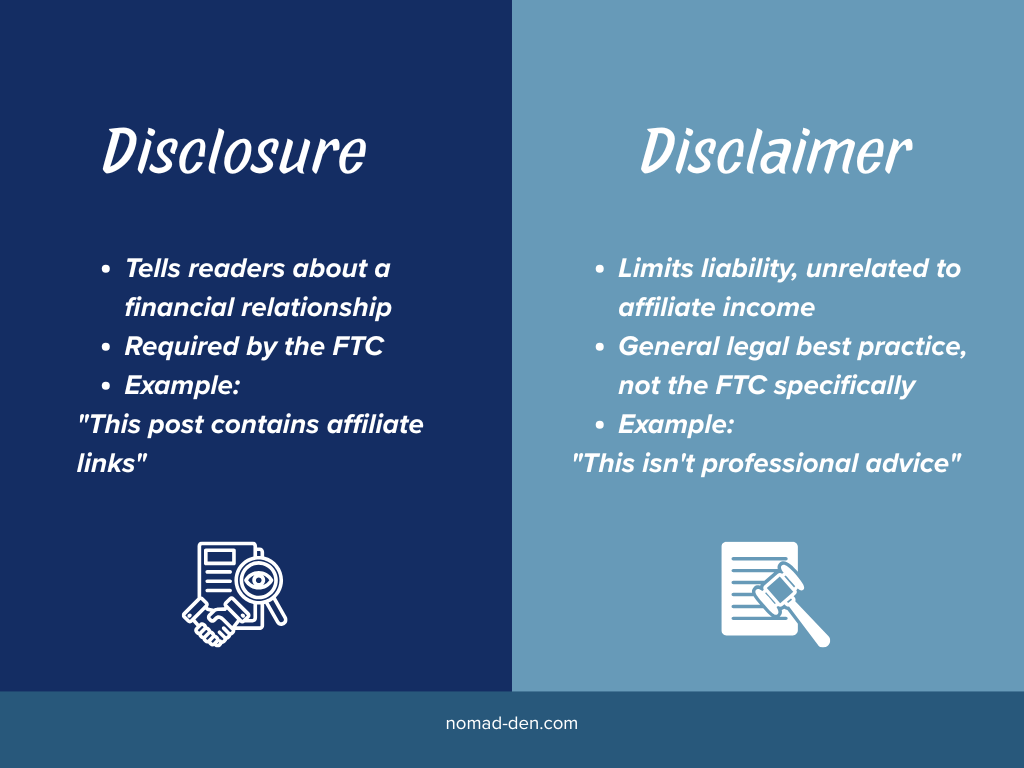
An affiliate disclosure and a legal disclaimer solve two different problems, and treating them as interchangeable is one of the most common compliance gaps on small business sites. A disclosure is the FTC-mandated statement telling readers about a financial relationship that could bias a recommendation. A disclaimer is broader liability language, “this isn’t professional advice,” “results aren’t guaranteed,” that protects the site from claims unrelated to affiliate relationships at all.
The gap shows up when a site has a general “Disclaimer” page in its footer and assumes that covers affiliate compliance too. It doesn’t. The FTC’s requirement is about proximity to the endorsement itself, a disclaimer page a reader never visits doesn’t satisfy a disclosure requirement that has to be seen before they click a link. The two can live side by side, and often should, but one doesn’t substitute for the other.
A quick note before you read further: I’m not a lawyer, and this isn’t legal advice. What follows is a plain-language summary of publicly available guidance, meant to help you understand the basics, not to replace professional counsel for your specific situation. If you need advice tailored to your business, speak with a licensed attorney.
Where to Place Your Disclosure
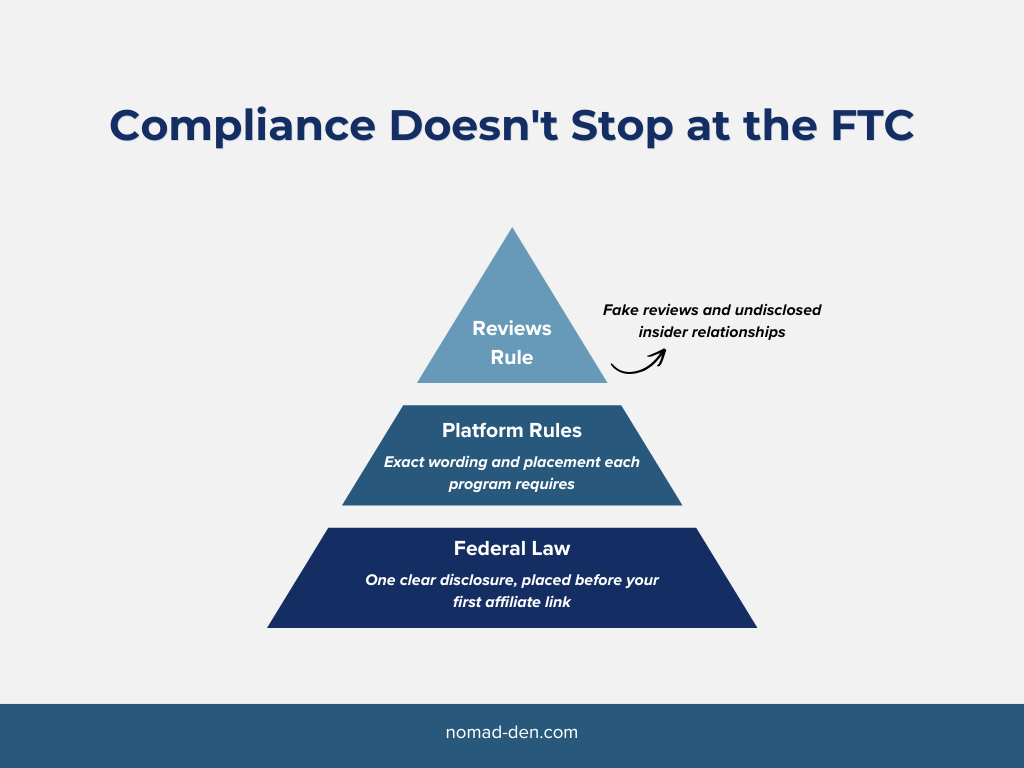
Your disclosure has to appear before a reader reaches the first affiliate link, not after it, and not tucked away where they’d have to go looking for it. For a standard blog post, that means the top, ahead of any recommendation or link in the body. The FTC’s own guidance on the Endorsement Guides confirms that a single disclosure can cover an entire post’s worth of affiliate links, as long as it sits where a reader will see it before they act on anything in the content.
A second disclosure at the bottom, linking through to a more complete legal page, isn’t required to satisfy the rule on its own, but it reinforces the top one and gives readers a place to go if they want more detail.
Format changes the specifics. Video needs the disclosure spoken and shown on screen near the start, and repeated periodically since viewers can join partway through. Social media needs it in the visible post itself, not buried behind a “see more,” and platform tools like Instagram’s Paid Partnership label aren’t automatically sufficient on their own, since the FTC has stated it won’t always treat built-in labels as adequate disclosure. Email needs it near the top of the message, before the first link, the same logic as a blog post.
Platform Rules Stack on Top of the FTC
Meeting the FTC’s bar doesn’t automatically satisfy the platform you’re using, since Amazon, ClickBank, and most affiliate networks layer their own disclosure requirements on top of it. Amazon’s Associates Program Operating Agreement requires the exact phrase “As an Amazon Associate I earn from qualifying purchases” to appear clearly on any site displaying Amazon links, worded precisely as written, not paraphrased. Amazon also expects a shorter, link-level tag near individual product links, something like “(paid link)” or “#CommissionsEarned,” in addition to the sitewide statement.
ClickBank takes a similar approach through its Advertising Guidelines, which bakes FTC compliance directly into the terms affiliates agree to when promoting ClickBank products. The practical takeaway is the same across networks: your sitewide disclosure covers the legal requirement, but if you’re running Amazon, ClickBank, Digistore24, or similar programs, check each program’s own operating agreement for anything more specific it expects, since violating the platform’s terms is a separate risk from violating the FTC’s.
The FTC Reviews Rule Most Affiliate Content Hasn’t Caught Up To
A newer rule, separate from the Endorsement Guides most affiliate content still cites, now gives the FTC direct authority to fine violators, and a lot of published disclosure advice hasn’t caught up to it yet. The Trade Regulation Rule on the Use of Consumer Reviews and Testimonials (16 CFR Part 465) took effect October 21, 2024. Unlike the Endorsement Guides, which are advisory and don’t by themselves authorize monetary penalties, this rule is enforceable directly, with civil penalties reaching tens of thousands of dollars per violation, according to the Federal Register’s final rule notice.
The rule targets fake and manipulated reviews specifically, including reviews written by company insiders without disclosing the relationship, and review suppression tactics like burying negative feedback. It matters for affiliate sites because product reviews are often exactly where affiliate links live, and the standard for insider disclosure under this rule is stricter than the general Endorsement Guides language most disclosure posts still quote.
What Happens If You Don’t Disclose
Enforcement rarely lands on a solo blogger who forgot a banner, it tends to land on companies and networks that built a business around hiding the connection. Two cases illustrate the range. In 2017, the FTC brought its first-ever case against individual social media influencers, settling with the owners of CSGO Lotto after they promoted the gambling site to their following without disclosing they owned it, and paid other influencers to promote it without requiring any disclosure either. The order that resulted required them to clearly disclose any material connection going forward, a standard remedy in cases like this.
The bigger structural risk shows up at the network level. In 2012, the FTC settled its first-ever suit against an affiliate network, Copeac (IMM Interactive), for recruiting a network of affiliates who ran fake news sites to sell acai berry supplements without disclosing the paid relationship. The settlement didn’t just penalize the network, it required Copeac to actively monitor every affiliate it worked with, vet their advertising, and cut off anyone found using deceptive claims. That’s the part worth internalizing: enforcement risk isn’t limited to the person writing the post, and a network’s compliance failure can trace back to the affiliates it never checked on.
A Disclosure Statement You Can Adapt
A compliant disclosure doesn’t need to be long or “legally worded”, it just needs to be specific, honest, and placed where a reader sees it before they click. A template that covers the standard case:
“This post may contain affiliate links. If you make a purchase through one of these links, I may earn a commission at no extra cost to you. I only recommend products and services I’ve used or genuinely believe in.”
Treat this as a starting point, not a drop-in fix. If you’re a co-owner or employee of something you’re recommending, swap “commission” language for a direct statement of that relationship, since “affiliate” understates ownership. If a specific program requires exact wording, like Amazon’s Associates phrase, that language needs to appear as written in addition to your general disclosure, not instead of it.
Why This Post Doesn’t Have an Affiliate Disclosure
This post doesn’t carry an affiliate disclosure because it doesn’t need one, there is no product or program being promoted here, and no company had any influence over what was included. The sources cited throughout, the FTC, Amazon, ClickBank, are referenced because they’re the authorities that actually define these rules, not because any of them are paying for placement. If that changes on a future update to this post, the disclosure will be added at the top, in the same place it would appear on any other post on this site.
FAQs
Conclusion
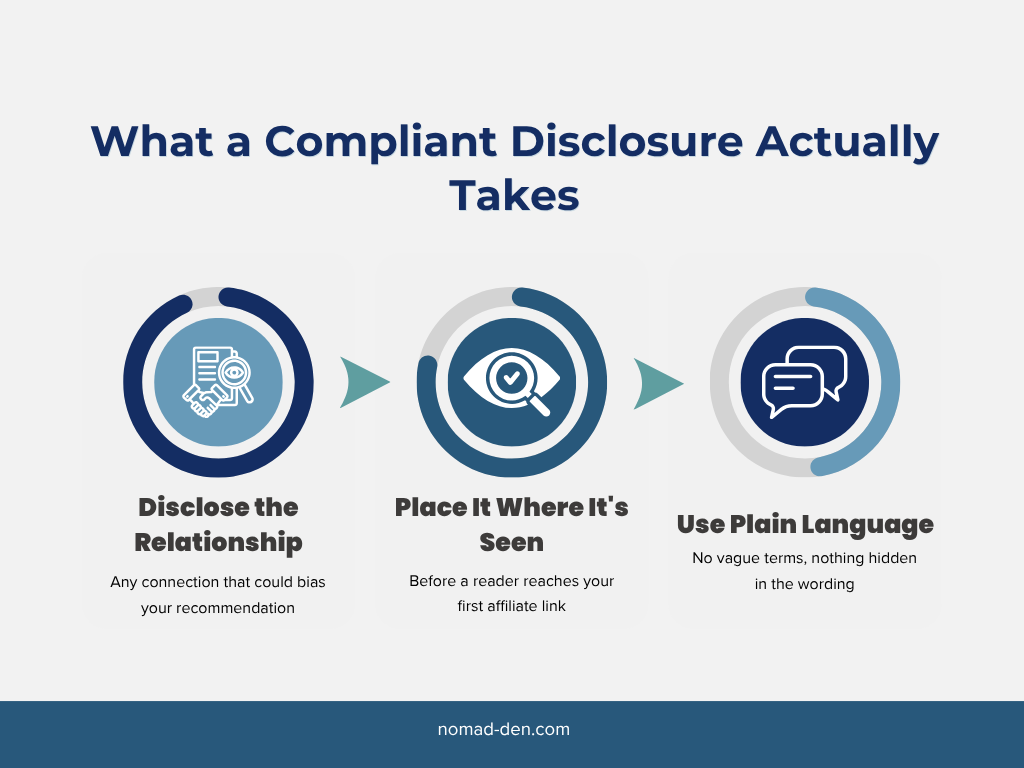
The core of FTC affiliate compliance comes down to three things:
- Disclose any relationship that could bias a recommendation
- Put that disclosure somewhere a reader will actually see it before they click
- Use language that isn’t trying to hide what it means
Everything else, platform-specific wording, format differences between blog and video and social, the newer reviews rule, builds on that same foundation. If you’ve never audited your own site against this, the fastest place to start is checking whether your disclosure sits above your first affiliate link or below it. That one detail is the difference most enforcement actions in this space actually turn on.
Continue Reading: Related Posts

Affiliate Marketing Scams: How to Spot Them (and Protect Your Own)
Affiliate marketing is a legitimate, commission-based business model, not a scam, that predates the internet…

Affiliate Marketing Networks Compared: Which Ones Are Actually Worth Joining?
An affiliate network is a middleman platform that connects you to multiple merchants or vendors…

6 Affiliate Niches That Last (And Beginners Can Start Today)
Most people pick an affiliate niche based on what’s trending right now. While that may…

How to Start Affiliate Marketing For Less Than $50 (Beginner Guide)
Affiliate marketing is one of the most affordable and accessible ways to start earning income…

17 Affiliate Marketing Terms Beginners Need to Know
Affiliate marketing terms are the core vocabulary that explains how the business model works, including…
ClickBank for Beginners: Step-by-Step Tutorial to Your First Commission
ClickBank is a digital marketplace where product creators list offers and affiliates earn commissions by…