
Some links in this post may be affiliate links. I may earn a commission at no extra cost to you.
Table of Contents
- What Counts as Identity Theft
- Why Identity Theft Looks Different in 2026
- The Hidden Risk for Freelancers and Online Business Owners
- The Hidden Risk for Digital Nomads and Remote Workers
- How to Know If You’ve Been Hit
- Step-by-Step Recovery Plan
- How to Prevent It Going Forward
- FAQs About Identity Theft
- Conclusion
- Related Posts
Identity theft happens when someone steals your personal information, such as your Social Security number, bank details, or login credentials, and uses it without your permission. The Federal Trade Commission received 1,135,270 identity theft reports in 2024 alone, a 9.5% increase from the year before. Separately, consumers reported losing more than $12.5 billion to fraud overall that year, a 25% increase over 2023.
If you’re reading this because it just happened to you, you’re not alone, and there’s a clear, step-by-step path to fixing it. This guide covers what identity theft actually looks like, why it’s escalating in 2026, and exactly how to recover, including the extra steps freelancers, remote workers, and digital nomads need that most identity theft guides leave out.
What Counts as Identity Theft
Identity theft and identity fraud are related but not the same thing. Identity theft is the theft itself: someone getting hold of your personal information. Identity fraud is what happens next, like opening a credit card in your name, filing a tax return you didn’t file, or draining an account you thought was secure. The distinction matters because the recovery steps you take depend on which stage you’re dealing with.
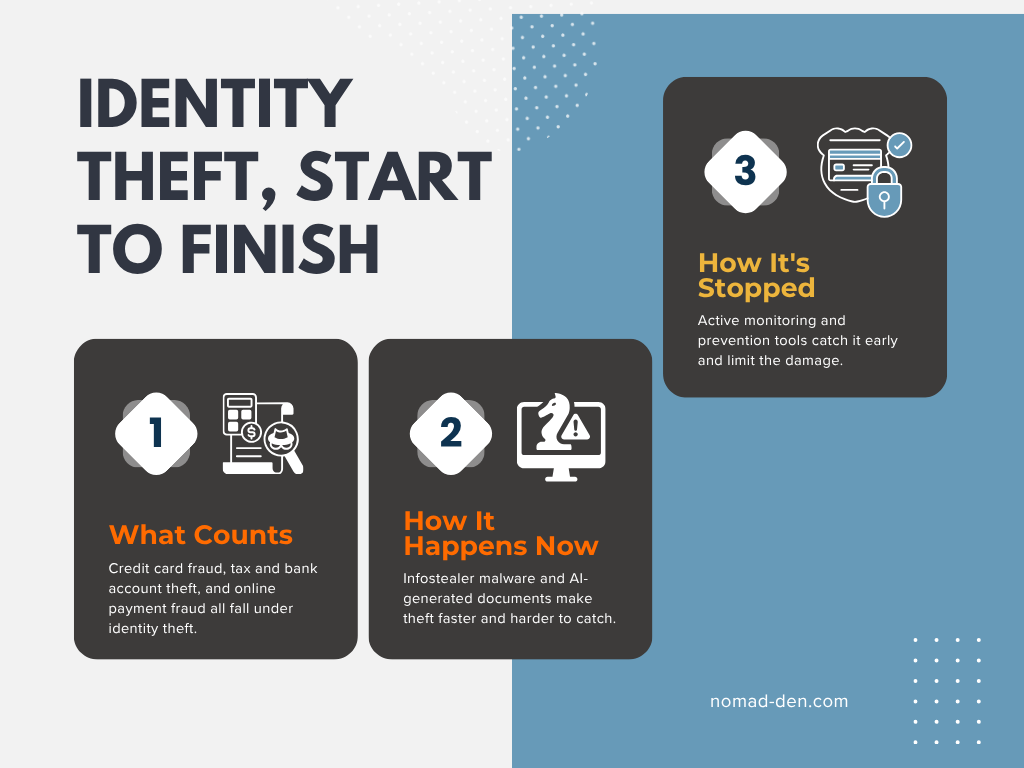
Credit card fraud remains the most common type, accounting for roughly 40% of all reports and driven mostly by new accounts opened in your name rather than charges to an existing card. Beyond that, a few other categories show up consistently in FTC data:
- Tax and employment fraud: someone files a tax return or gets a job using your Social Security number
- Bank account takeover: fraudulent access to an existing account
- Loan or lease fraud: someone takes out a loan or signs a lease using your identity
- “Other” identity theft: online shopping, payment accounts, email, and social media fraud (the second most common type behind credit card fraud, accounting for roughly 32% of all reports)
That last one deserves attention if you run any part of your income through the internet. It’s the category most likely to hit a PayPal account, an ad platform, or an online store rather than a traditional bank account. If you’ve ever wondered how a scammer gets into an online shopping account in the first place, our guide to holiday shopping scams breaks down the exact tactics.
Why Identity Theft Looks Different in 2026
Identity theft in 2026 doesn’t look like it did five years ago. The mechanism has shifted from large-scale database breaches to everyday device compromise. Infostealer malware, software that quietly harvests saved passwords, browser cookies, and autofill data, drove an 800% surge in credential theft in the first half of 2025 alone, with 1.8 billion credentials stolen from 5.8 million infected devices. Those stolen credentials get sold within hours, sometimes giving criminals access to an account before the real owner even knows their password was compromised.
Generative AI has made the fraud itself harder to catch, too. Criminals can now fabricate identity documents convincing enough to pass automated verification checks, and combine a real stolen Social Security number with fabricated details to build an entirely new, synthetic identity that doesn’t trace back to a single victim in any obvious way.
The upshot: early detection matters more than it used to. Catching fraud through active monitoring, rather than finding out via a bank notification after the fact, generally means less exposure and a faster recovery. That’s the strongest case for pairing good password hygiene with active monitoring, rather than relying on either one alone.
The Hidden Risk for Freelancers and Online Business Owners
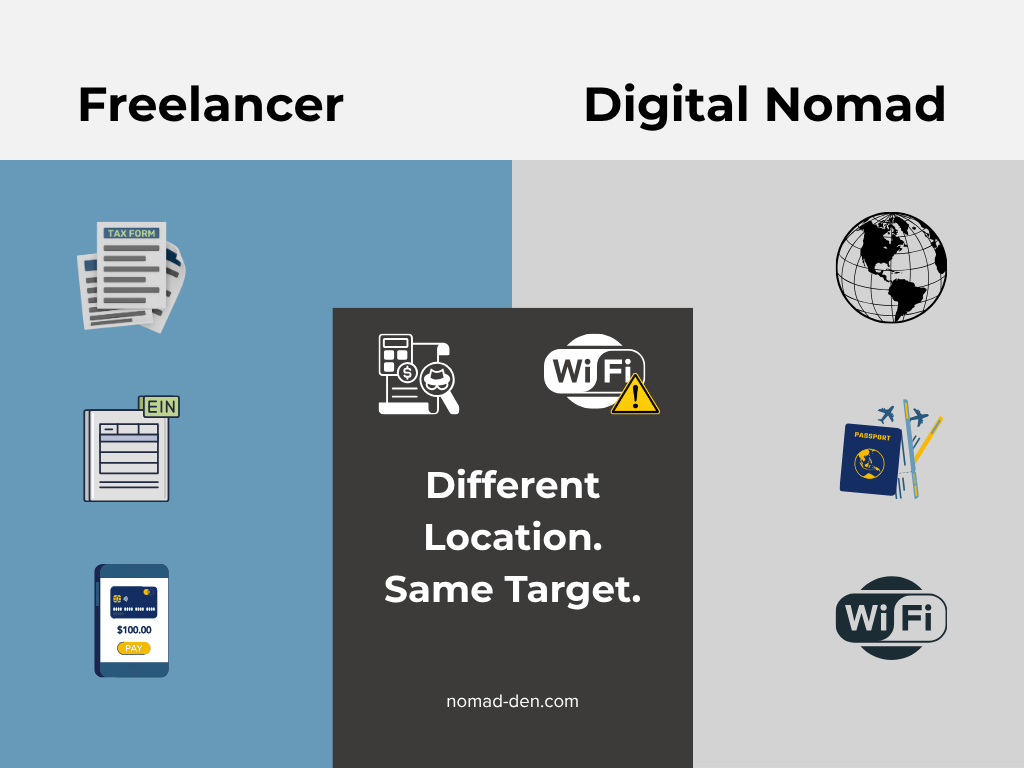
Freelancers and self-employed workers face a version of identity theft that rarely shows up in mainstream coverage: tax and business identity theft. Because your income isn’t reported through a single employer, a stolen Social Security number can be used to file a fraudulent return in your name, claim a refund before you do, or apply for a job under your identity, and you may not find out until the IRS rejects your legitimate return or sends a notice about income you never earned.
If that happens, the fix isn’t the same as disputing a credit card charge. You’ll need to file Form 14039, the IRS Identity Theft Affidavit, and you can request an Identity Protection PIN going forward so future returns filed under your Social Security number require that PIN to process. If you run your business under an EIN rather than your personal SSN, business identity theft is its own category with its own form: 14039-B. Warning signs include a rejected e-filed return because one was already filed under your EIN, or an IRS notice referencing employees or income you don’t recognize.
Watch for a scam making the rounds in 2026 specifically: promoters pushing a “Self-Employment Tax Credit” through TikTok, YouTube, and Facebook ads, promising thousands of dollars in refunds tied to pandemic-era relief. The credit doesn’t exist in the form being marketed. The IRS has flagged it as a high-risk trap for gig workers, online sellers, and solopreneurs, and the filer, not the promoter, is the one left owing the money back.
Your payout accounts are identity theft targets too: PayPal, Stripe, ad network dashboards, and affiliate platforms hold financial access the same way a bank account does, and “other identity theft,” the category covering online payment and account fraud, is currently the fastest-growing type the FTC tracks. Most payout account breaches start the same way any account takeover does, with a compromised email or reused password, so tightening your account security is the first place to focus.
The Hidden Risk for Digital Nomads and Remote Workers
Working from a different city or country every few weeks changes your exposure to identity theft in ways a traditional remote employee doesn’t deal with. Remote workers face meaningfully higher rates of unintentional data exposure than office-based employees, largely due to unsecured networks, personal devices, and unvetted apps. Digital nomads face all three at once, on a rotating basis, with no IT department to catch a mistake before it becomes a problem.
Public Wi-Fi is the most immediate risk. A café or coworking space network has no way to verify who’s actually connecting, which means a criminal can intercept unencrypted traffic from a few tables away, or set up a fake network with a convincing name to capture whatever you type. Every new city means a new unknown network, repeated indefinitely.
Recovery logistics are harder from abroad, too. Replacing a stolen passport or driver’s license, freezing a domestic credit file, or getting a new phone number for account recovery all take longer and involve more friction when you’re not in the country that issued the document in the first place. Plan for it before it happens, not during a scramble in an unfamiliar city.
The practical fixes here are less about any single tool and more about layering: encrypting your connection on unfamiliar networks, keeping a secure and reliable way to stay connected that doesn’t depend on borrowing whatever Wi-Fi is available, and using authenticator apps rather than SMS for two-factor authentication, since SMS-based codes become unreliable the moment your phone number changes across borders.
How to Know If You’ve Been Hit
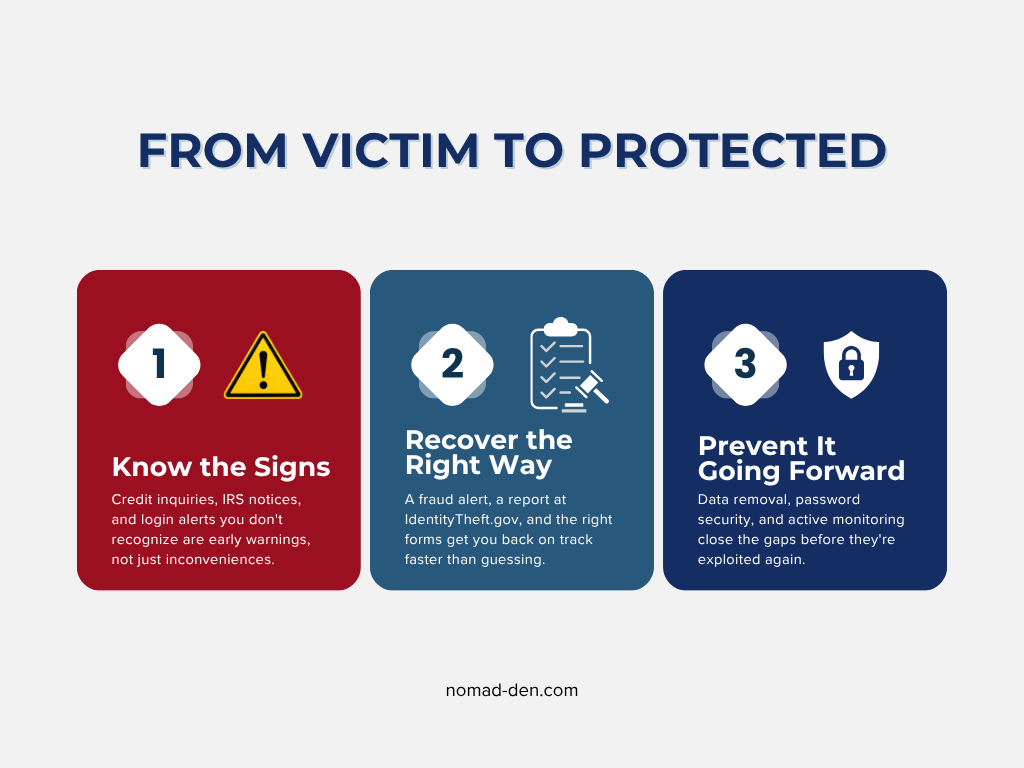
Identity theft rarely announces itself. Most victims find out through an indirect signal rather than a single, obvious moment, which is exactly why catching it early through active monitoring tends to mean less financial damage than finding out after the fact. A few signs to watch for:
- A credit inquiry or new account you don’t recognize on your credit report
- An IRS notice referencing a return, W-2, or income that isn’t yours
- A rejected e-filed tax return because one was already filed under your SSN or EIN
- Bills or collection notices for accounts you never opened
- A login alert, password reset email, or two-factor code you didn’t request
- A sudden inability to log into an account you use regularly, which can mean someone else already changed the credentials
If any of these show up, the next move isn’t to panic, it’s to move through a specific sequence of steps in the right order. That’s what the next section covers.
Step-by-Step Recovery Plan
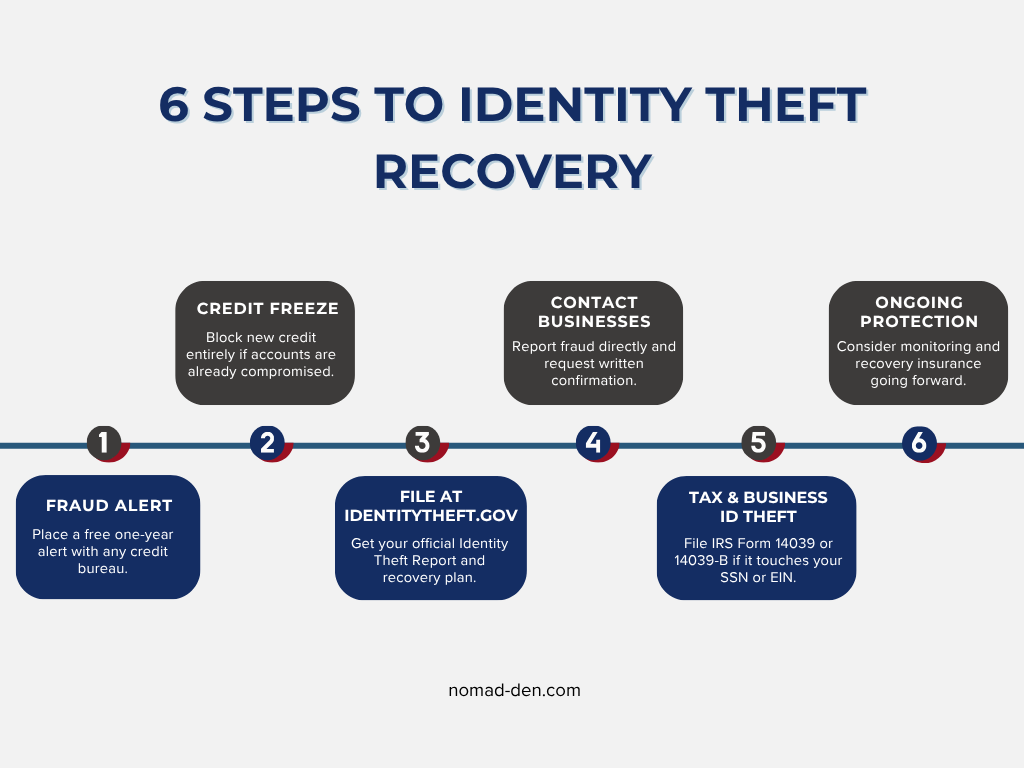
The order you take these steps in matters as much as the steps themselves. Acting out of sequence can mean redoing work, so start here:
1. Place a fraud alert and pull your credit reports
Contact any one of the three major credit bureaus, TransUnion, Experian, or Equifax, and request a fraud alert. That bureau is required to notify the other two, so one call covers all three. A fraud alert is free and lasts one year, and it requires businesses to take extra steps to verify your identity before opening new credit in your name. Once it’s placed, pull your credit reports from all three bureaus and note any account or inquiry you don’t recognize.
2. Understand when a credit freeze makes more sense
A fraud alert adds a verification step. A credit freeze blocks new credit from being opened entirely until you lift it, which is a stronger response if you know accounts have already been opened fraudulently, not just at risk. Freezes are also free, and you can freeze and unfreeze as needed through each bureau directly.
3. File your report at IdentityTheft.gov
This is the FTC’s official reporting tool, and it generates a personalized recovery plan along with an Identity Theft Report, a document that carries specific legal weight when disputing fraudulent accounts with creditors and credit bureaus. Create an account when you file so your report and plan stay accessible; if you skip that step, you have to save and print everything before leaving the page, since it won’t be retrievable afterward.
4. Contact the businesses involved directly
For any account opened or charged fraudulently, call that company’s fraud department, explain the situation, and reference your Identity Theft Report. Follow up in writing using the sample letters available through IdentityTheft.gov, and request written confirmation once the account is closed or the charges are removed.
5. Handle tax and business identity theft separately
If the fraud touches your tax return or your EIN, the steps above don’t cover it. File Form 14039 for personal tax-related identity theft or Form 14039-B if your business’s EIN was used fraudulently, and consider requesting an Identity Protection PIN so future returns require it. If you suspect but haven’t confirmed tax fraud, the IRS recommends against filing an amended return over income that isn’t yours; contact them directly using the number on the notice instead.
6. Consider a Monitoring and Recovery Service Going Forward
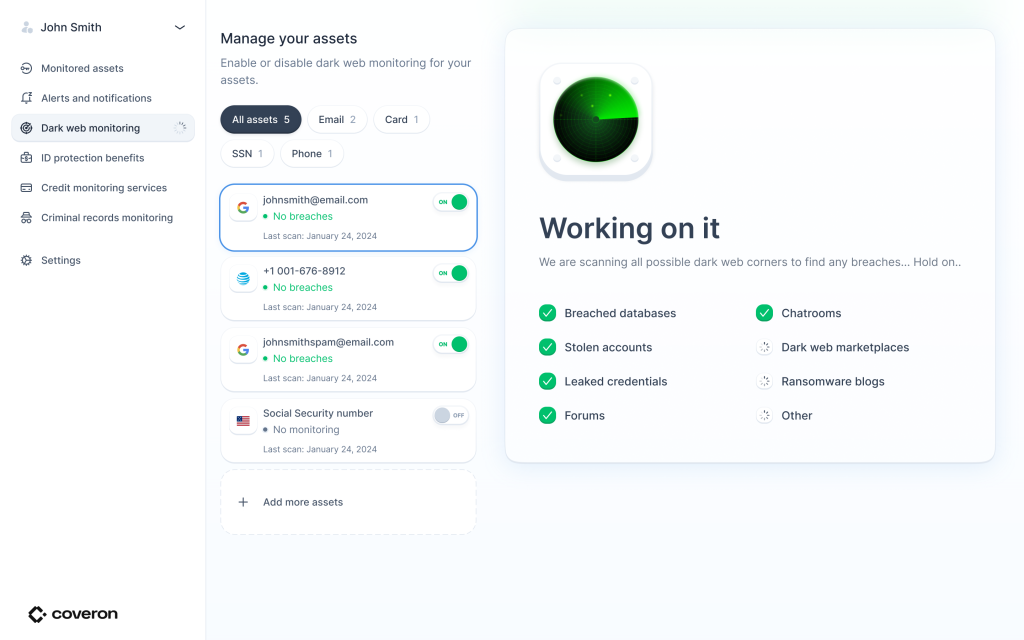
Once you’ve been through recovery once, most people don’t want to do it manually a second time. Services like Coveron combine ongoing credit and dark web monitoring with recovery insurance, up to $2,000,000 in eligible expense reimbursement on higher tiers, along with a dedicated case manager if it happens again. It’s built specifically for the after-it-happens phase, distinct from prevention tools, and it’s currently limited to U.S. residents, excluding New York.
Recovery insurance isn’t something you want to be shopping for after you’re already dealing with the fallout. See what Coveron covers.
How to Prevent It Going Forward
Recovery fixes the damage. Prevention reduces how often you have to do it again. Three areas make the biggest difference:
Reduce what data brokers already have on you
Most people don’t realize how much personal information, home address, phone number, employer, even relatives’ names, is sitting on public data broker sites, freely available to anyone who searches. Services like Incogni automate the process of requesting removal across hundreds of these sites and continue monitoring for new listings over time. This is prevention at the source: less exposed data means fewer entry points for the kind of information gathering that leads to synthetic identity fraud in the first place. Incogni handles the removal requests and follow-ups automatically, so it’s not something you have to manage site by site yourself. Try Incogni.

Fix password reuse before it becomes the way someone gets in
Reused or weak passwords remain one of the most common paths into an account, and they’re exactly what infostealer malware is built to harvest at scale. A password manager like NordPass gives every account its own unique password, so a breach on one site doesn’t allow access to the rest. NordPass builds this fix into your daily browsing rather than something you have to remember to do. Try NordPass free.

Add a layer of connection security, especially if you work from public or unfamiliar networks
NordVPN closes that gap directly, encrypting your traffic so it’s unreadable to anyone else on the same network, whether that’s the risk covered above or any other network you don’t control. For anyone traveling internationally and relying on local SIMs or public networks by necessity, an eSIM like Saily reduces that exposure further by keeping your connection off networks you can’t vet in the first place.
None of these tools replace each other. Data removal, password security, and connection security each close a different gap, and together they meaningfully lower the odds you’re writing an identity theft report of your own next year.
FAQs About Identity Theft
Conclusion
Identity theft is disruptive, but it’s also recoverable, and the process is more predictable than it feels in the moment. Report it in the right order, use the specific channels built for your situation, whether that’s IdentityTheft.gov, the IRS, or your credit bureaus, and treat prevention as an ongoing habit rather than a one-time fix. If you run your income through the internet, travel regularly, or both, the risks look a little different than they do for the average FTC statistic, but so do the solutions once you know where to look.
If you’re serious about not going through this twice, ongoing monitoring and recovery support are worth having in place before you need them, not after. Learn more about Coveron.

Some links in this post may be affiliate links. I may earn a commission at no extra cost to you. Learn more here.
Related Posts
Best Antivirus Software for Small Business Owners and Freelancers (2026)
If you run your business off a single laptop, ‘I should probably get antivirus eventually’…
Why DeGoogling Actually Matters in 2026 (And Where to Start)
DeGoogling means deliberately reducing your dependence on Google’s products and replacing them with privacy-respecting alternatives,…
Cybersecurity for Digital Nomads: The Risks Your VPN Won’t Cover
More than 40 million people are now working as digital nomads worldwide. Despite that scale,…
How to Remove Your Personal Data from the Internet (And Why It Matters)
Your personal information is being bought and sold right now, and you almost certainly didn’t…

Cybersecurity Basics: How to Protect Yourself Online
If you spend any time online, whether running a business, working remotely, or just managing…
Remote Work Scams: What You Need to Know Before You Apply
What’s actually happening in the remote work space right now is more serious than any…