Some links in this post may be affiliate links. I may earn a commission at no extra cost to you.
Table of Contents
- Why Traditional Keyword Research Advice Is Outdated
- What Search Intent Actually Means (and Why It Beats Volume)
- Search Everywhere Optimization: Finding Intent Beyond Google
- How to Actually Do Keyword Research Today
- Mangools KWFinder
- Writing Content That Search Engines and AI Actually Cite
- FAQs
- The Bottom Line: Keyword Research Isn’t Dead, the Goal Is
- Related Posts
Keyword research in 2026 isn’t about ranking on Google anymore. It’s about understanding what a person actually wants when they type or speak a query, and building something that satisfies that want, regardless of which platform they searched on. That distinction matters more now than it has in the entire history of SEO. Roughly 60% of searches on Google now end without a single click, and every AI-generated summary is a chance for Google to answer the question itself instead of sending a click to your site. If you’re still doing keyword research the way it was taught five years ago, you’re optimizing for a game that’s already changed.
This guide walks through what’s actually happening to search right now, what search intent means when the “top result” might be an AI paragraph instead of a website, and how to do keyword research that works whether the person searching ends up on Google, in ChatGPT, or scrolling a social feed.
Why Traditional Keyword Research Advice Is Outdated
The core promise of keyword research used to be simple: find a term, rank for it, get the click. That promise is breaking down. Ahrefs’ most recent research, based on December 2025 Google Search Console data across 300,000 keywords, found that the presence of an AI Overview on a search results page now causes a 58% reduction in click-through rate for the top-ranking result, up sharply from the 34.5% drop the same research team measured less than a year earlier.
Pew Research Center ran an independent study tracking actual browsing behavior across 68,000 queries and found something similar from a different angle: only 8% of users click a traditional search result when an AI Overview is present, compared to 15% when it isn’t, and 26% of those sessions end entirely right after the AI Overview page loads.
Recipe blogs are where this problem can show up most clearly. Adam and Joanne Gallagher have run the food blog Inspired Taste since 2009, testing and photographing every recipe themselves before publishing it. In a recent video, Joanne walked through what happened when she searched for their own key lime pie recipe: the AI Overview generated a version that pulled from multiple sources and produced a noticeably different, less reliable result than the one she’d actually tested in her kitchen.
Joanne noted it wasn’t a one-off either, since the AI-generated version can change from search to search. Adam and Joanne refer to this as a “Frankenstein recipe,” and a representative from Ahrefs’ own research team has corroborated the pattern independently. The lesson isn’t really about food blogging. It’s that when your content is easily reduced to interchangeable facts, an AI system will happily do that reducing for you and keep the click.
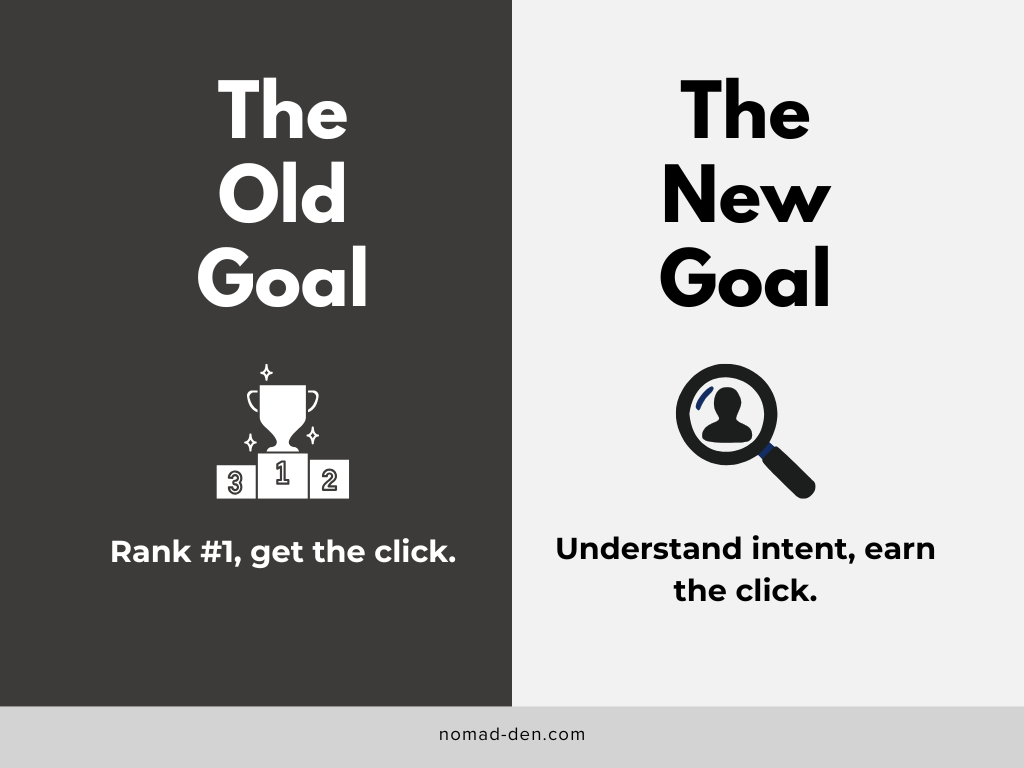
None of this means keyword research is pointless now. It means the goal has changed. You’re no longer researching keywords purely to chase a ranking. You’re researching them to understand a real question well enough that you can answer it more specifically, more usefully, and with more evidence of firsthand experience than a stitched-together AI summary ever could.
What Search Intent Actually Means (and Why It Beats Volume)
Search intent is the actual reason behind a search, not just the words used to type it. Two people can type nearly identical phrases and want completely different things: someone searching “best VPN” might want a quick recommendation, while someone searching “best VPN for streaming Netflix abroad” already knows what they want and is close to choosing one. Search volume tells you how many people are asking. Intent tells you what they need once they get an answer, and getting that wrong is a bigger problem than picking a slightly lower-volume keyword.
Most guides split intent into four rough categories:
- Informational – the searcher wants to learn or understand something (“what is a VPN”)
- Navigational – the searcher already knows where they want to go (“NordVPN login”)
- Commercial – the searcher is comparing options before deciding (“best VPN for privacy”)
- Transactional – the searcher is ready to act (“NordVPN discount code”)
The practical test is simple: before targeting any keyword, search it yourself and look at what’s already ranking. If the results are all long, detailed guides, a short surface-level post won’t satisfy that intent no matter how well it’s optimized. If the results are product pages, a blog post probably isn’t what that searcher wants at all.
This is also where the case for long-tail keywords has changed, not as a beginner’s easy-win tactic but as a genuine defensive strategy. Long-tail searches make up roughly 91.8% of all search queries and convert at about 2.5 times the rate of short, broad terms. They’re also the queries an AI Overview is least equipped to fully satisfy in one paragraph, since they tend to carry more specific, personal context. A broad term like “SEO tips” is exactly the kind of query Google can summarize in three sentences. A specific term tied to a real situation is a lot harder to flatten into a generic answer, which means it’s a lot more likely to still send you a click.
Search Everywhere Optimization: Finding Intent Beyond Google
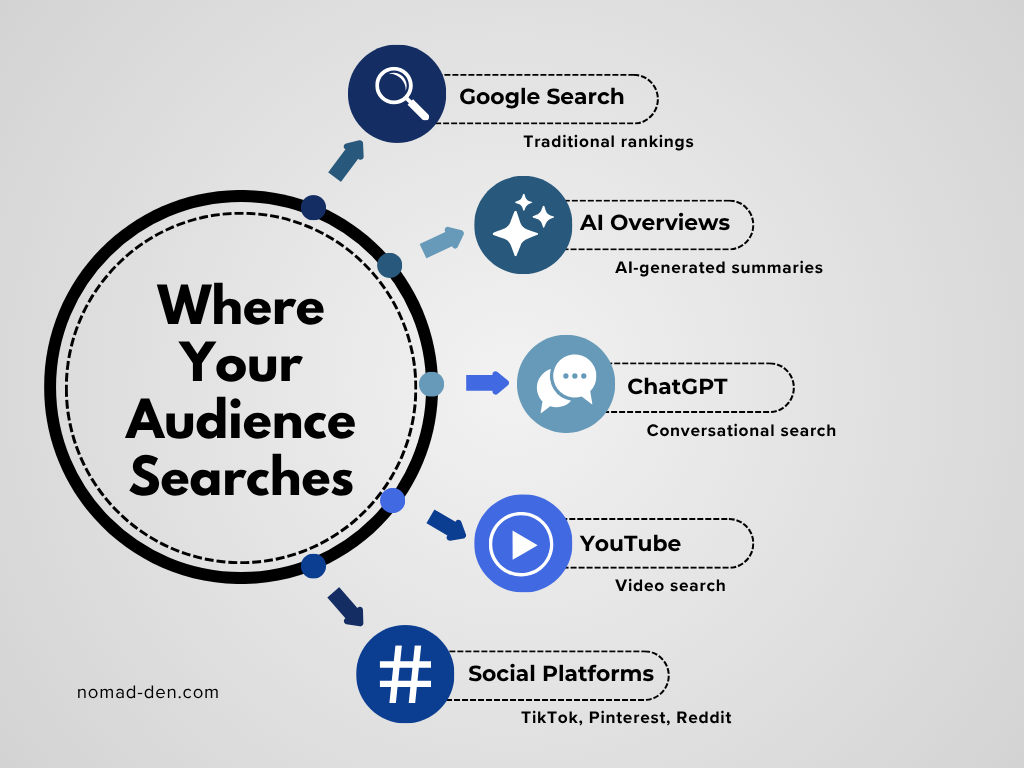
Google is still the largest search engine by a wide margin, but it’s no longer the only place people go to find answers. Neil Patel has been describing this shift as “search everywhere optimization,” arguing that as AI Overviews, zero-click searches, and platforms like TikTok and ChatGPT reshape how people find information, visibility now depends on more than ranking well in traditional search results. His practical guidance for getting cited by AI tools is worth keeping in mind while you write: keep answers short, specific, and sourced, since a five-paragraph response is less likely to get pulled into an AI-generated summary at all.
Scale matters here, since it’s easy to overstate how far this shift has actually gone. ChatGPT now has around 900 million weekly active users and processes roughly 2.5 billion prompts a day, putting it at about 17% of all global digital queries. It’s also still small next to Google, and Google sends roughly 190 times more traffic to websites than ChatGPT does, largely because ChatGPT is built to keep people in a conversation rather than send them elsewhere.
Research tracking user behavior before and after ChatGPT adoption backs this up further: users showed no statistically significant drop in daily Google Search sessions after people started using ChatGPT regularly, suggesting AI tools are expanding how much people search overall rather than replacing traditional search.
The practical takeaway isn’t to “abandon Google.” It’s that the people looking for the content you’re already creating are asking the same underlying questions in more places than they used to. Understanding their intent well enough to show up in any of those places (a search engine, an AI answer, a platform’s own search bar) now matters more than chasing a single ranking ever did.
How to Actually Do Keyword Research Today
Good keyword research now starts with a question, not a tool. Before opening anything, write down the actual problems your reader is trying to solve, in their own words rather than industry jargon. Those are your seed terms. From there, the process still follows a familiar shape, just with an added filter at the end:
- Expand your seed terms using a keyword tool to surface related phrases, questions, and long-tail variations
- Check search intent manually by searching the term yourself and looking at what’s currently ranking, since the format of the top results tells you what Google (and by extension, most AI systems trained on that same data) considers the correct answer to that query
- Prioritize long-tail, specific phrasing over broad, high-volume terms, since specific queries convert better and are harder for an AI Overview to fully absorb
- Confirm the keyword fits content you can genuinely deliver on, meaning you have real experience, data, or a specific angle, not just the ability to summarize what already exists
A quick note on tools here, since most keyword research guides assume a budget most beginners may not have yet. Free options like Google Search Console (for terms your own site already gets impressions on) and Google’s own autocomplete and “People also ask” boxes will get you further than most people expect. When you’re ready to add a paid tool, you don’t need to jump straight to an enterprise-tier platform.
Mangools KWFinder
KWFinder is built specifically for the beginner-to-intermediate keyword research workflow, which makes it a natural next step once free tools stop giving you enough depth. Enter a seed keyword and it returns long-tail variations along with a difficulty score, search volume, and a breakdown of the current top-ranking pages, so you can check intent without leaving the tool.
- Difficulty scores that are genuinely readable for a smaller or newer site, rather than calibrated for enterprise competition
- Location-specific volume data, useful if any of your target keywords have a regional angle
- A far lower price point than the larger suites, without needing every feature those suites bundle in
It won’t match the sheer database size of the bigger platforms, and it isn’t trying to. For a site that’s still in the process of building authority, that’s the right tradeoff. Ready to put this into practice? Try KWFinder and see what your audience is actually searching for.
Writing Content That Search Engines and AI Actually Cite
Getting the keyword research right is only half the job, since the content itself now has to satisfy two different readers: the human searching, and the AI system deciding whether to summarize or cite you. Neil Patel’s guidance here is simple: keep your answers concise, specific, and sourced. A five-paragraph windup before the actual answer is exactly the kind of content an AI Overview will skip past or flatten into its own summary, taking your click with it.
In practice, that means leading each section with a direct, bolded answer to the question the header implies, the same structure this post follows. It means backing claims with a specific number or source instead of a vague generalization, since specificity is exactly what’s hard for an AI system to fabricate or stitch together convincingly. And it means writing from genuine, firsthand experience wherever you have it.
That last point is the real lesson from the Frankenstein-recipe problem: Adam and Joanne Gallagher’s advantage was never just that they had a recipe online, it’s that they’d actually tested it, tasted it, and could speak to it with a specificity no AI remix could fake. The same principle applies whether you’re writing about cooking or cybersecurity. Content that could only exist because you actually did the thing is the content that’s hardest to flatten into a generic answer.
FAQs
The Bottom Line: Keyword Research Isn’t Dead, the Goal Is
Keyword research hasn’t stopped mattering. What’s changed is what it’s for. It used to be a means of chasing a ranking. Now it’s a way of understanding a real person’s question well enough to answer it better, more specifically, and more honestly than a stitched-together AI summary ever could, regardless of whether that answer shows up on Google, in an AI Overview, or somewhere else entirely. Get that part right, and the traffic question tends to take care of itself.
Ready to put this into practice? Explore our SEO Resources for the tools mentioned here.
Related Posts

Best Free Tools for Content Creators (and What They Really Cost)
The best free tools for content creators cover four main jobs: planning what to make,…

White Hat vs. Black Hat SEO (and the Gray Area In Between)
SEO tactics fall into three categories: white hat, black hat, and a shrinking grey area…

How to Use Social Media Scheduling Tools to Grow Without Being Online 24/7
There’s a version of social media growth that gets sold constantly: post more, post everywhere,…

How to Validate a Business Idea Before Wasting Months Building It
When you come up with an idea for an online business, you’re anxious to make…
Digital Marketing Analytics for Beginners: Stop Guessing, Start Tracking
When I first launched Nomad Den, I was publishing posts, building out a network of…
Lead Magnets That Convert in 2026 (And What to Build First)
Building an email list sounds straightforward until you actually try it. The real challenges aren’t…