Working remotely isn’t a backup plan anymore. It’s not something people do when they can’t find a “real job.” In 2025, over 5.6 million U.S. independents earned $100,000 or more working for themselves1. Since the Covid-19 pandemic in 2020, that number has nearly doubled. The shift is from traditional cubicle employment is already happening.
The problem is that most people focus on where to work remotely. While that’s important, very few focus on what skills actually pay once they get there. That’s where most people lose time — chasing the wrong skills and realizing too late they don’t pay.
Not all remote skills are equal. Some cap out quickly. Some take years to pay off. And some look good on paper but don’t translate into real income. This breakdown focuses on skills that:
- Have proven earning potential
- Can be used independently (not just in a job)
- Align with building long-term, flexible income
And just as important, we’re going to be honest about what it actually takes to make these skills pay.
The Part of Remote Work Most People Ignore
Before getting into the skills, understand this: freelancers and independent workers don’t just replace a salary. They replace everything that’s normally covered in a traditional job. That includes:
- Health insurance
- Retirement contributions
- Taxes (self-employment tax alone changes the equation)
- Income stability
In practical terms, you often need to earn 25–40% more than a traditional salary just to match the same standard of living. Most content either skips this or buries it. It shouldn’t. If you understand this upfront, your approach changes. You stop chasing shortcuts and start focusing on skills that actually scale.
How to Choose the Right Skill (Without Wasting Time)
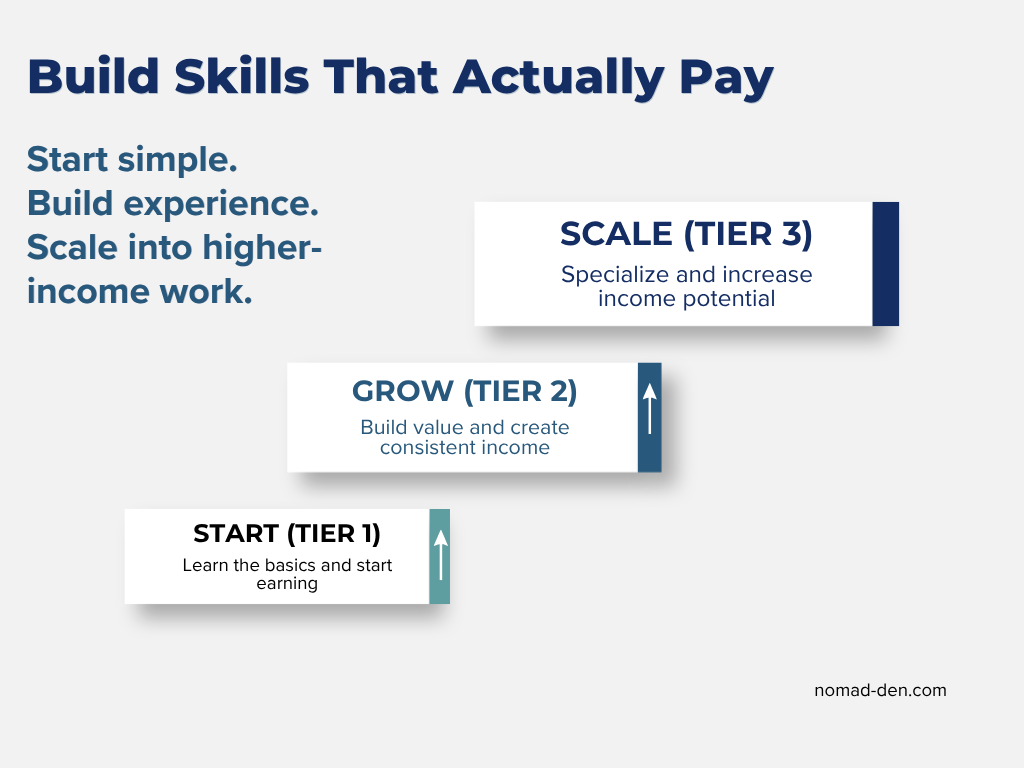
This is where most people get stuck. They jump into something random, spend months learning it, and realize too late it that it either doesn’t pay well or it doesn’t fit. A better way to approach this is to follow a progression.
- Tier 1 (Starter) → Fast entry, lower barrier, builds initial income
- Tier 2 (Growth) → Higher value, more stability, stronger positioning
- Tier 3 (High Income) → Specialized, higher ceiling, less competition
Most people don’t start at the top. They build into it by gaining experience and developing real skills over time.
Think of it like leveling up in a game. There’s no shortcut to the final stage, but each level increases your skill, your value, and your opportunities.
Tier 1 — Solid Starter Skills ($30k–$60k)
These are the easiest skills to get started with. They don’t take as long to learn, and they’re usually the fastest way to begin earning remotely.
Copywriting & Content Writing
Writing is still one of the most reliable entry points for remote work. Businesses always need content. The difference is in specialization. General writing pays modestly, while niche writing (finance, SaaS, cybersecurity) can pay significantly more. This is where positioning matters more than raw talent.
Short-Form Video Editing
Demand here is driven by the growth of platforms like TikTok and Instagram. Creators need volume. Businesses need conversions. Editors who understand pacing, hooks, and retention outperform those who just “cut clips.”
Virtual Assistance (Specialized)
General VA work is crowded and lower-paying. Specialized VA work is different. If you understand tools like Notion, Zapier, or basic automation, you move into a higher-value category quickly.
Niche Newsletter Monetization
This is slower at the start but compounds over time. A focused audience around a specific topic can generate income through:
- Sponsorships
- Affiliate offers
- Digital products
This aligns directly with long-term content strategy.
Tier 2 — Strong Middle Skills ($50k–$100k)
This is where things start to stabilize. These skills require more experience, are more valuable, less saturated, and can lead to recurring income.
Email Marketing & Automation
Email is still one of the highest ROI channels. Businesses don’t just need traffic, they need a way to capture and convert it over time. They need help with:
- List building
- Automation sequences
- Campaign optimization
This is where one-time traffic turns into repeat engagement and revenue. This ties directly into tools like Systeme.io and other platforms built around funnels and conversion. Learn how to set this up properly here.
Conversion Rate Optimization (CRO)
Instead of getting more traffic, this focuses on getting better results from existing traffic. Small improvements here can lead to significant revenue gains. That’s why businesses pay for it.
CRO looks at why visitors aren’t taking action — and fixes it. In practice that means testing and refining things like:
- Headline clarity and value proposition
- Call-to-action placement and wording
- Page load speed and mobile experience
- Form length and friction points
- Trust signals like testimonials, guarantees, and social proof
The math is straightforward: a site converting at 3% instead of 1% on the same traffic is effectively tripling its results without spending more on acquisition. That’s why even small CRO wins compound over time.
For beginners, the starting point isn’t expensive software. It’s paying attention to where people drop off and making one change at a time to find out why. Understanding your analytics is where that process begins.
Affiliate Marketing
Affiliate marketing is a simple model: you promote products or services and earn a commission when someone takes action through your link. For beginners, it’s one of the most practical ways to start earning online without creating your own product.
Businesses use affiliate programs to expand their reach, while individuals use them to build income streams through content, reviews, and recommendations. It works best when paired with:
- Content (blogs, videos, social media)
- Traffic (search, Pinterest, short-form platforms)
- Trust (clear positioning and honest recommendations)
The ceiling isn’t fixed, but it requires consistency and a structured approach. Choosing the right niche makes a major difference in long-term results.
No-Code Development (Webflow, Bubble)
Some tools allow you to build websites, landing pages, and simple applications without writing code.
Platforms like Webflow (for websites) and Bubble (for web apps) give businesses a faster way to build and launch without relying on full development teams.
This sits between technical and non-technical work. There is a strong demand for people who can build functional pages, funnels, or simple tools effectively. AI and no-code tools are often used together, which is part of why this skill is growing.
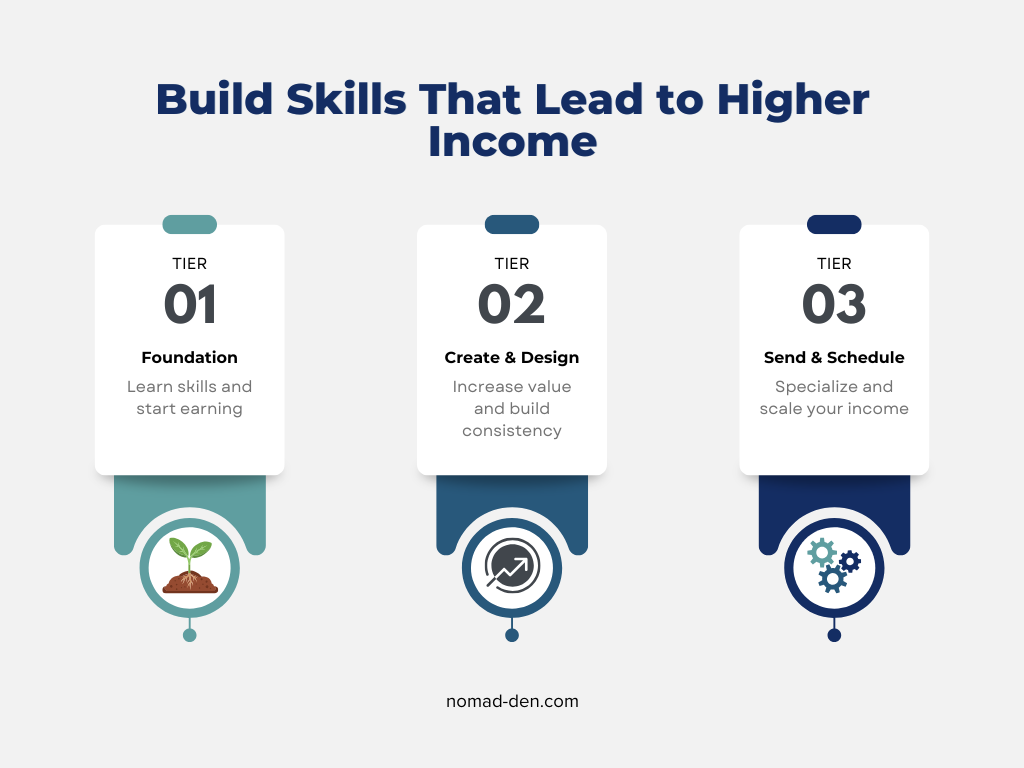
Tier 3 — Skills with the Highest Income Potential ($100k+)
These skills require experience, specialization, and a track record of results. They take longer to develop, but they offer the highest income potential.
Cybersecurity Consulting
As more business moves online, risk increases. Every system, account, and transaction creates potential exposure. Companies need help with:
- Security audits
- Vulnerability assessments
- Protection systems
This goes beyond prevention. It’s about identifying weak points before they turn into real losses. This is one of the few areas where demand is growing faster than supply, especially for businesses handling sensitive data or operating remotely.
Understanding how to protect accounts, data, and identity is becoming essential for anyone working online.
SEO & Content Strategy
This isn’t just writing. It’s about creating content that gets found, brings people in, and keeps working long after you publish it. I’ve watched posts I wrote months ago continue pulling in traffic without touching them again. That’s the compounding effect SEO creates — and it’s why I prioritize it over almost every other channel.
The real skill isn’t just knowing keywords. It’s understanding what someone actually wants when they search, and structuring content that answers it better than what’s already ranking. Businesses pay for that because it replaces a significant chunk of what they’d otherwise spend on ads.
If you’ve heard that SEO is no longer relevant, that’s not the full picture.
Paid Media (Google & Meta Ads)
Businesses are willing to spend more on ads when results are measurable and directly tied to revenue. If you can improve:
- Cost per acquisition
- Conversion rates
- Return on ad spend
You become valuable quickly. This is one of the fastest ways to generate results, but it requires testing, data analysis, and ongoing optimization.
AI + Skill Integration (Not Just Prompting)
AI is not a standalone skill for most people. The real leverage comes from combining it with something else, like:
- AI + content
- AI + marketing
- AI + automation
This is where efficiency increases and workflows improve, not where human input disappears. At higher levels, AI becomes less about prompting and more about applying it within a specific skill.
If you want to go deeper, Anthropic offers free courses on using Claude effectively.
More broadly, AI is changing how these skills are used, not replacing them. It speeds up repetitive work and supports research, but judgment, positioning, and decision-making still come from you.
The advantage comes from combining AI with a skill, not relying on it by itself.
Why Skill Stacking Changes Everything
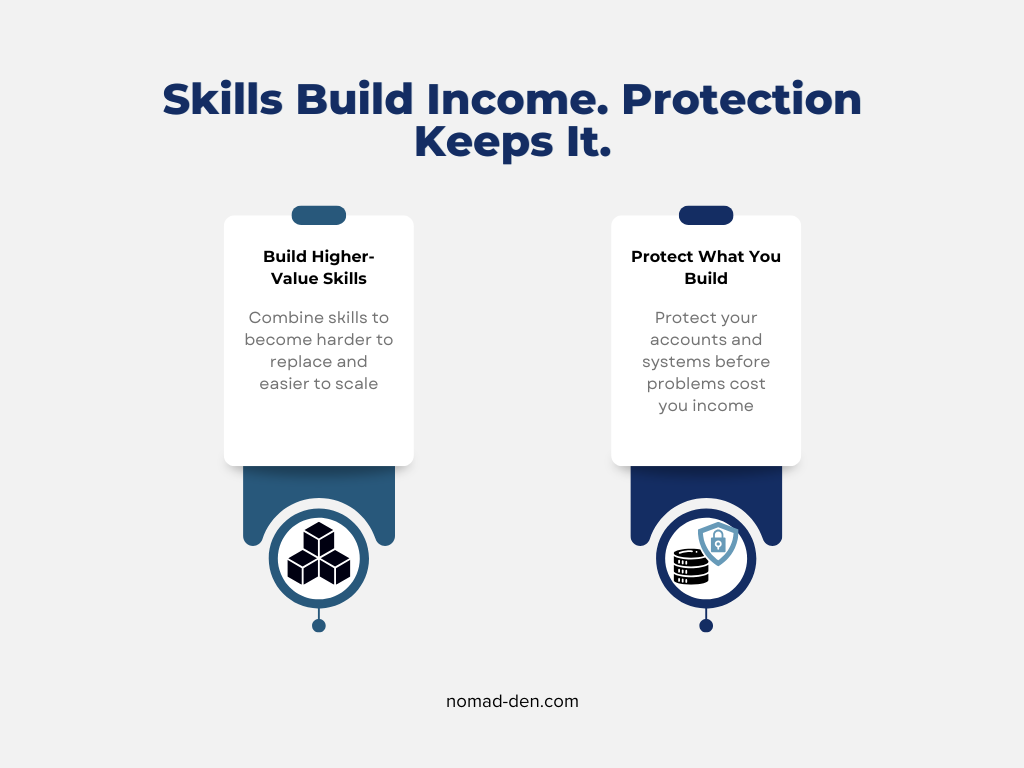
The highest earners rarely rely on a single skill. They combine them. Examples:
- SEO + cybersecurity → high-value niche positioning
- Email marketing + affiliate → scalable income system
- AI + no-code → rapid product creation
Individually, these skills are valuable. Combined, they become harder to replace and easier to scale. This is where most of the real advantage comes from.
The Layer Most People Ignore
Building income online is one thing. Protecting it is just as important. Accounts can be compromised, data exposed, and systems exploited if you’re not paying attention.
Most people don’t think about it until something goes wrong. If you’re building online income, security isn’t optional. It’s part of the system.
The more you rely on digital tools, platforms, and accounts, the more important this becomes.
Frequently Asked Questions
Final Perspective
The opportunity is real. But it’s not random. The people earning consistently online aren’t chasing trends or jumping between ideas. They’re building skills that stack, compound, and increase in value over time.
Most people get stuck trying to find the fastest path. The better approach is to build the right foundation and grow into higher-value work. Start with something practical. Apply it. Improve it. Then stack it with something else. That’s how this actually works.
- 2025 marks the 15th year of tracking the rise and evolution of the independent workforce in the United States. ↩︎
Continue Reading Related Posts
Freelance Retainers: How to Turn One-Off Clients Into Repeat Work
A freelance retainer is an ongoing agreement where a client pays you a set amount…

Freelance Scams: How to Spot a Fake Client Before It Costs You
A fake-client scam is when someone poses as a paying client to take your money,…
How to Build a Steady Income as a Freelancer: Protect What You Earn First
Steady freelance income starts with protecting what you’ve already earned, not just chasing more of…

When to Start Outsourcing: How to Vet Your First Virtual Assistant (or Freelancer)
Outsourcing makes sense the moment a task is both teachable and consistently the thing standing…

Freelancing vs. Remote Work: What’s the Difference?
Freelancing and remote work are not the same thing, even though people use the terms…
Freelance Business Tools: Getting Paid and Staying Protected
Most freelance tool summaries and comparison posts point you toward the same handful of project…