
Some links in this post may be affiliate links. I may earn a commission at no extra cost to you.
Building an online business starts with picking a model that fits your skills, then treating security as part of that plan from day one. U.S. business applications hit 578,926 in July 2026, up 8.1% from June, according to the Census Bureau’s most recent report. More people building online also means more competition, and more customer accounts, data, and payment details for someone else to go after.
There’s plenty of misinformation mixed in with the useful advice out there: promises of easy money, passive income, or overnight success are common. Some contain partial truths, but they usually skip over how results are actually achieved, and what it takes to keep them once you have them.
At Nomad-Den, the focus is practical, step-by-step guidance for building a sustainable online business, grounded in real strategy and paired with the security habits that keep what you build from becoming someone else’s opportunity.
Building the Foundation
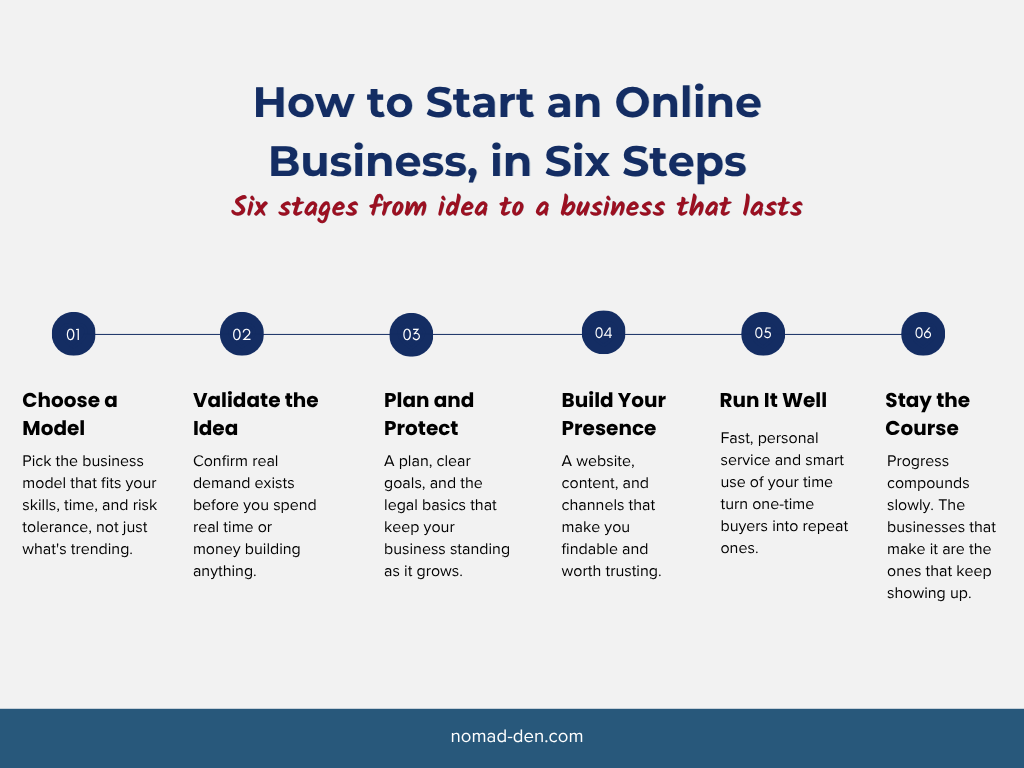
A strong foundation starts with understanding which online business model actually fits your skills, time, and risk tolerance. The paths differ, but they share common ground: real value creation, audience trust, and building for the long term rather than chasing a quick payout.
Below, we’ll break down the business models covered in this guide, and how each one fits into a broader plan for building online securely from the start.
Digital Marketing
Digital marketing covers virtually any promotion done through digital channels, including search engines, email, social media, and paid ads. It’s how most online businesses get discovered and stay in front of an audience over time.
For a full breakdown of how these channels work together, see Digital Marketing Guide: Where to Start and How It Works.
Affiliate Marketing
Affiliate marketing is one of the most accessible online business models. You promote other companies’ products or services and earn a commission when your referral leads to a sale or signup. There’s no inventory, no shipping, and no product to build, just a tracked link and the audience trust behind it, which is worth protecting, since compromised affiliate accounts and hijacked links are a common way marketers lose commissions to fraud.
For a full walkthrough of choosing a niche, evaluating affiliate networks, and landing your first sale, see Affiliate Marketing for Beginners: Your Step-by-Step Roadmap to First Sales.
E-commerce
E-commerce covers any transaction made online, buying or selling products, services, or digital goods, regardless of platform or frequency. That’s broader than just running a store. It includes everything from a one-off digital download to a fully self-hosted storefront handling inventory, payments, and customer service end to end.
For the terms and concepts that come up most in e-commerce specifically, see E-Commerce Basics: 15 Terms That Explain How Online Stores Work. And if you’re ready to actually launch a store, How to Set Up an Online Store: 4 Platforms Compared walks through picking a platform and getting started.
Despite their differences, all three models lean on similar methods: SEO, content marketing, and social media. The real difference is what you’re selling and how you get paid. Affiliate marketers promote someone else’s product and earn a commission on each sale; digital marketers and e-commerce businesses sell their own products or services directly.
Market Research
Market research answers three questions before you spend real time or money: is there demand, is it profitable, and how much competition are you up against? Skipping this step is one of the most common reasons new products and services stall before they gain traction.
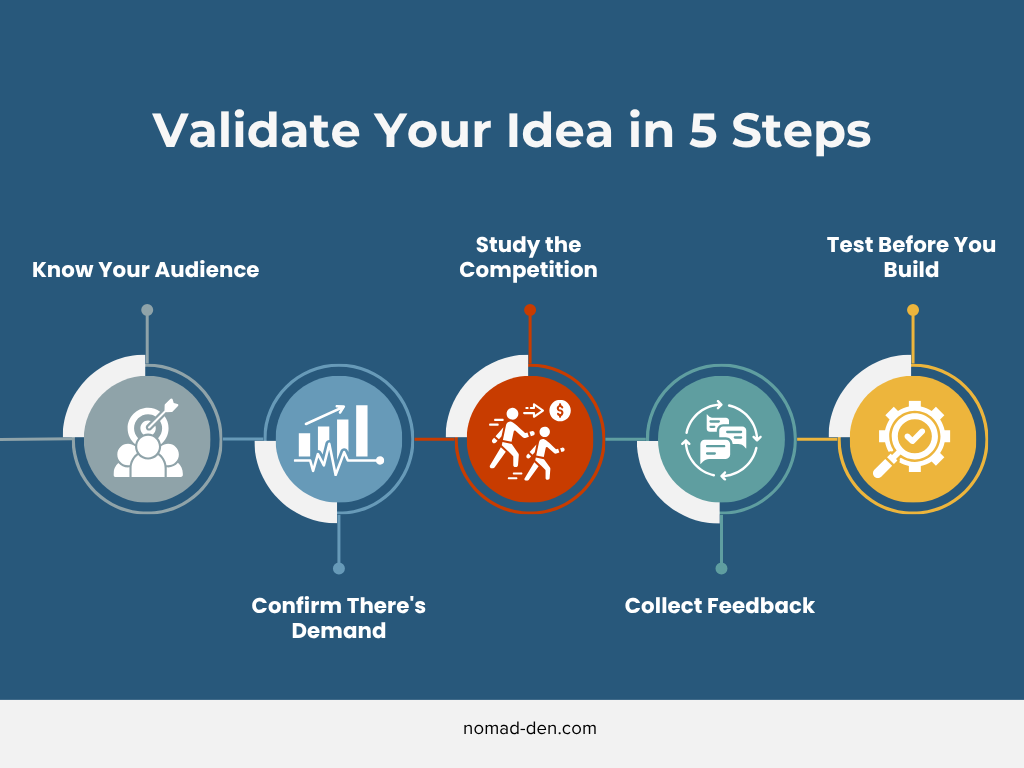
The five checks below give you a repeatable way to validate an idea before committing to it. For a deeper walkthrough of the full process, see How to Validate a Business Idea Before Wasting Months Building It.
1. Identify Your Target Audience
Start by defining who your product or service is actually for: not everyone, but a specific group with a specific problem you can solve. Consider their demographics, but go deeper by asking what they’re struggling with, where they spend time online, and what they’ve already tried that didn’t work. The more specific your answer, the easier it becomes to create messaging that resonates instead of speaking to no one in particular.
2. Analyze Market Demand
Are people actively looking for solutions to the problem you’re addressing? Tools like Google Trends and Ubersuggest can show you the search volume and trend data behind your idea before you invest further. If nobody’s searching for a solution, that’s better to know now than after you’ve built one.
3. Evaluate Competition
Competition is actually a good sign because it often means real demand exists. What matters is finding the gap: an underserved audience, a weaker angle competitors haven’t covered, or a clearer way to solve the same problem. Tools like Mangools or SEMrush can show you who’s already ranking, what they’re producing, and where the openings are. The goal isn’t to avoid competitors, it’s to find where they’re falling short.
SiteProfiler from Mangools helps you analyze competitor websites and uncover key insights to refine your strategy.
4. Gather Feedback
Once you have a sense of demand and competition, talk to real people in your target audience before you build anything. A handful of short surveys, direct messages, or even casual conversations can tell you whether the problem you’re solving is one people actually want solved, and whether they’d expect to pay for a solution. Feedback this early is cheap. Feedback after launch is expensive.
5. Test for Real Demand
Before committing further, run a small test with the audience you’ve already talked to. That might mean a landing page that measures signups before the product exists, a limited pre-order window, a small paid ad campaign pointed at one offer, or a soft launch to a small group instead of everyone at once.
What you’re really testing is whether people take action, not just interest, but willingness to sign up, pre-order, or pay. A weak response here is far cheaper to learn from now than after a full launch.
Selecting the right business model and validating it through market research are the first real steps toward building an online business, not just picking an idea and hoping it works. These decisions keep you focused on what actually matters: understanding your audience and giving your business a real shot at surviving in the market.
Planning for the Future
Long-term success rarely comes down to one decision. It comes from stacking a few fundamentals, a plan, clear goals, ongoing research, and consistency. This way, momentum builds instead of resetting every time something changes. None of these guarantee success on their own, but skipping them makes everything downstream harder.
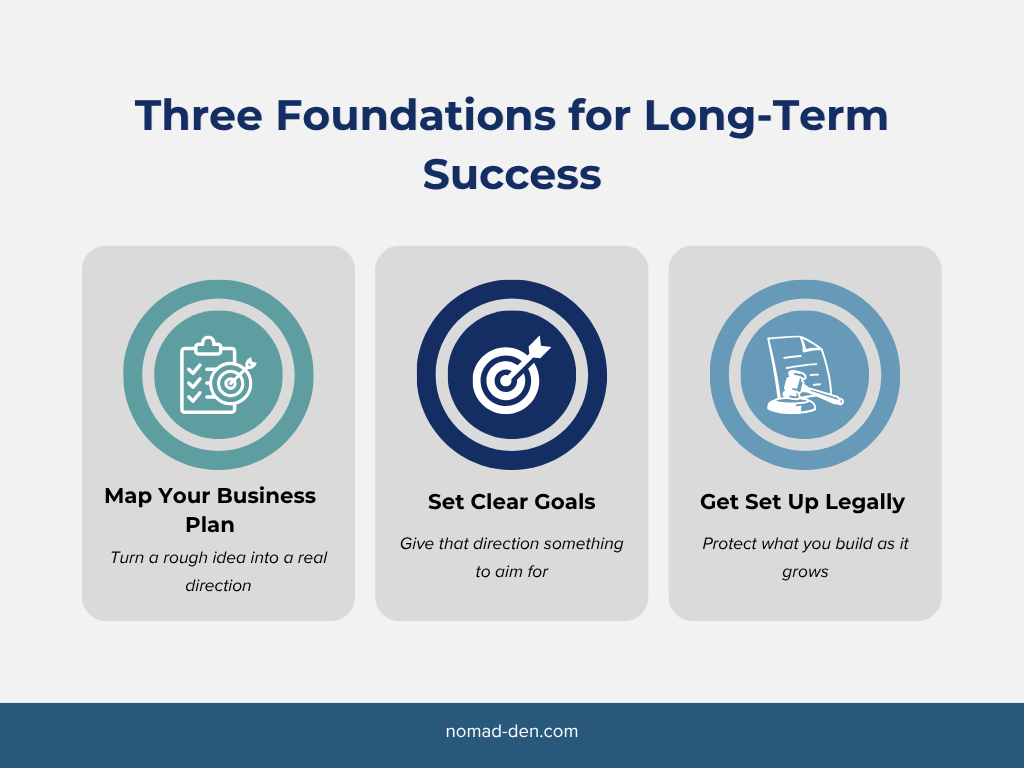
Creating a Business Plan
A business plan gives you a concrete path from concept to execution instead of a vague direction. It forces you to think through what you’re actually building, who it’s for, and how it makes money, before you’ve sunk time into building it.
Setting Achievable Goals
Once your plan is in place, outline it into specific, measurable, and realistic goals. Vague ambitions like “grow my business” are easy to abandon; a goal like “publish two posts a week for three months” isn’t. Start with short-term, actionable steps, and adjust the goals as your business and priorities change.
Want a framework for setting goals you’ll actually track? Measure What Matters breaks down OKRs (Objectives and Key Results), the goal-setting system Google popularized, and how to apply it to your own business.
Legal and Tax Considerations
Many entrepreneurs put off thinking about the legal side of running an online business, but a few basics are worth handling early. If you’re promoting affiliate offers or sponsored content, FTC compliance is the first thing to get right. Our guide on writing a compliant affiliate disclosure covers exactly what’s required. For a deeper dive into staying compliant more broadly, the book Don’t Say That is a useful read.
It’s perfectly acceptable to start your online business as an individual. However, as your business grows, setting it up legally, such as forming an LLC, becomes essential. LegalZoom and Rocket Lawyer are experts in providing legal services and can assist when you’re ready.
Depending on how you set up your business (see above), make sure you understand the tax implications of your new venture.
Note: I’m not a legal or tax professional. The above information is general and based on experience. Always consult a qualified expert when making legal or financial decisions.
Building an Online Presence
Your online presence is what makes it possible for potential customers to find you in the first place, and what makes them trust what they find once they do. A website, active social profiles, and consistent content all work together to establish you as a real, credible source, not just another link in someone’s feed. That combination, content built around a real strategy rather than posted at random, is what content marketing actually is.
Website or Landing Pages
Your website or landing page is often someone’s first real impression of your business, so it needs to load fast, be easy to navigate, and actually be built to convert, not just look nice. For most beginners, WordPress is the most practical long-term starting point: flexible, strong SEO support built in, and it scales as your needs grow. My WordPress setup guide walks through the full process, including the security plugins worth installing from day one, since a site collecting visitor or customer data is also a site worth protecting.
If you’d rather start with something simpler and free, Systeme.io bundles a basic website builder in with funnels, email, and course hosting, which can be helpful for testing an idea before committing to a full WordPress build.
Social Media
Social media isn’t mandatory, but skipping it means missing one of the largest, lowest-cost channels available for reaching new people. The real challenge isn’t whether to use it, it’s staying consistent without burning out trying to post everywhere every day. My guide to social media scheduling tools covers how to build a sustainable system instead of chasing daily consistency manually.
SEO (Search Engine Optimization)
SEO helps people find your website or landing pages through search engines. It takes time to build, but it’s one of the most reliable ways to generate consistent, long-term organic traffic instead of relying on one-off spikes, like a viral video.
Tools like Ahrefs and Mangools can help you research keywords, analyze competitors, and track performance over time. SEO isn’t about quick wins, it’s about building visibility that compounds as your content grows. If you want the bigger picture of how SEO itself has changed in recent years, SEO Is Dead… Or Is It? is a lighter read on where things stand now.
Mangools is the SEO tool suite I recommend for beginners: it’s more user-friendly and affordable than most competitors in the space. See the full walkthrough of how it can support your strategy.
Email Marketing
Once you have a website or landing page set up, start building an email list. Unlike a following on social media, your list is something you actually own. Used well, it also becomes one of the most reliable ways to turn casual visitors into customers, provided you’re collecting and storing that data responsibly in the first place.
My Email Marketing Essentials guide breaks down the platforms worth considering, how automation multiplies your results, and the list hygiene habits that keep your emails landing in inboxes instead of spam folders.
Customer Service
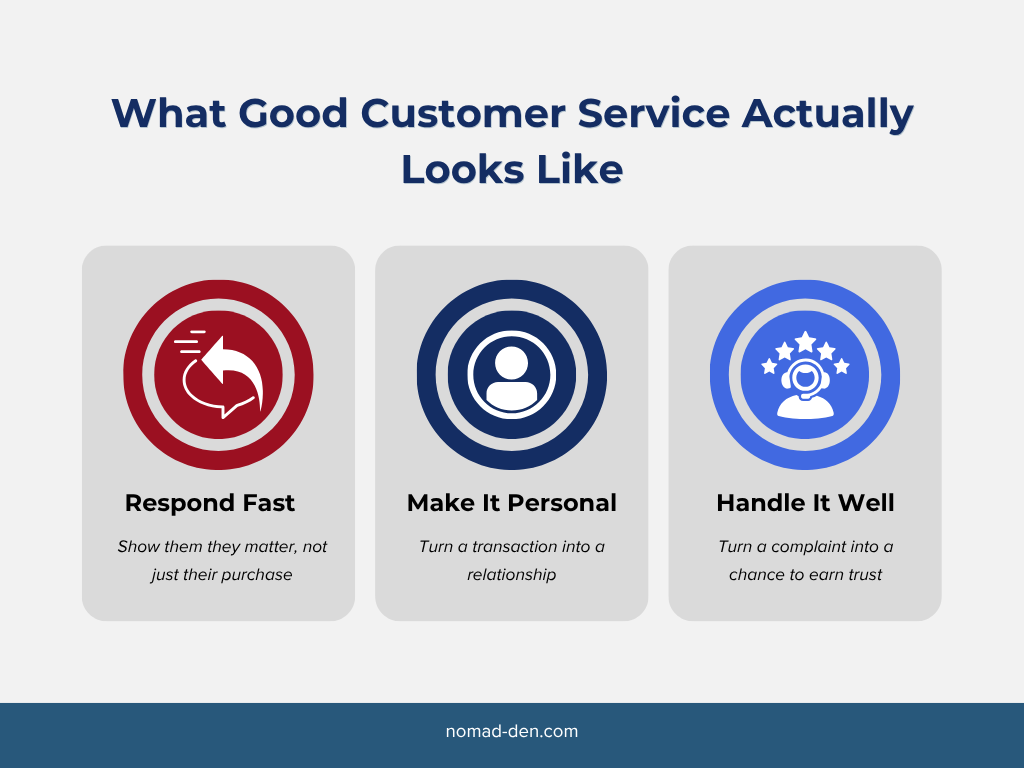
As your business grows, customer service becomes one of the clearest ways to stand out. It’s often the difference between someone buying once and someone coming back, or telling a friend. A few habits make the biggest difference:
Responsiveness
Responding quickly to inquiries, complaints, or feedback tells your customer that you value them, not just the sale. A fast reply doesn’t need to be a full resolution: even a quick acknowledgment that you’ve seen their message and are looking into it buys goodwill while you sort out the real answer.
AI chatbots can help you respond to routine questions instantly, especially outside business hours, but they’re not a substitute for a real person when someone has an actual problem. Use them to acknowledge and triage quickly, not to replace the option to talk to someone.
Personalization
Personalization makes an interaction feel like it’s between two people, not a form response. Using someone’s name, referencing a past purchase, or tailoring a recommendation to what they’ve actually bought goes a long way, but that only works if you’re handling their information carefully in the first place. Store what you actually need to personalize the experience, not everything you could collect, and be clear about how it’s used.
How to Handle Complaints
Every business gets complaints eventually. What sets one apart isn’t avoiding them: it’s how they’re handled. Listen first before responding, acknowledge what went wrong without getting defensive, and focus on an actual fix rather than a scripted apology. Handled well, a complaint can turn into one of your most loyal customers; handled poorly, it becomes a public review.
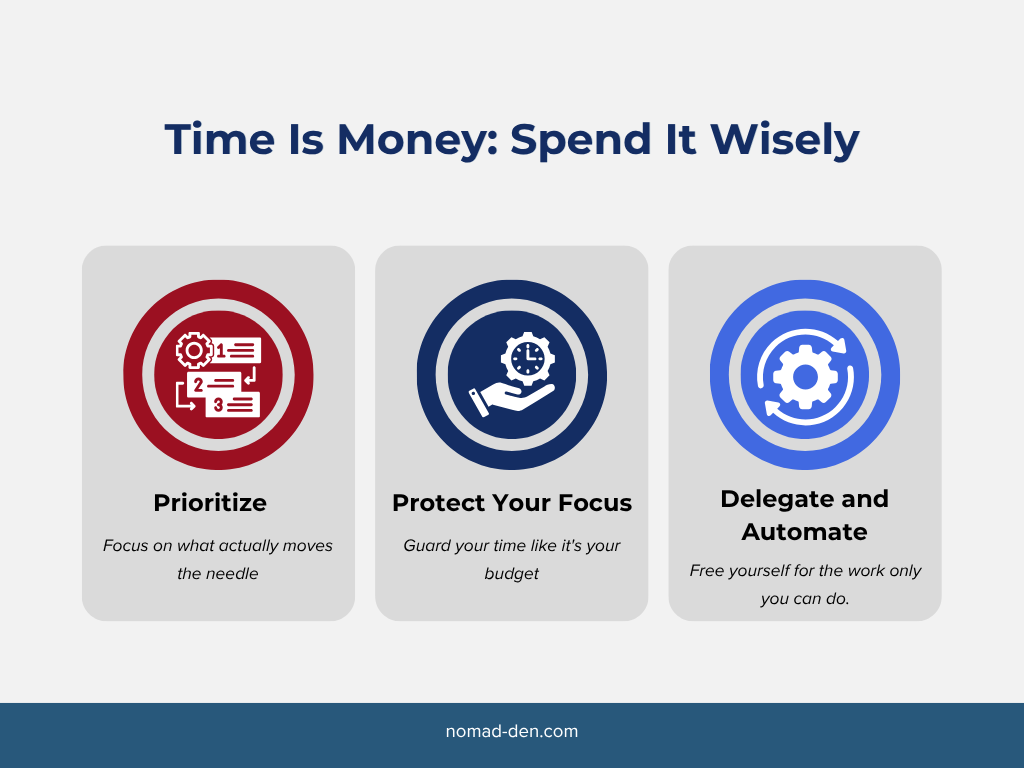
Time Is Money: Manage it Accordingly
Proper management of both your time and finances is integral to the success of your business. Monitoring the flow of money in and out, managing invoices, and planning for future expenses all help you make informed decisions and avoid costly mistakes. Free accounting tools like Wave can streamline this process and keep your finances organized without adding another monthly expense early on.
At the same time, running an online business often means juggling multiple tasks. Developing strong time management and prioritization skills is just as important as financial management. Here are some key strategies to help manage your time effectively:
Prioritize
Not every task deserves the same amount of attention. A simple way to sort them: ask whether something is urgent, important, both, or neither. This is the logic behind the Eisenhower Matrix, tasks that are both urgent and important get done first, important-but-not-urgent tasks get scheduled deliberately instead of squeezed in around everything else, and anything that’s neither is a strong candidate to delegate, automate, or drop entirely.
Revisiting that list weekly keeps you working on what actually moves the business forward instead of whatever feels most pressing in the moment.
Stay Focused and Organized
Working from home has its own unique challenges, often filled with distractions that don’t exist in a traditional office. Setting clear work hours and consistently blocking out time for specific tasks helps protect your focus and keeps the workday from bleeding into the rest of your life.
Delegate and Automate
As your business grows, trying to do everything yourself becomes the bottleneck. Delegating and automating solve the same problem two different ways: freeing up your time for the decisions only you can make. Routine or specialized work, design, editing, and admin tasks, can go to a freelancer through a platform like Fiverr, while repetitive processes like email sequences, social scheduling, and customer follow-ups can run on automated triggers through one of seven tools covered in the productivity tools rundown. Between the two, most of the work that keeps you busy eats into your day doesn’t need to be done by you directly.

Mindset and Resilience
Building an online business tests your patience long before it tests your skills. Progress is rarely linear, plenty of weeks will feel like nothing is working, and the businesses that make it through aren’t necessarily the ones with the best idea, they’re the ones that kept showing up through the slow, uncertain middle. A few habits make that easier to sustain:
Learn From Setbacks, Adapt as You Go
Failure isn’t the opposite of progress, it’s usually part of it. Something you overlooked, tested wrong, or hadn’t considered yet gets revealed each time something doesn’t work, and that’s information you didn’t have before. The businesses that last aren’t the ones that avoid setbacks, they’re the ones that treat each one as a signal to adjust rather than a reason to quit, staying open to new tools or strategies while keeping what’s already working.
Patience and Consistency
Building a successful business takes time, and there’s no shortcut around that. What gets you through the slow stretches isn’t motivation, it’s discipline: setting clear goals, sticking to a consistent routine, and letting the data, not the calendar, tell you when something actually needs to change. Progress compounds quietly before it becomes visible, which is exactly why so many people quit right before it would’ve paid off.
Seek Support
Surround yourself with people who support what you’re building, and don’t be afraid to create some distance from those who consistently discourage it. You don’t have to do this alone. The right people around you can offer encouragement, perspective, and occasionally the push you need when motivation runs low.
FAQs
Conclusion: Build With Intention, Not Shortcuts
Building an online business isn’t about chasing trends, shortcuts, or overnight success. It’s about choosing a model that fits your goals, understanding your audience, and committing to consistent, focused effort over time. The strategies outlined in this guide are designed to help you build something real. Not just traffic, but a business with direction, structure, and longevity.
By focusing on strong foundations, smart planning, and ethical growth, you give yourself a far better chance of long-term success. Start where you are, use the tools available to you, and refine your approach as you gain experience. Progress compounds when effort is applied consistently and with intention.
Some links in this post may be affiliate links. I may earn a commission at no extra cost to you. Learn more here.
Continue Reading Related Posts

How to Validate a Business Idea Before Wasting Months Building It
When you come up with an idea for an online business, you’re anxious to make…

6 Affiliate Niches That Last (And Beginners Can Start Today)
Most people pick an affiliate niche based on what’s trending right now. While that may…
Digital Marketing Guide: Where to Start and How It Works
Digital marketing is the promotion of products or services using digital channels such as search…

Content Creation vs Content Marketing: What’s the Difference?
Content creation is producing content. Content marketing is strategically using the content you produced to…
The Only Free Tools You Need to Launch (Before You Upgrade)
Having a limited budget — or the discipline to stick to one — is actually…
Beginner’s Guide to Selling Digital Products (Low-Cost)
One of the most practical ways to earn income online, whether you’re starting a side…