

Some links in this post may be affiliate links. I may earn a commission at no extra cost to you.
The best platform for selling digital products depends on where your audience already is. Stan Store fits creators selling straight from a social bio, SendOwl fits anyone who already has a website, Beacons fits creators who want content, digital products, and affiliate links managed from one place, and Systeme.io fits people building a full online business from scratch.
Social media now reaches 5.79 billion people, or about 70% of the world’s population, most of it concentrated on four platforms: YouTube, Facebook, Instagram, and TikTok. Whichever of those you’re already using to reach people is the best signal for which sales platform actually fits you.
Platforming Your Opportunity
Reaching an audience is only half the equation. Converting that audience into paying customers is the other. A following on social media or a website only becomes revenue once there’s a clear and simple path for people to actually buy from you. That’s the gap all four platforms below are built to close, each one just closes it differently depending on where your audience already lives.
Don’t have that audience built out yet? Our digital marketing guide walks through where to start before a sales platform even matters.

The Importance of Choosing the Right Platform
Selling digital products online comes down to three things working correctly: how you get paid, how the product reaches the buyer, and what happens after the sale. Get any one of them wrong and it costs you money, trust, or both.
- Payment Processing: Your platform is handling real financial data on your behalf, so a security failure here is a data breach, not just an inconvenience. Look for PCI-compliant processing through Stripe or PayPal rather than a platform that touches card numbers directly, and confirm refunds are handled inside the platform instead of over email.
- Product Delivery: Automated delivery through download links that automatically expire, or through license keys protects both sides, your customer gets instant access, and you get some protection against a link getting screenshotted and passed around for free.
- Customer Management: A built-in inbox or support ticketing system keeps buyer questions and refund requests out of your DMs and personal email, where they’re easy to lose track of.
Getting these three right isn’t just about running a smoother operation. It’s what keeps your business, and your customers’ payment data, actually secure.
Stan Store: A Platform for Social Media Entrepreneurs
Stan.store is a link-in-bio storefront built for social media creators who want to sell digital products directly from their profile, without needing a separate website. Key features include:
- Simple store setup: An intuitive, mobile-friendly setup process lets followers browse and buy directly from your bio link, no separate website required.
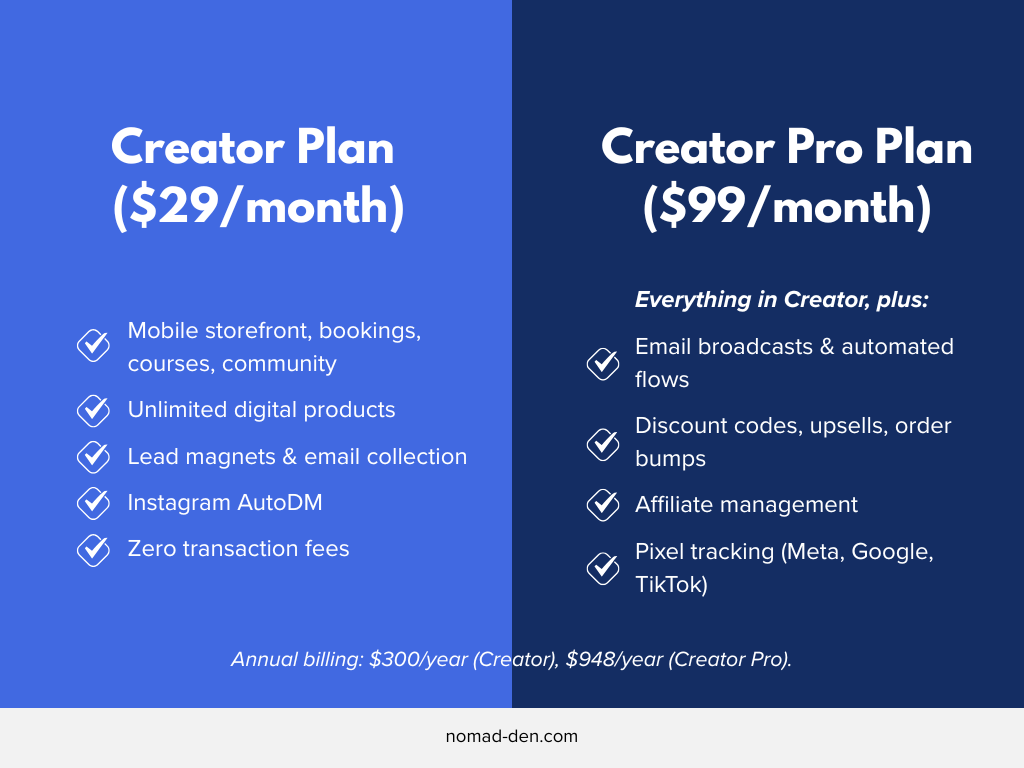
- Two-tier pricing: The Creator plan ($29/month) covers the storefront, products, and bookings. Email marketing, funnels, discount codes, and affiliate management are reserved for Creator Pro ($99/month).
- Payment processing: Stan integrates directly with major processors, so transactions and payouts are handled without a separate merchant account.
- Affiliate management (Pro plan): Build your own affiliate program and set commission rates to expand reach through other creators.
- Analytics and customer management: Built-in analytics track sales and customer behavior, making it easier to see what’s actually converting.
Stan’s biggest strength is how directly it plugs into social media. An intuitive, mobile-friendly setup lets creators start selling from their bio link within minutes, and customers can buy from any device without leaving the platform they found you on. The tradeoff shows up as you grow: product customization is more limited than dedicated e-commerce platforms, and transaction fees run higher than some alternatives, which can eat into margins on lower-priced digital products.
Try Stan.store free for 14 days. No cost, cancel anytime.
SendOwl: Simple, Effective, and Focused
SendOwl is built for creators who want to sell digital products securely without building a full e-commerce site. It’s a popular choice for anyone who already has a website or wants a lightweight, dedicated checkout just for digital delivery. Key features include:
- Direct integration with popular payment gateways: SendOwl connects with Stripe and PayPal for secure, reliable transactions.
- Secure digital delivery: License keys, PDF stamping, and time-limited download links help prevent your products from being freely shared or pirated.
- Full feature access on every plan: SendOwl removed gated access to features across the board in early 2026, every tier now gets unlimited products and storage. Plans differ by order volume instead: Launch ($39/month, up to 5,000 orders/year) through Business ($299/month, up to $200K in annual sales).
SendOwl’s strength is how little setup it asks for: strong security and flexible payment options without needing a full storefront. The tradeoff is there is no built-in email marketing, so staying in touch with customers after the sale means connecting an outside tool like GetResponse.
Get started with SendOwl today. 7-day free trial, no commitment.

Beacons: A Platform for Creators, Content, and Community
Beacons.ai is a link-in-bio platform built for creators who want content, digital products, and affiliate marketing managed from the same page. Rather than functioning as just a store or a bio link, it works more like a home base, combining a media kit, storefront, and email tools in one place. Key features include:
- Media kit for brand deals: Auto-updating stats and audience demographics creators can share directly with brands pitching sponsorships.
- Built-in affiliate marketplace: Beacons connects creators to a marketplace of affiliate products they can promote from their page, alongside whatever they sell themselves.
- Digital product sales: Sell ebooks, templates, and courses, with video hosting available on paid tiers, from the same page driving social traffic.
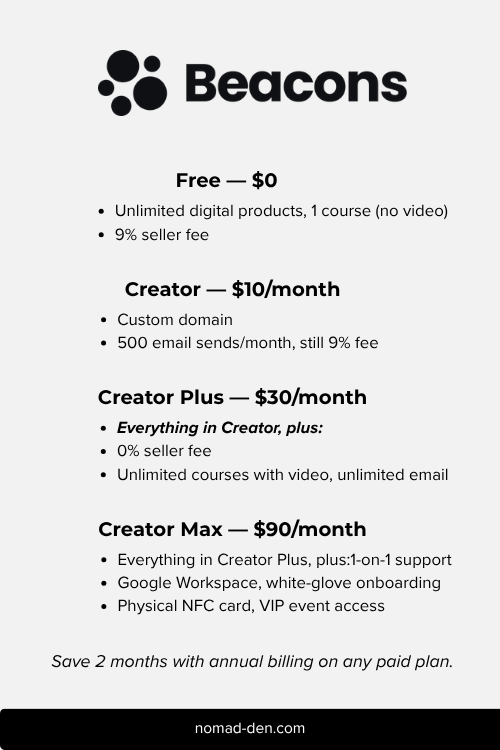
- Tiered transaction fees: The free plan charges a 9% fee per sale. That drops to 0% starting on the Creator Plus plan ($30/month).
Beacons’ strength is breadth: it’s the only platform here pairing a media kit and affiliate marketplace with product sales, useful for creators earning through brand deals and their own products at the same time. The tradeoff is that free-plan fee, which adds up fast at any real sales volume, and the mobile-first block editor can feel cramped for more complex page layouts, better handled from a desktop.
Try Beacons free. No credit card required.
Systeme.io: The Ultimate All-In-One Starter Kit
Systeme.io is a full digital marketing suite built for entrepreneurs who want a complete online business, not just a place to list products. It combines funnels, email marketing, and automation in one platform, cutting out the cost and hassle of stitching separate tools together.
Unlike link-in-bio platforms, Systeme.io treats a link-in-bio funnel as one feature among many rather than the core of its design. Key features include:
- Funnel-Building: A user-friendly, budget-priced funnel builder, a practical entry point if you want to avoid the steep learning curve of more advanced tools.
- Email Marketing: Build campaigns triggered by opt-ins, with room to scale into integrations like ActiveCampaign as your list grows.
- Affiliate Management: Run a custom affiliate program for digital or physical products, and set your own commission rates.
- Automation: Add rules and workflows that trigger automatically based on customer behavior, no separate automation platform required.
- E-commerce Integration: Sell physical and digital products from the same dashboard, with built-in product pages, inventory, and payments. For the fuller breakdown of digital vs. physical, see our e-commerce guide.
For a deeper dive into Systeme.io’s versatility as an all-in-one marketing platform, check out our previous post.
Systeme.io’s biggest advantage is price relative to what’s included: funnels, email, and automation that would cost far more stacked separately elsewhere, plus a genuinely free tier to actually start on. The tradeoff shows up as you scale, advanced customization and polish lag behind platforms built exclusively for one job, so businesses with more complex needs will eventually outgrow it.
Build your online business with Systeme.io for free. No obligation to upgrade, no time limit.

Choosing a platform solves how you’ll sell. It doesn’t solve what you’re selling, and that’s the part most guides skip. Whatever platform you land on, from Stan’s social-first storefront to Systeme.io’s full marketing suite, the product itself still has to look professional enough that someone’s willing to pay for it.
How Do I Design Digital Products?
If you’re creating your own digital products rather than promoting someone else’s through affiliate marketing, you’ll need to design them yourself. Canva is the tool most creators reach for.
Canva offers millions of templates covering everything from ebooks and social graphics to YouTube banners. Its brand kit saves your fonts, colors, and logo in one place, so every product you make stays visually consistent without rebuilding it from scratch each time. Team members can be added as you scale, and the platform is free to start, with a paid Pro tier for advanced features.
Maintain Consistency Through Your Marketing
Inconsistent posting is one of the fastest ways to lose the audience a platform depends on. A following built on social media only stays engaged if content keeps showing up, and manually posting to every platform every day isn’t sustainable once you’re also running a store.
SocialPilot handles that by scheduling and publishing across platforms in bulk, with analytics and team collaboration built in. It’s especially useful for solo creators managing several accounts without the time to post to each one manually. For a deeper system to avoid burning out on this entirely, our guide to social media scheduling tools covers five options and how to batch content effectively.
Save hours every week with SocialPilot’s scheduling and tracking tools. Try it for free.


Platform Comparison of Features
| FEATURES | Stan.store | SendOwl | Beacons.ai | Systeme.io |
|---|---|---|---|---|
| Type | Link-in-Bio Platform | Link-in-Bio Platform | Link-in-Bio + Media Kit | All-in-One Marketing Platform |
| Free Plan/Trial | 14-Day Free Trial | 7-Day Free Trial | Free Forever (9% fee) | Free Forever Plan |
| Starting Price | $29/mo. | $39/mo. | $10/mo. | $17/mo. |
| Email Marketing | Basic | Integration Only | Basic | Basics + Automations |
| Funnels | Link-in-Bio Funnel | None | None | Complete Funnel Builder |
| Analytics | Sales Tracking | Delivery & Sales | Traffic & Media Kit | Sales & Advanced |
| Affiliate Program | Yes | Yes | Yes (12K brand marketplace) | Yes |
| Best For | Content Creators | Digital Product Sales | Brand Deals & Media Kits | Complete Online Businesses |
Pricing and plan details are current as of publication but may change. Check each platform’s pricing page for the latest rates, and note that annual billing typically costs less than paying monthly on all four platforms above.
FAQs
Conclusion
Choosing between these four platforms comes down to matching the tool to what you’re actually building, not picking whichever one has the most features. Stan and Beacons fit creators selling straight from a social profile, SendOwl fits anyone who already has a website, and Systeme.io fits people building a full online business from the ground up.
The only way to know for sure is testing one against your own audience. A week of real use will tell you more than another comparison post ever could.
Some links in this post may be affiliate links. I may earn a commission at no extra cost to you. Learn more here.
Continue Reading Related Posts
How to Use Social Media Scheduling Tools to Grow Without Being Online 24/7
There’s a version of social media growth that gets sold constantly: post more, post everywhere,…
SEO Tools for Beginners (Free + Paid): The Only Stack You Need (2026)
As long as people are searching for information online, SEO (search engine optimization) will remain…
Digital Marketing Guide: Where to Start and How It Works
Digital marketing is the promotion of products or services using digital channels such as search…
Top 5 Tools Every Online Business Owner Needs
Most online businesses are built on five foundational tool categories: a domain and hosting, a…
Build an Online Business (Free) With Systeme.io
Systeme.io is a free all-in-one marketing platform that consolidates the tools most online entrepreneurs need…
Email Marketing Essentials: Platforms, Automation, and List Hygiene
Email marketing means sending targeted messages directly to people who’ve opted in to hear from…