
Some links in this post may be affiliate links. I may earn a commission at no extra cost to you.
Table of Contents
- What Is a Digital Nomad Visa?
- What Most Digital Nomad Visas Require
- Digital Nomad Visa Options by Country in 2026
- Portugal (D8 Visa)
- Spain (International Telework Visa)
- Estonia (Digital Nomad Visa)
- Thailand (Destination Thailand Visa)
- Japan (Digital Nomad Visa)
- Indonesia (E33G Remote Worker Visa, Bali and beyond)
- Costa Rica (Estancia para Trabajadores Remotos)
- Colombia (Digital Nomad Visa)
- Mexico (Temporary Resident Visa)
- Digital Nomad Visas and Taxes: What Most Guides Get Wrong
- How to Avoid Digital Nomad Visa Scams
- Protecting Your Data and Identity While You Apply and Once You’re Abroad
- How to Choose the Right Digital Nomad Visa for You
- FAQs
- Conclusion
- Related Posts
A digital nomad visa is a temporary residency permit that lets you legally live in another country while working remotely for employers or clients based elsewhere. More than 60 countries now offer one, and the details vary greatly: some hand out a visa in weeks with a modest income threshold, while others demand six figures in savings and a formal interview. This guide breaks down nine of the most established programs in 2026, what they actually require, and the tax and security questions most guides skip entirely.
A quick note before you read further: I am not a lawyer or a licensed immigration consultant, and this isn’t legal or immigration advice. What follows is a plain-language summary of publicly available guidance, meant to help you understand the basics, not to replace professional counsel for your specific situation. If you need advice tailored to your circumstances, speak with a licensed attorney or immigration professional.
What Is a Digital Nomad Visa?
A digital nomad visa is different from a tourist visa in one important distinction: it makes remote work legal. Tourist visas and visa-free entry stamps typically prohibit any form of work, paid or unpaid, regardless of where your employer or clients are based. Technically, opening your laptop and doing your job while on a 90-day tourist stay violates the terms of that stay in most countries, even if no one ever checks.
That’s the problem a digital nomad visa solves, as it grants legal cover in exchange for proof of income, health insurance, and a clean background check.
It’s also distinct from a standard work visa, which usually requires local sponsorship from an employer inside the country. Digital nomad visas require the opposite: proof that your income comes from outside the country, often capped at 15 to 25 percent local client work if any is allowed at all.
What Most Digital Nomad Visas Require
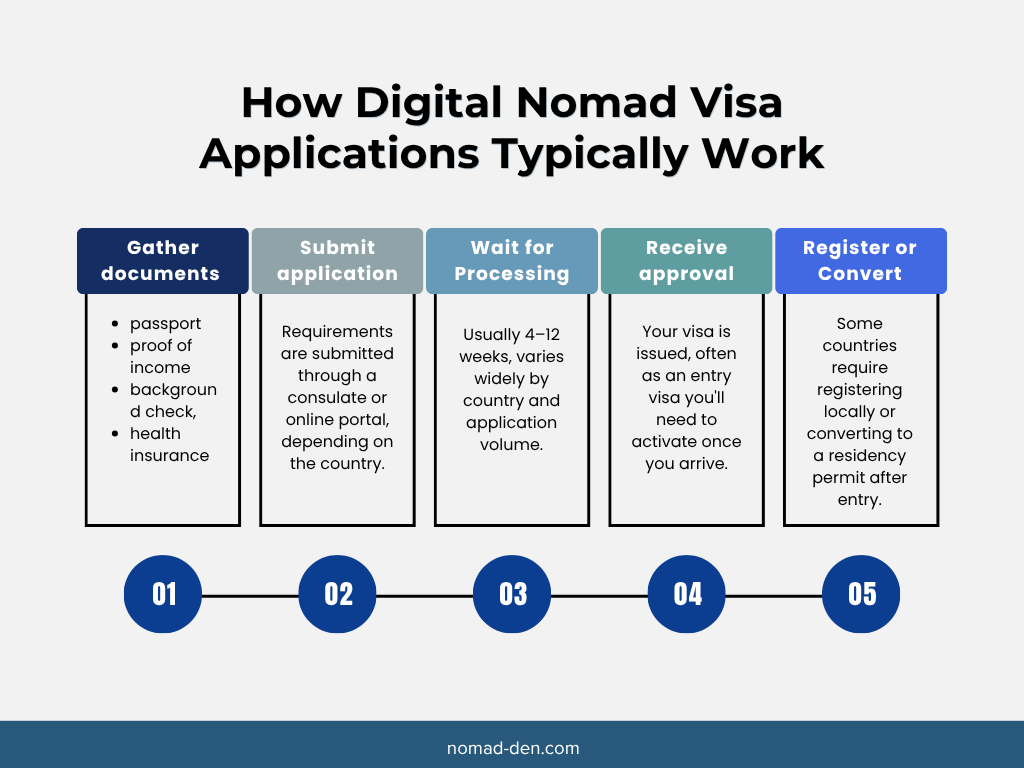
Application requirements differ by country, but the primary checklist of items is consistent almost everywhere:
- Proof of remote income (employment contract, freelance invoices, or business registration)
- A minimum monthly or annual income threshold
- Private health insurance valid for the visa’s full duration
- A clean criminal background check, usually issued within the last 3 to 6 months
- A valid passport for several more months
- An application fee, typically $50 to $200
Some countries add a degree or professional experience requirement, a minimum applicant age, or a cap on how many days per year you’re allowed to spend outside the country while holding the visa. The comparison table and each country’s summary below note which of these extra requirements apply.
Digital Nomad Visa Options by Country in 2026
These nine represent some of the most established and widely searched digital nomad visa programs, chosen for range as much as popularity, from Portugal’s long-term settlement path to Japan’s tighter, shorter-term option.
| Country | Visa | Duration | Income Requirement | Family Allowed |
|---|---|---|---|---|
| Portugal | D8-Visa | 1 year, renewable up to 5x, or 2-year residency permit | ~€3,480/month | Yes |
| Spain | International Telework Visa | 1 year (consulate) or 3 years (in-country) | ~€2,849/month | Yes |
| Estonia | Digital Nomad Visa | Up to 12 months | ~€4,500/month | Yes |
| Thailand | Destination Thailand Visa (DTV) | 5-year multiple entry, 180 days per stay | 500,000 THB in savings | Yes (dependents) |
| Japan | Digital Nomad Visa | 6 months, non-renewable | ~¥10,000,000/year | Yes |
| Indonesia | E33G Remote Worker Visa | Up to 12 months | ~$60,000/year recommended | Yes |
| Costa Rica | Estancia para Trabajadores Remotos | 1 year, renewable | $3,000/month | Yes |
| Colombia | Digital Nomad Visa (Visa V) | Up to 2 years | ~$1,400/month | Yes |
| Mexico | Temporary Resident Visa | 1 year, renewable up to 4 years | ~$4,300–4,700/month | Yes |
Figures are approximate USD conversions and fluctuate with exchange rates. For current conversions, use a currency converter like xe.com.
Portugal (D8 Visa)
- Temporary stay visa valid 1 year, renewable up to 5 times
- Long-term route: initial 4-month visa converts to a 2-year residency permit, renewable, with a path to permanent residency after 5 years
- Income threshold roughly €3,480/month, tied to Portugal’s minimum wage and adjusted annually
- Proof of accommodation for at least 1 year required
Portugal remains the most established option on this list, and its long-term route is the only one here with a clear path to citizenship. That’s the trade-off worth weighing: more paperwork upfront, but a genuine settlement pathway rather than a renewable extension. Portugal’s official visa requirements
Spain (International Telework Visa)
- 1 year if applying through a Spanish consulate, or 3 years if applying from inside Spain, renewable up to 5 years total
- Income threshold €2,849/month gross, calculated at 200% of Spain’s minimum wage
- No more than 20% of income may come from Spanish clients
- A university degree or 3 years of relevant work experience required
Spain’s visa is unusual for capping how much local client work is allowed, which most other countries on this list don’t specify at all. That 20% ceiling matters if you have any Spain-based clients or side income. Spain’s official digital nomad visa page.
Estonia (Digital Nomad Visa)
- Type D long-stay visa valid up to 12 months, non-renewable, though a second application is possible
- Income threshold roughly €4,500/month, with 6 months of income history required
- Health insurance must carry at least €30,000 in coverage
- Grants Schengen travel access for the visa’s duration
Estonia launched the first dedicated digital nomad visa in the EU back in 2020, and its process still reflects that head start: streamlined, well-documented, and less prone to the ambiguity that newer programs carry. Republic of Estonia E-residency page.
Thailand (Destination Thailand Visa)
- 5-year multiple-entry visa, up to 180 days per entry, extendable once for another 180 days
- Requires 500,000 THB (roughly $14,000–15,000) in personal savings, seasoned for at least 3 months
- Falls under a special tourist visa category, not a residency permit; local work permits and Thai employment are prohibited
- Must be applied for from outside Thailand through the official e-visa portal
The DTV’s 5-year validity makes it look like the longest visa on this list, but the 180-day-per-entry cap means it’s really a repeated-entry system, not a continuous stay. Thailand’s official e-Visa portal.
Japan (Digital Nomad Visa)
- 6 months only, non-renewable; applicants must leave Japan before reapplying
- Income threshold roughly ¥10,000,000/year (about $67,000–70,000)
- Limited to nationals of roughly 50 countries with tax treaties and visa-exempt agreements with Japan
- No path to renewal or residency through this visa category
Japan has the highest income requirement and the shortest, non-renewable window, of any country on this list, which makes it more of a short-term experience than a genuine long-term base. Anyone comparing options purely by ease of approval should treat Japan as the outlier here, not the baseline. Japan’s Ministry of Foreign Affairs digital nomad visa guidance.
Indonesia (E33G Remote Worker Visa, Bali and beyond)
- Grants up to 12 months of residency (KITAS) for remote workers employed by companies outside Indonesia
- Recommended income around $60,000/year, with most agents citing at least $2,000/month in verifiable bank statements
- Applied for through Indonesia’s official e-visa portal, then converted to a residency card after arrival
- Working remotely on a tourist visa is illegal, and enforcement tightened substantially through 2026, with regular sweeps and deportations in nomad-heavy areas like Canggu and Seminyak
Bali’s popularity created a long-running workaround culture of working on tourist visas, but that’s no longer a safe bet. 2026 enforcement data shows hundreds of deportations tied specifically to unauthorized remote work, which makes the E33G less optional than it used to be. Indonesia’s official immigration e-visa portal.
Costa Rica (Estancia para Trabajadores Remotos)
- 1-year visa, renewable for a second year
- Income threshold $3,000/month for individuals, $4,000/month for families
- Costa Rica’s territorial tax system exempts foreign-source income from local tax
- Long-term health insurance required; standard travel insurance doesn’t qualify
Costa Rica’s territorial tax system is one of the more overlooked advantages here, since it means visa holders generally owe nothing locally on income earned from outside the country. Costa Rica’s Dirección General de Migración y Extranjería.
Colombia (Digital Nomad Visa)
- Type V visa, with reported validity up to 2 years
- Income threshold roughly $1,400–1,600/month, tied to Colombia’s minimum wage and increased for 2026
- Some sources note a limit on how many consecutive months a holder can be absent from Colombia without risking cancellation
- Family members can be included with proof of relationship
Colombia’s income threshold rose noticeably for 2026 after a 23% increase to the national minimum wage, so figures from last year’s guides are already out of date. Colombia’s Ministry of Foreign Affairs visa portal.
Mexico (Temporary Resident Visa)
- Mexico has no dedicated digital nomad visa; remote workers use the Temporary Resident Visa instead, granted on proof of financial self-sufficiency
- Initial grant of 1 year, renewable annually up to 4 years total, after which permanent residency becomes available
- Income or savings thresholds vary significantly by consulate, generally in the range of $2,500–$4,400/month or $40,000–$70,000+ in savings
- Must be applied for at a Mexican consulate outside Mexico; cannot be started from within the country
Mexico is the most commonly misunderstood entry on this list, since so many guides describe it as having a “digital nomad visa” when no such category actually exists. The Temporary Resident Visa works, but the process and thresholds depend heavily on which consulate handles the application. Mexico’s official consular services portal.
Digital Nomad Visas and Taxes: What Most Guides Get Wrong
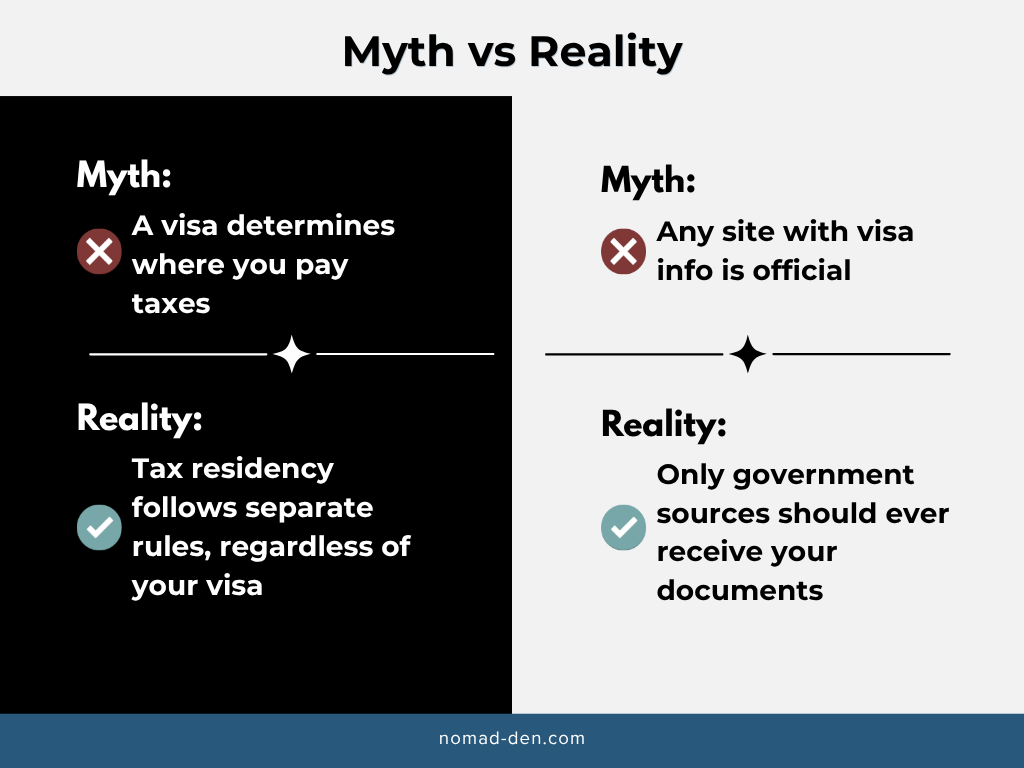
Holding a digital nomad visa says nothing about where you owe taxes. Immigration status and tax residency are governed by completely separate rules, and conflating them is one of the most common mistakes people make when planning a move.
Most countries apply a 183-day rule: spend more than half the year physically present, and you typically become a tax resident there, regardless of what your visa is called. That triggers local tax obligations on top of whatever you already owe at home.
For U.S. citizens, the obligation is even broader. The U.S. taxes citizens on worldwide income no matter where they live. The Foreign Earned Income Exclusion can offset a meaningful portion of that, up to $132,900 per person for tax year 2026, but only for people who qualify under the bona fide residence test or the physical presence test (330 full days abroad in a 12-month period). It doesn’t eliminate the filing requirement, and it doesn’t apply automatically.
How to Avoid Digital Nomad Visa Scams
The visa application process itself is a target for fraud, not just something to get through safely once you’re approved. Fake immigration consulting sites routinely charge for forms and information that official government sources provide for free, and some go further, collecting passport scans, bank statements, and other sensitive documents under the guise of “processing” an application that was never real.
The U.S. State Department has issued repeated warnings that official visa information only comes from websites ending in .gov, and that any site promising expedited processing for an extra fee should be treated as suspicious. The same logic applies to every country on this list: the immigration portal, consulate, or embassy website is the only source that should ever receive your actual documents.
Protecting Your Data and Identity While You Apply and Once You’re Abroad
Applying for a digital nomad visa means handing over more personal data than almost any other process you’ll go through as a remote worker.
Before You Apply
Visa applications generate a lot of exposure fast. You’re creating accounts on multiple government portals, submitting scanned copies of your passport and financial records, and often repeating that process across several consulates if you’re comparing countries.
A password manager keeps each of those portal logins unique and out of your memory, which matters more than usual here given how many separate government systems are involved. One password to remember, hundreds of secure ones generated for you. Get NordPass and secure your logins.

And because visa paperwork tends to circulate through third-party agents, consultants, and sometimes data brokers, a service that actively removes your personal information from broker databases adds a layer most applicants never think to check for.
Once You’re Living Abroad
Public Wi-Fi in co-working spaces, cafes, and short-term rentals is where most of the real exposure happens, especially when you’re logging into home-country banking or the visa renewal portal from an unfamiliar network. A VPN encrypts that connection before it ever leaves your device. Get NordVPN before you connect to another public network.

Landing in a new country without reliable, secure connectivity on day one is its own risk, particularly if you need to verify a banking login or respond to an embassy request before you’ve sorted out a local SIM. An eSIM built for international travel solves that gap immediately on arrival.
Lost or stolen documents during a visa process carry a higher identity theft risk than most people plan for, since a single passport scan and bank statement combination is enough to open fraudulent accounts in your name. Identity theft protection and monitoring covers you during the months your documents are moving between consulates, agents, and immigration offices, when identity theft is hardest to catch early.

How to Choose the Right Digital Nomad Visa for You
Most people land on a country first, pulled in by cost of living, safety, climate, or how easy it is to get around, and only check the visa mechanics once a destination already has their interest. That’s a reasonable place to start. But once a country’s on your shortlist, these five factors determine whether the move is actually realistic:
- Income fit: match your actual monthly income against the threshold, not just the headline figure, since most countries want 3 to 6 months of consistent proof
- Family needs: confirm the per-dependent income increase before assuming a family visa is affordable
- Tax treatment: territorial tax systems (Costa Rica) differ meaningfully from worldwide-income systems, and neither replaces your home-country filing obligations
- Duration and renewal: a 6-month non-renewable visa (Japan) serves a different purpose than a 5-year renewable path (Portugal)
- Approval timeline: processing ranges from a few weeks to several months depending on the country and consulate
None of these factors work alone. A destination that checks every lifestyle box still needs a visa that fits your income and timeline, or the move doesn’t happen.
FAQs
Conclusion
A digital nomad visa turns remote work abroad from a legal gray area into an authorized, documented stay. The nine countries covered here range from Portugal’s multi-year path to residency to Japan’s tighter six-month window, and the right fit comes down to your income, your tax situation, and how long you actually want to stay in one place. None of that replaces checking the current official requirements before you apply, since thresholds and processing rules shift from year to year.
What doesn’t shift is the exposure that comes with the process itself. Every application means submitting sensitive documents across multiple portals, often in a country whose systems and language you don’t fully know yet. That’s something you can protect before you ever board a flight.
Ready to lock down your accounts before you start applying? Compare the best password managers for protecting your visa documents.
Related Posts

What Is a VPN? How It Works, What It Protects, and What It Doesn’t
A VPN, or virtual private network, is a service that encrypts your internet connection and…
Cybersecurity for Digital Nomads: The Risks Your VPN Won’t Cover
More than 40 million people are now working as digital nomads worldwide. Despite that scale,…

What is Content Creation? A Beginner’s Guide
Content creation is the act of producing valuable material within a chosen niche, whether that’s…
Best VPN for Beginners: Why You Need One and Where to Start
Cybercrime is rising, with estimates suggesting it costs the global economy $10.5 trillion annually, a…
Saily eSIM Review: Is It the Best eSIM for International Travel?
Saily is an eSIM app from Nord Security (the company behind NordVPN) that lets you…