
Some links in this post may be affiliate links. I may earn a commission at no extra cost to you.
A domain is your website’s address, and web hosting is the service that stores your site’s files and makes it accessible on the internet. You need both to get a website live: the domain is what people type into their browser, and hosting is what actually serves the content once they get there.
Getting this right matters more than it might seem. A slow hosting provider or a confusing domain name can cost you visitors before they even see what you’ve built. Switching later, while possible, is more work than choosing well the first time. This guide walks through how domains and hosting actually work together, then compares seven of the top providers so you can pick with confidence.
What is a Domain and Web Hosting?
A URL is made up of a few distinct parts, each doing a different job. The protocol (http:// or https://) tells your browser how to connect to the site; the “S” in HTTPS stands for Secure and adds encryption that protects your visitors’ data, which is why it’s standard practice today rather than optional.
The domain name itself (e.g., nomad-den.com) is what people actually type in to find your site, and it has two parts: the name itself (nomad-den), which should reflect your brand or content, and the extension (.com, .org, .net, etc.), also called a top-level domain or TLD, which signals the type of site or organization.
Key Domain Extensions to Consider
When choosing a domain name, the extension you select can impact how your website is perceived. Here are some of the most relevant options:
- .com: The most popular and widely recognized extension. Ideal for businesses and individuals looking for credibility and a global audience.
>> Most Recommended << - .org: Commonly used by non-profits and community organizations, ‘.org’ lends a sense of purpose and trust.
- .net: A solid alternative to ‘.com,’ often chosen when the ‘.com’ version of a domain is unavailable.
- .io: Popular with tech startups and SaaS businesses; carries a modern, tech-forward association even though it’s technically the ccTLD for the British Indian Ocean Territory.
- .co: A short, clean alternative to .com, often used when the .com version isn’t available; carries less baggage than most alternatives.
- .store: Signals an e-commerce site clearly and immediately. Stan.store is a well-known example, using the extension as part of its actual brand name.
- .online: A flexible, general-purpose option for businesses that don’t fit neatly into another category.
- .edu :Reserved for accredited educational institutions, signaling authority in the education sector.
New to the term ccTLD? Learn more in our Glossary.
Choose a domain that is easy to spell, memorable, and relevant to your brand. For example, if your niche is organic skincare, a domain like ‘speedyracers.com’ wouldn’t make sense and could confuse your audience. A well-chosen domain not only reflects your brand but can also boost your SEO by aligning with relevant keywords.
The Relationship Between Domain Names and Web Hosting
When creating a website, both the domain name and web hosting are essential components, each serving a distinct purpose.
- Domain Name: Think of the domain name as your website’s address on the internet. It’s what users type into their browsers to find your site, like ‘nomad-den.com.’ Without a domain name, people wouldn’t have an easy way to locate your website.
- Web Hosting: Web hosting, on the other hand, is where your website’s files, images, and content are stored. It’s like the physical space that your website occupies on the internet. Without web hosting, your domain name would be an empty address with no content for visitors to see.
In essence, the domain name points to the web hosting, allowing users to access the website you’ve built. Both are essential for getting your site online and making it accessible to the world. That said, you can technically have a domain without hosting, such as when using a platform that provides built-in hosting. But hosting without a domain leaves you without an address for people to find you.
To learn more about building an online business without a website, check out my guide to affiliate marketing without a website.
Web Hosting Essentials
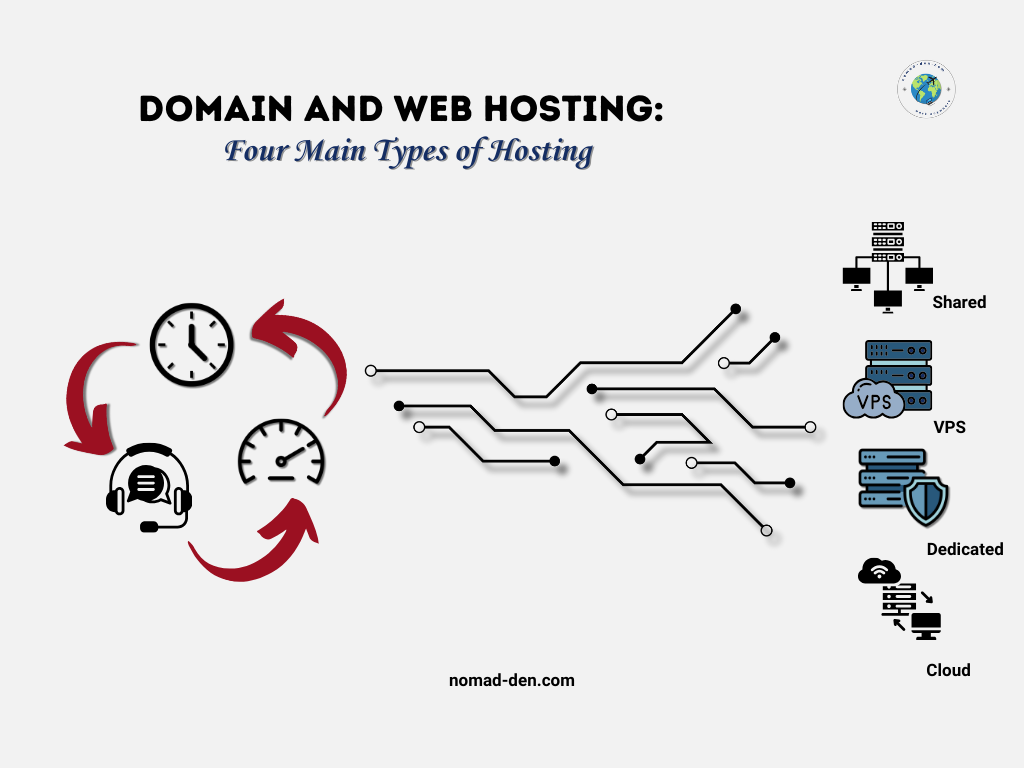
The three factors that matter most in web hosting are uptime, speed, and customer support. Here’s what to look for in each:
- Uptime: High uptime ensures your website is always accessible. Look for hosts with 99.9% uptime or higher.
- Speed: Fast loading times improve user experience and search engine rankings. Choose a host that prioritizes speed.
- Customer Support: Responsive support is essential for resolving issues quickly and assisting with more technical challenges. Choose a hosting provider with strong customer service.
Types of Web Hosting
There are four main types of web hosting, each suited to a different stage of business. Here’s a breakdown of the most common options:
Shared Hosting is the most affordable option, with your website living on the same server as many others; it’s beginner-friendly and cost-effective, though bandwidth and memory are divided among users, which can slow your site during traffic spikes. This makes it best suited for small blogs, personal sites, or early-stage businesses.
VPS Hosting (Virtual Private Server) still shares a server with other sites, but gives you dedicated portions of its resources, like an apartment in a larger building where you control your own unit. This added stability and customization makes VPS ideal for growing businesses, e-commerce stores, or websites expecting moderate traffic.
Dedicated Hosting gives you full control of an entire server, offering the best performance, security, and customization at a higher cost. This is best suited for large businesses, enterprise-level sites, or platforms handling high volumes of traffic and sensitive data.
Cloud Hosting uses a network of servers working together to keep your website online. If one server fails, another takes over, meaning greater uptime and scalability, making it a flexible choice for businesses of all sizes, especially those with fluctuating or unpredictable traffic.
Uptime, speed, and customer support are the factors that actually separate a good host from a bad one, and the right hosting type depends on where your website is right now, not where you eventually want it to be. With those basics covered, here’s how seven of the top providers compare.
| Hosting Type | Cost | Performance | Ideal For | Scalability |
|---|---|---|---|---|
| Shared | Low | Limited | Beginners, Blogs | Low |
| VPS | Medium | Balanced | SMBs, e-commerce | Moderate |
| Dedicated | High | Maximum | Enterprises, high-traffic | Limited (single server) |
| Cloud | Varies | Variable (Often high) | All businesses | High |
Top Web Hosting Recommendations
There are thousands of web hosting companies worldwide, but only a handful consistently deliver on speed, reliability, and support. These seven providers are the ones worth your consideration.
Hosting.com (formerly A2 Hosting)
- Turbo Servers for up to 20x faster page loads
- Free site migration and SSL certificate
- 24/7/365 Guru Crew support
Hosting.com has rebranded with the goal of becoming the world’s most trusted hosting provider. They’re backing it up with global infrastructure investments, 100% carbon offset operations, and standout customer service. Speed isn’t just a spec here either. Hosting speed affects far more than load times, and Hosting.com’s Turbo Servers are built around that. Known for speed, reliability, and flexibility, Hosting.com serves everyone from small startups to enterprise-level e-commerce.
This is the hosting provider I currently use for this website, moved over from Bluehost along with a previous domain. The core features that factored into that decision were speed, customer service, and affordability. Any issues I’ve encountered are typically handled quickly, with little delay or confusion. I’m satisfied with the service and plan to renew for a second time when my subscription ends.
Hosting.com backs its speed claims with real infrastructure investment, not just marketing copy. Discover Hosting.com today and see why thousands of businesses trust them to keep their sites fast, secure, and always online.


Bluehost
- Longest-running recommended host by WordPress.org
- Free CDN, SSL, and domain for the first year
- Easy-to-use dashboard and one-click WordPress installs
Bluehost has been a trusted name in web hosting for over 20 years, and still remains a popular choice for beginners. Backed by strong uptime (99.98%) and straightforward tools, it’s an easy starting point for anyone starting out on WordPress. While it doesn’t lead the pack on speed (3.0s average load), Bluehost makes up for it with simplicity, accessible pricing, and a long-standing reputation in the hosting world.
Personally, I used Bluehost with a previous domain, before I moved everything over and rebranded as Nomad Den. My experience with Bluehost wasn’t bad, just some room for improvement on customer service, and the UI/dashboard was a little confusing to me at the time.
If you’re looking for a beginner-friendly host with WordPress’s official stamp of approval, Bluehost is a dependable pick for your first website.

GreenGeeks
- As a leading green web host, GreenGeeks offsets 300% of its energy usage with renewable energy credits.
- Free nightly backups and CDN integration
- 24/7 expert support with advanced speed technologies
GreenGeeks stands out for its unique commitment to sustainability without cutting corners on performance. Alongside their environmental commitment, they deliver competitive speeds (2.0s average load, 0.9s cached) and a reputation for round-the-clock support that actually solves problems quickly. It’s a hosting solution where you don’t have to choose between doing right by the planet and getting the reliability your site needs.
GreenGeeks proves eco-friendly hosting doesn’t mean giving up speed or support. Explore GreenGeeks’ green hosting plans and get dependable performance at a competitive price.

GoDaddy
- Largest domain registrar with over 80 million domains managed
- Free SSL certificate, CDN, and 24/7 support included
- Easy domain + hosting integration for beginners
GoDaddy is one of the most recognizable names in web hosting and domains, making it an easy first stop for new site owners. While it trails the leaders in speed (3.8s average load, 2.5s cached), its strength lies in simplicity and scale, plus an extensive marketplace of add-ons, from business email to site builders. For users who want everything managed in one place, GoDaddy remains a flexible choice.
For those who value convenience and one-stop service, GoDaddy remains a reliable option for getting your domain and hosting bundled together.

SiteGround
- Google Cloud infrastructure for reliability and global reach
- Free CDN, SSL, and daily backups
- 24/7 support with a reputation for solving issues fast
SiteGround holds a 4.9/5 “Excellent” rating on Trustpilot from nearly 30,000 reviews, built on Google Cloud infrastructure that gives it a reliability edge most budget hosts can’t match. Its developer-friendly tools pair well with that backbone, and support has the track record to back up the praise rather than just claiming it.
Discover why so many businesses trust SiteGround. Explore SiteGround’s hosting plans that balance speed, support, and scalability at a fair price point.

HostGator
- Free domain for the first year, plus SSL certificate included
- One-click installs for WordPress and other apps
- 24/7/365 support with live chat and phone options
HostGator has been around for decades and built its reputation as a budget-friendly hosting provider. With strong uptime (99.9%) and affordable pricing, it’s a popular choice for small businesses and personal sites. While not the fastest option (3.1s average load, 1.6s cached), HostGator is known for budget plans built around unmetered bandwidth and generous domain allowances, making it a common entry point for new site owners.
If you’re seeking a low-cost entry point into web hosting, HostGator provides steady performance and a full suite of beginner-friendly tools.

FastComet
- SSD-only cloud with global data centers for faster loading times
- Free daily and weekly backups
- 24/7 customer support with real-time chat
With SSD-only infrastructure and global data centers, FastComet is built for speed and worldwide reach. It’s a reliable option for site owners who need fast performance paired with strong security measures. Add responsive support into the mix, and FastComet offers a balanced package of speed, safety, and service.
Need a hosting solution that’s fast, secure, and globally accessible? FastComet’s worldwide data centers and cloud technology can keep your site performing at its best, all at a competitive price.
Pricing is one of the biggest factors when choosing a web hosting provider. The cost can range from just a few dollars to premium rates depending on speed, uptime, and support.
| Company | Uptime % | Free SSL & CDN | 24/7 Support | Starting Price | Unique Features |
|---|---|---|---|---|---|
| Hosting.com | 99.9% | ✅ | ✅ | $1.99/mo. | Turbo Servers, up to 20x faster page loads |
| Bluehost | 99.99% | ✅ | ✅ | $3.99/mo. | Official WordPress.org recommended host |
| Greengeeks | 99.9% | ✅ | ✅ | $2.95/mo. | 300% green energy match |
| GoDaddy | 99.9% | ✅ | ✅ | $5.99/mo. | 82M+ domains under management |
| SiteGround | 99.9% | ✅ | ✅ | $2.99/mo. | Runs on Google Cloud infrastructure |
| HostGator | 99.9% | ✅ | ✅ | $3.75/mo. | 45-day money-back guarantee |
| FastComet | 99.97% | ✅ | ✅ | $1.99/mo. | Free domain renewal for life when you transfer your domain to them |
Pricing shown reflects rates at the time of this update and is subject to change. Please check each provider’s website for current pricing before purchasing. Updated July 20, 2026.
FAQs
Conclusion
Your domain and hosting choice shapes everything that follows for your site, so it’s important to get it right the first time rather than migrating later out of frustration. If you’re just starting out, Bluehost’s WordPress.org endorsement makes it a safe, beginner-friendly entry point.
If eco-conscious hosting matters to you, GreenGeeks’ renewable energy commitment stands out from the rest of the field. And if you want a provider that’s held up under real, ongoing use rather than just a launch-day review, that’s Hosting.com, which is what currently powers this site.
Some links in this post may be affiliate links. I may earn a commission at no extra cost to you. Learn more here.
Continue Reading Related Posts

Email & Account Security: Guard Your Data Online
With an astounding 392.5 billion emails sent and received every day by well over 4…
WordPress for Beginners: Setting Up Your Website
WordPress is a free, open-source content management system (CMS) that powers more of the internet…
Digital vs. Physical Products: Which E-Commerce Path Is Right for You?
E-commerce lets you sell products and generate income online without a physical storefront, set hours,…

Essential Tech Tasks for Online Business Owners, Made Easy
The core technical tasks every online business owner runs into, including DNS setup, SSL certificates,…

Top 5 Tools Every Online Business Owner Needs
Most online businesses are built on five foundational tool categories: a domain and hosting, a…

Hosting.com Review: Why Website Speed Matters
Web hosting speed, specifically how quickly your site responds and fully loads, directly affects conversions,…