
Some links in this post may be affiliate links. I may earn a commission at no extra cost to you.
Table of Contents
- Why Freelance Income Feels So Unpredictable
- Protect the Income You Already Have
- Build Client Relationships That Actually Repeat
- Don’t Let One Platform or One Client Carry You
- Price and Structure Work for Predictability
- Build a Buffer for the Slower Months
- FAQs
- Steady Income Starts With What You Protect, Not Just What You Earn
- Related Posts
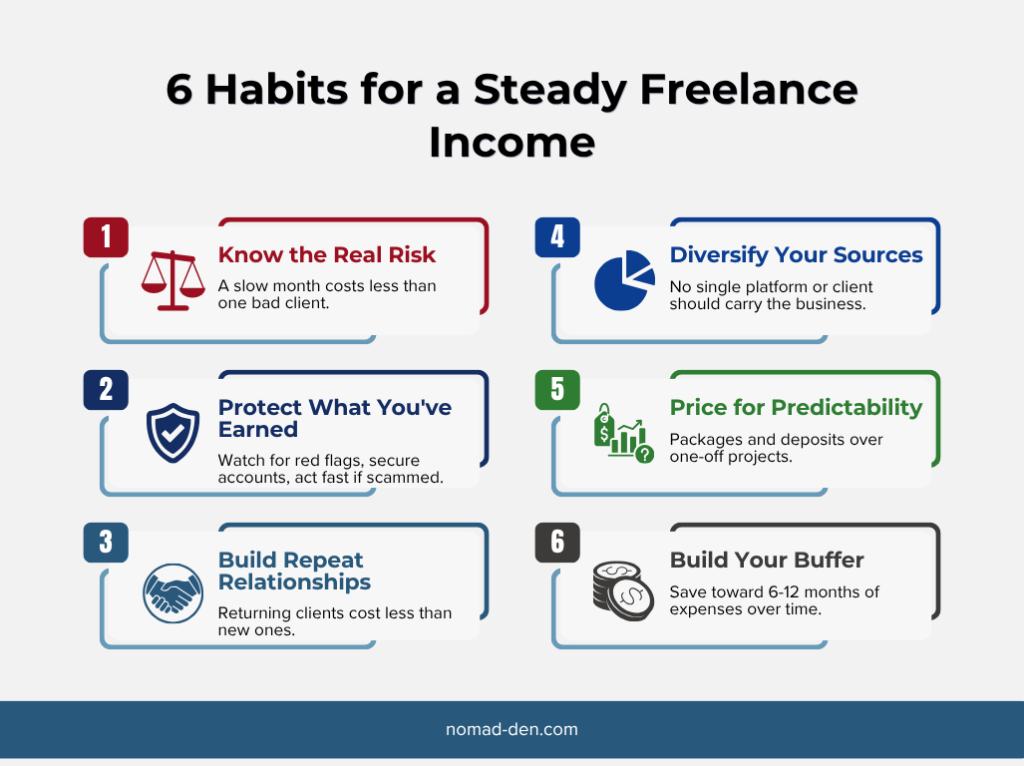
Steady freelance income starts with protecting what you’ve already earned, not just chasing more of it. Most advice on this topic treats a slow month as the main threat to stability. However, the bigger risk is a client who never pays, or a scam that takes a project’s worth of work outright. A quiet week costs some income. An unpaid invoice or a scam can cost all of it at once.
Freelance income swings by more than most people realize. Research from the JPMorgan Chase Institute on hourly workers found a typical month-to-month earnings change of 9%, with one in four months seeing a swing of 21% or more. That is often bigger than the worker’s entire checking account balance. That’s the backdrop every freelancer is working against, whether or not they’ve put a number on it.
Why Freelance Income Feels So Unpredictable
The unpredictability isn’t a personal failing, it’s structural. Freelance work runs on individual projects and individual clients instead of a fixed paycheck, so a single canceled contract or a client who goes quiet shows up immediately in that month’s earnings. DemandSage’s 2026 data puts the average U.S. freelance hourly rate at $47.71, with full-time freelancers working around 43 hours a week, yet that rate alone doesn’t say anything about how consistently the work is.
Most freelance advice repeats the same few fixes: market constantly, chase retainers, build a cash buffer. None of that is wrong, but it treats income stability as a marketing problem alone, and it skips the kind of instability that happens in a single afternoon. A client who vanishes after the work is delivered, or a payment that was never real to begin with, are problems that no amount of marketing would fix. It needs its own section, not a mention in passing.
Protect the Income You Already Have
The fastest way to destabilize a freelance income isn’t a slow month, it’s one bad client. A scammed invoice or an unpaid project doesn’t just cost the money for that job. It costs the time spent on it, and often the time spent chasing it afterward. Building steady income starts with keeping the income you’ve already earned. This covers the client-side risks specific to freelance income. For more complete security coverage (devices, accounts, and general remote-work practices) see How to Start Remote Work: Skills, Tools, and Security Explained.
Red Flags to Watch For Before You Start Work
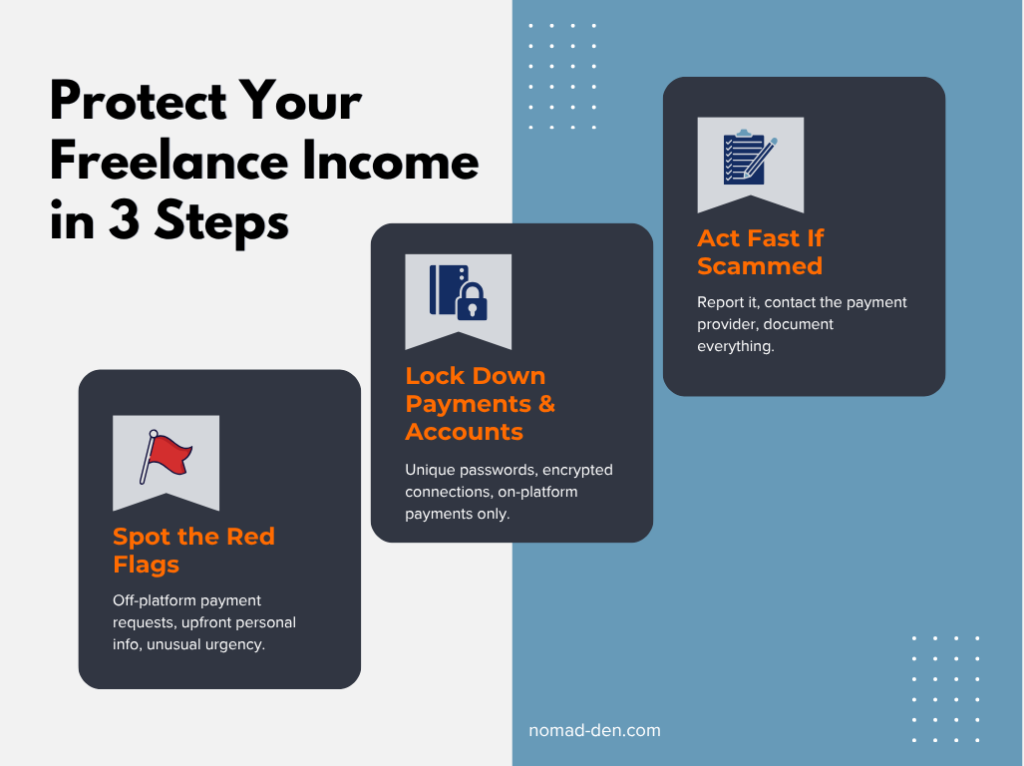
A client pushing to process payment off the platform you’re working on is the single most common warning sign. Freelance marketplaces hold funds in escrow and offer dispute resolution specifically to protect against this, and stepping outside that system removes those protections entirely, according to Upwork’s own guide to spotting scams.
Other patterns to look out for include a client who asks for personal financial information before any contract exists, an “accidental” overpayment followed by a request to send back the difference, or a job offer that arrives with unusual urgency attached. The FTC’s consumer alert on job scams notes that scammers often move quickly once contact is made, sending official-looking paperwork before an actual interview happens. That speed is deliberate. It’s designed to get a freelancer past the questions they would normally ask.
Unfortunately, this isn’t a rare problem. The Better Business Bureau’s Scam Tracker logged close to 50,000 employment-related scam reports over a three-year span, and reports doubled in a single year between 2024 and 2025, per BBB’s 2026 employment scams update. The report also notes that only a small share of victims file a report at all, so the real number is almost certainly higher.
Payment and Account Safeguards
Keeping payments inside a platform’s built-in protections is the simplest safeguard, but it only helps if the accounts behind those payments are actually secure. A freelancer juggling client portals, invoicing tools, and platform logins tends to reuse passwords out of convenience, which turns one compromised account into several. A password manager like NordPass closes that gap by generating and storing a unique login for every account instead of relying on memory or repetition.

The same logic applies to where that work happens. Freelancers frequently log into client portals and payment dashboards from coworking spaces, coffee shops, or shared wifi networks, all of which expose that traffic to anyone else on the same connection. A VPN like NordVPN encrypts that connection, so financial and client data stays private regardless of the network it’s sent over.
If You Think You’ve Been Scammed
Take action as quickly as possible. Make sure to report the account or client directly to the platform, since most freelance marketplaces have a dedicated process for flagging suspicious activity, and contact the payment provider involved to see if a transaction can still be reversed. Keep every message and file exchanged with that client, since it becomes the evidence a platform or payment provider needs to act. Getting scammed doesn’t reflect poorly on a freelancer’s judgment. It reflects how deliberately these schemes are built to look legitimate.
Build Client Relationships That Actually Repeat
Repeat clients are the most reliable path for income stability, and the numbers back that up. A survey cited in Malt’s research on repeat freelance business found that 54% of full-time freelancers had completed more than one project with the same client over a two-year period, and 70% said they prioritize long-term client relationships specifically for the stability they provide.
The math behind that preference is straightforward. Every new client costs unpaid time before the first invoice ever goes out. Outreach, proposals, and onboarding all take real hours, and none of it is billable. A returning client skips all of that. The relationship already exists, the scope is already understood, and the next project starts without a new sales cycle attached to it.
Retainers take this a step further by turning that relationship into a fixed monthly arrangement instead of a series of separate projects. The same type of work can usually be structured either way. A single project might be a one-off, while the same service delivered on a recurring basis becomes a retainer (like a subscription), and that shift alone changes how predictable the income behind it becomes.
Don’t Let One Platform or One Client Carry You
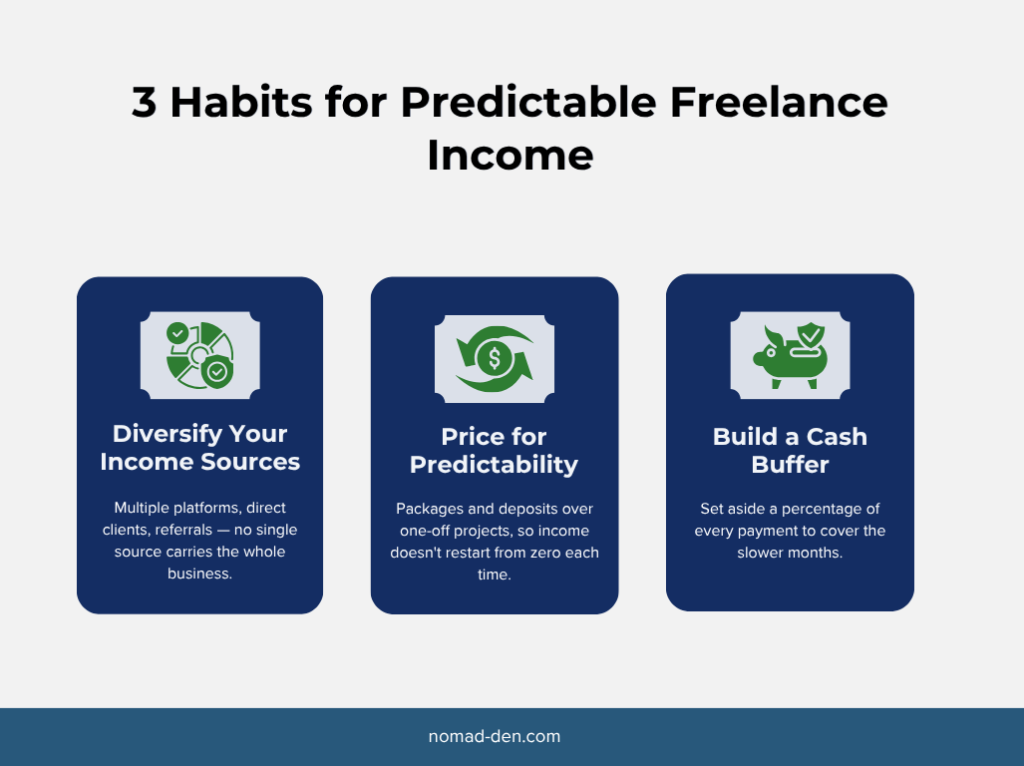
A single platform or a single client is a single point of failure. If one account gets suspended, one algorithm change buries a profile, or one major client leaves, income built entirely around that one source disappears with it. Spreading client acquisition across more than one channel, whether that’s a marketplace like Fiverr, direct outreach, or referrals, means no single disruption can take out the whole business at once.
This doesn’t mean chasing every platform at once. It means treating any one source of income, no matter how reliable it currently feels, as something that could change without warning. Still narrowing down which freelance path to build this around? Here’s a breakdown of the roles currently in demand.
Price and Structure Work for Predictability
How work gets packaged affects income stability as much as who it’s sold to. A single flat-rate project ends the moment it’s delivered, with nothing guaranteed after that. A monthly package, whether that’s a set number of deliverables or ongoing access to a service, keeps that same client generating income without a new pitch every time.
Asking for a deposit before starting a project accomplishes two things at once: it protects against non-payment on work already delivered, and it gives a clearer signal early on that a client is serious. The reverse also matters: a deposit that’s disproportionate to the project, especially a full payment demanded upfront with no track record on either side, is the same red flag in the other direction. A reasonable partial deposit builds trust. A client hesitant to put any money down before work begins is still worth a second look before the project starts, not after.
Build a Buffer for the Slower Months
No amount of client diversification eliminates every slow month, so a cash buffer still matters. Freelance income doesn’t arrive on a fixed schedule the way a paycheck does, which means a gap between projects has to be handled by savings rather than by the next deposit. Financial planners commonly recommend a larger buffer for freelance income than for a salaried paycheck, often in the 6–12 month range instead of the standard 3–6. However, that’s not a number most new freelancers have available right away, and it doesn’t need to be. Setting aside a percentage of every payment, even a small one, and building toward that range over time keeps a quiet month from becoming a financial emergency.
Tax setup deserves the same treatment. Freelance income typically isn’t taxed automatically the way an employee’s paycheck is, and requirements vary by location. Speak to a tax professional about a specific situation rather than relying on a general percentage.
FAQs
Steady Income Starts With What You Protect, Not Just What You Earn
A steady freelance income isn’t built by working more hours or chasing more clients, it’s built by protecting the income that’s already coming in. Retainers, diversified client sources, and a cash buffer all help smooth out the normal ups and downs of freelance work. But none of that matters if one scammed invoice or one client-side fraud attempt wipes out a month’s worth of income in a single afternoon. Build the habits in this guide in order, protect what you have first, then grow what comes in next.
Ready to lock down the accounts and payments behind your freelance work? See the full toolkit for getting paid safely as a freelancer.
Some links in this post may be affiliate links. I may earn a commission at no extra cost to you. Learn more here.
Related Posts

When to Start Outsourcing: How to Vet Your First Virtual Assistant (or Freelancer)
Outsourcing makes sense the moment a task is both teachable and consistently the thing standing…

Freelancing vs. Remote Work: What’s the Difference?
Freelancing and remote work are not the same thing, even though people use the terms…
Freelance Business Tools: Getting Paid and Staying Protected
Most freelance tool summaries and comparison posts point you toward the same handful of project…
Digital Nomad Visas in 2026: Requirements, Costs, and How to Apply Safely
A digital nomad visa is a temporary residency permit that lets you legally live in…
What Is a VPN? How It Works, What It Protects, and What It Doesn’t
A VPN, or virtual private network, is a service that encrypts your internet connection and…
Best Antivirus Software for Small Business Owners and Freelancers (2026)
If you run your business off a single laptop, ‘I should probably get antivirus eventually’…