
Some links in this post may be affiliate links. I may earn a commission at no extra cost to you.
What’s actually happening in the remote work space right now is more serious than any “kick back in your pajamas and collect a paycheck” list that most articles let on. The FTC reported $220 million in task scam losses in just the first six months of 2024 alone, and that’s only one category of job scam, and only the cases that got reported. The FTC estimates fewer than 10% of fraud victims actually file a complaint with a federal agency, which means the real number is likely several times larger.
This isn’t a fringe problem happening to other people. It’s happening to people with experience, people who are careful and who know better. I’ve been on the receiving end of many of these schemes myself, and a close family member almost fell victim as well. These aren’t abstract cautionary tales. They’re legitimate and commonplace.
What’s made this dramatically worse in the last two years is criminals specifically using AI against you. Prior to 2024, most job scams were detectable by poor grammar, generic copy, or recognizably copied text. In 2025–2026, those indicators have become unreliable. Scammers now use LLMs (Large Language Models) to produce professional, specific-sounding job descriptions in seconds.
The fake recruiter contacting you on LinkedIn might have a photorealistic headshot, a convincing work history, and (in the most sophisticated cases) a deepfake video face running in real time over a Zoom call. Only 61% of U.S. adults say they’re confident in their ability to spot a job scam, and that number was established before AI made them significantly harder to detect.
Legitimate remote work is real, it’s abundant, and it’s genuinely worth pursuing. The goal here isn’t to scare you out of it. It’s to make sure you can tell the difference between an opportunity and a trap. Because right now, that skill is more important than your resume.
The 8 Remote Work Scams You Need to Know
Not all remote work scams are created equal. Some are designed to steal your money directly. Others use you as an unwitting criminal accomplice. The newest ones are engineered by AI and nearly indistinguishable from legitimate hiring processes. What they all share is a deliberate exploitation of the one thing every job seeker brings to the table: hope.
Here are the eight you’re most likely to encounter, how they work, why they work, and what they actually look like in practice:
The Fake Job Offer / Upfront Fee Scam
This is the most common remote work scam running today, and it’s effective precisely because it mirrors a legitimate hiring process so closely.
There is no first paycheck because there is no job.
The scammer walks the victim through what sounds like a legitimate onboarding process, then asks them to pay through untraceable methods. The golden rule that exposes this scam every single time: legitimate employers never ask you to pay for the privilege of working for them. Ever.
If money flows toward you before you’ve done a single hour of work, that’s a job. If money flows away from you before you’ve done a single hour of work, that’s a scam.
The Fake Check / Overpayment Scam
I’ve experienced this one personally, both for a fake job and through selling something online. When I deposited a check that turned out to be fraudulent, my bank initially held me liable, even though I was the one who got scammed. I pushed back hard and made clear I was the victim, not the perpetrator. It was resolved, but it was a fight I shouldn’t have had to have. The mechanics of this scam are simple, and once you’ve seen how it works, you’ll never fall for it.
Scammers exploit the banking float period: when deposited funds appear available before the bank can verify them, to pressure victims to act fast. The check looks real. It clears initially. You wire the money. Days later, the check is returned as fraudulent, the funds are removed from your account by your bank, and you are personally responsible for every dollar you already sent. The scammer is gone. They got what they wanted.
The rule: no legitimate employer sends you more money than they owe you and asks for any of it back. Full stop.
The Reshipping / Package Mule Scam
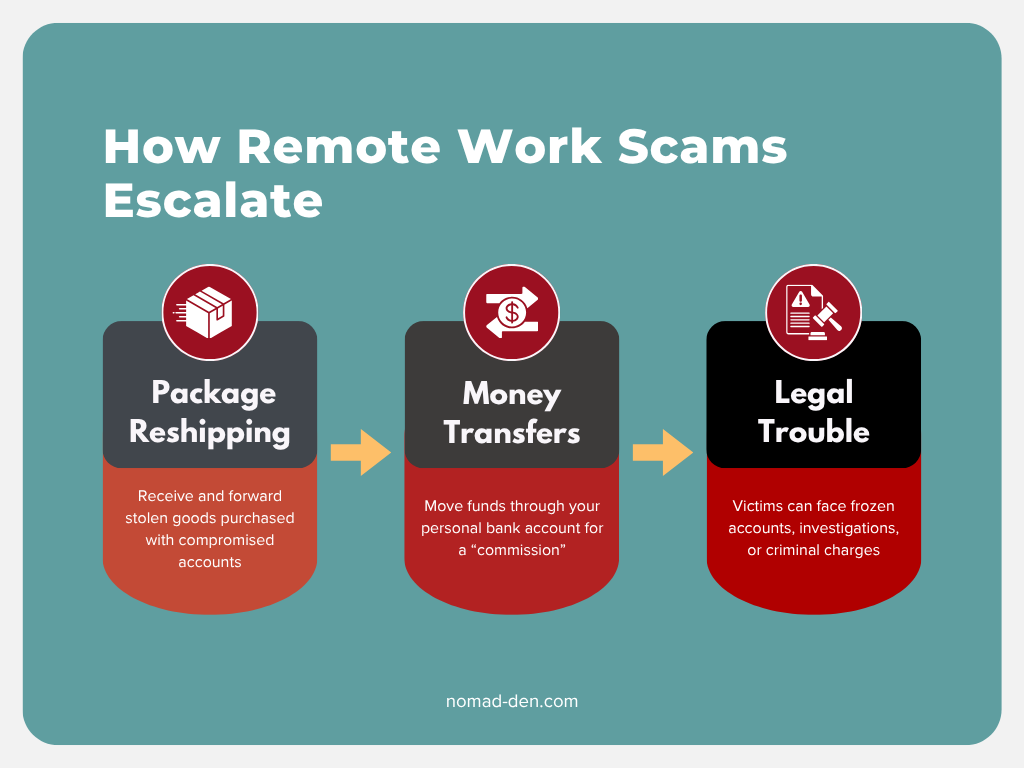
This one doesn’t just cost you money, but it can cost you your freedom. These scammers make you complicit in their criminal activity.
The work is framed as simple: receive packages at your home address, inspect them, repackage them, and forward them to another address. Flexible hours. Good weekly pay. Work from home.
What these employees don’t know is that the packages contain fraudulently obtained high-value goods bought with stolen credit cards or hacked bank accounts. The employee is unlikely to be paid, but is very likely to get into legal trouble for committing a felony by cooperating with scammers and handling stolen goods, even if they knew nothing about the origin of the packages.
When law enforcement traces the stolen goods, every trail leads directly to your front door. Your address received the packages. You reshipped them. Proving you had no knowledge of the scheme is an uphill legal battle most people aren’t equipped to fight.
If a job offer involves receiving and forwarding packages — regardless of how it’s framed — walk away immediately.
The Money Mule Scam
The reshipping scam moves stolen goods. The money mule scam moves stolen funds. Both can land you in federal court.
You’re recruited for a “financial processing” or “accounts management” role. Your job is to receive transfers into your personal bank account and forward the funds (minus a commission) to another account, often overseas. The money is laundered proceeds from fraud or theft.
In one documented case prosecuted by the U.S. Department of Justice, a Westminster woman was federally indicted for acting as a money mule, moving funds on behalf of a criminal operation she claimed not to fully understand. Ignorance of the scheme’s origins was not a sufficient defense.
Operating as a money mule — even unknowingly — is a federal crime.
Any job that involves receiving and forwarding money as a primary function is not a job. It is a criminal enterprise using you as the buffer.
The Task Scam
This is the fastest-growing category of remote work fraud right now, and it’s the one that caught a close member of my family. Understanding exactly how it works makes it obvious in hindsight, but in the moment, it’s engineered to feel like a legitimate side hustle.
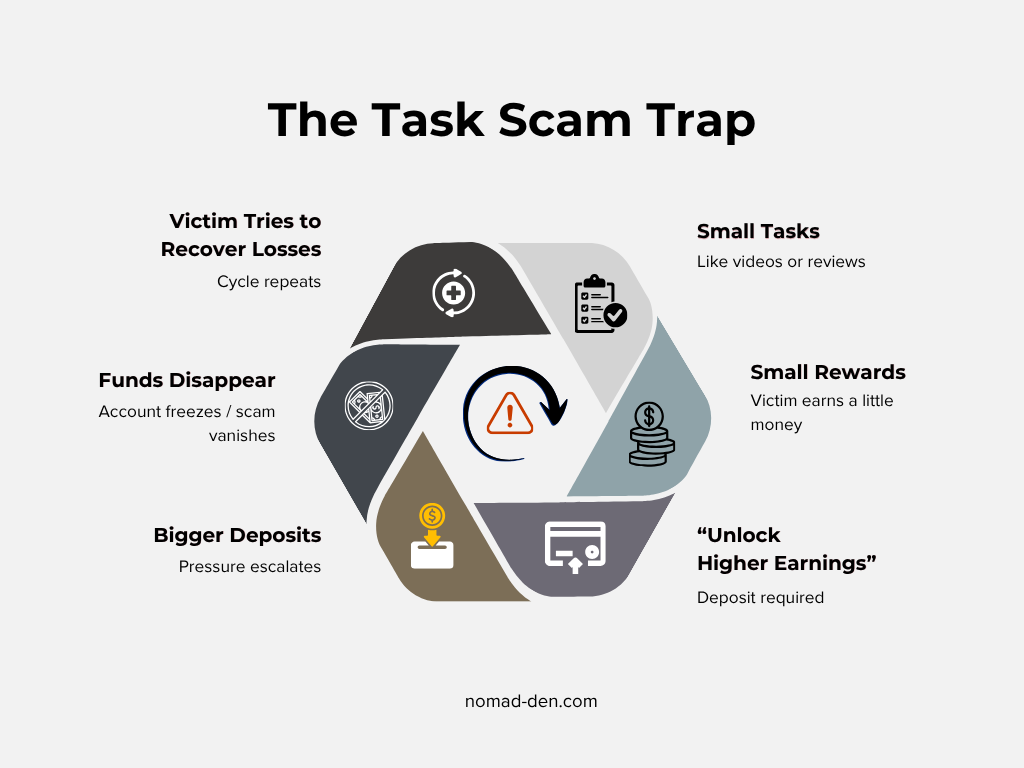
It starts with an unsolicited message: text, WhatsApp, Telegram, sometimes Instagram DM. A recruiter offers you simple online work: liking videos, rating products, writing reviews, boosting app ratings. You get paid small amounts immediately. It works. You do more tasks, you earn more, you build trust in the platform. Then the structure shifts.
You are asked to invest money to unlock higher-paying tasks. The FTC specifically flagged these game-like online job scams in a December 2024 press release, noting skyrocketing consumer reports. The withdrawal process is designed to extract more deposits before you realize nothing is coming back.
The tell is any platform that requires you to deposit money in order to receive money you’ve allegedly already earned is not paying you. It is robbing you incrementally, with your trust as the mechanism.
The Data Harvesting Interview Scam
This scam doesn’t always take your money. Sometimes it takes something more valuable: your identity.
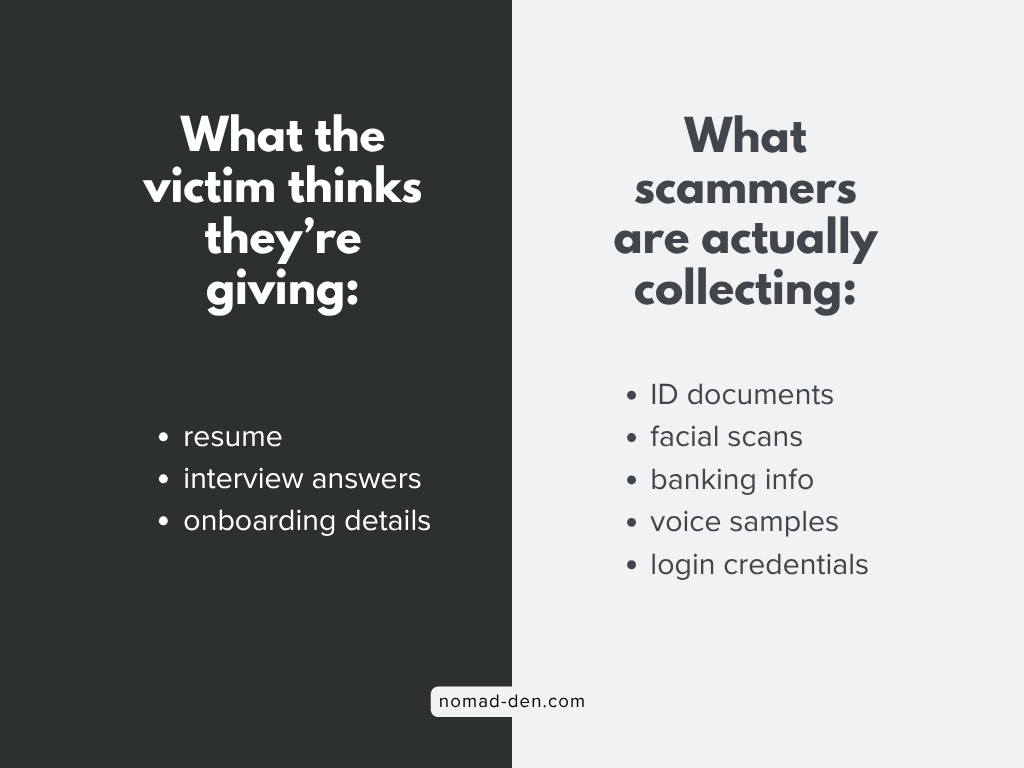
Recruiters claiming to be hiring for big-name employers reach out by email or text with a remote job offer, sometimes from a personal phone number or account. They send an official-looking interview invitation, then move fast. Before you’ve even interviewed, you receive an official-looking job offer with onboarding paperwork requiring your personal financial information, supposedly for direct deposit. The recruiter pushes for that information before answering any of your questions about the actual job. In reality, there is no job.
What they walk away with: your Social Security Number, bank account details, driver’s license number, date of birth. Everything needed to open fraudulent accounts, file false tax returns, or sell your identity on the dark web. The financial damage from identity theft can take years to untangle.
The rule: your SSN and banking information are provided after you have a verified, written offer from a confirmed company; never during the application process, and never before.
The Deepfake Recruiter Scam
This is the newest, most sophisticated threat on this list, and the one that’s made every other scam harder to identify by association.
Generative AI tools now let criminals spin up photorealistic profile pictures, write convincing professional histories, and produce deepfake video introductions that make a fake recruiter look and sound completely real.
LinkedIn identified and removed over 80 million fake accounts at registration in the second half of 2024 alone — up from 70 million in the prior six months. That’s what their automated systems caught. The ones that slip through are the problem.
What gives deepfakes away, even good ones: slight lip-sync delays, eyes that don’t track naturally, backgrounds that never change, and an interviewer who deflects every direct question about the company’s structure or team. Trust those instincts. If a video call feels subtly wrong, it probably is.
The verification move: find the recruiter on LinkedIn independently — not through the link they sent you. Contact the company’s HR department directly through the official website. Real recruiters have no problem with this. Fake ones disappear.
The MLM / Recruitment Commission Scam
This one wears the longest disguise. It presents itself as a business opportunity, a ground-floor moment, a chance to build something of your own. In practice, it’s a scheme that earns money for the people above you, using your time, your relationships, and your social capital as the fuel.
The structure is always the same: your income depends primarily on recruiting new members rather than selling a product or doing actual work. The commissions sound real until the math catches up, and it always does.
The tell is simple: if the primary path to earning is recruiting rather than selling, it’s a pyramid structure regardless of what it calls itself.
And One More: The Nigerian Prince Is Still Out There
No list of remote work scams is complete without acknowledging the grandfather of them all: the advance fee fraud. You know this one. An urgent email from a foreign dignitary, a displaced heir, a government official sitting on a fortune they need your help to access. Send a small fee to unlock millions.
It sounds laughably outdated. It isn’t. The FTC still receives thousands of advance fee fraud reports annually, but the format has evolved. Today’s version might be a LinkedIn message from an overseas investor, a WhatsApp recruiter promising offshore contract work, or an “inheritance” attached to a remote consulting role. The psychology is identical: a life-changing sum, just out of reach, requiring a small payment to unlock.
The rule hasn’t changed in thirty years: no legitimate windfall requires you to pay to receive it.
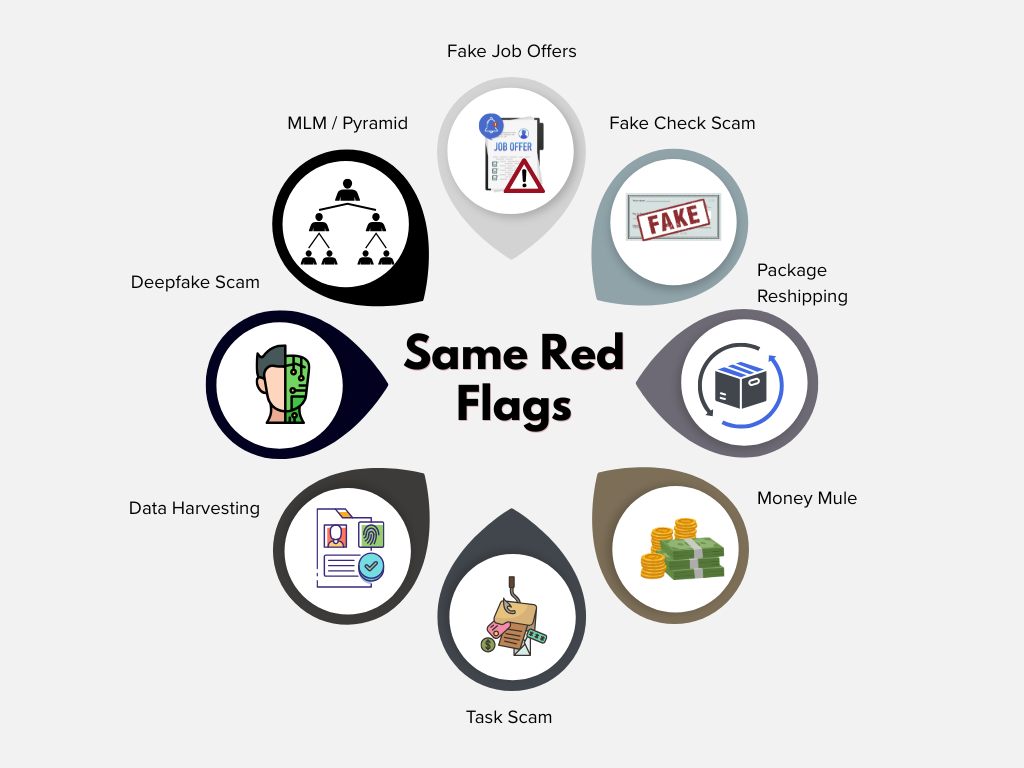
The Universal Red Flags Checklist
Scams change their design constantly. However, the tells remain consistent. Apply these before you invest a single hour or dollar in any remote opportunity:
- Fake recruiters claiming to be with legitimate companies you might recognize, mention pay without any details about the actual job, and ask you to reply with “YES” or “INTERESTED” to engage you.
- High pay, low requirements — fake job listings consistently follow a pattern: high pay, vague responsibilities, and requests for personal information early in the process.
- Artificial urgency — scammers try to pressure you to act quickly so you don’t have time to think or verify. Don’t fall for it. The right opportunity will still be there tomorrow.
- They want to move off-platform — watch for recruiters who ask to move the conversation to Telegram or WhatsApp, or offer payment outside the platform entirely.
- The company doesn’t survive independent research — search the company name plus “scam,” “complaint,” and “review”, and look for a consistent pattern. Cross-check their BBB profile or reviews on Google, Glassdoor, or Trustpilot. No reviews at all can be just as telling as bad ones.”
- The email domain doesn’t match the company — always verify that the recruiter’s email matches the official company domain and cross-check with the company’s careers page directly.
- They want your SSN or banking details before a formal offer — treat your SSN and bank information like cash: don’t hand it over until you have a legitimate, verified, written offer from a confirmed employer.
- You’re asked to pay anything before you start — legitimate employers invest in you, not the other way around. Training fees, equipment costs, background check processing; none of it is your responsibility before day one.
- The video interview feels wrong — lip sync delays, a background that never changes, and deflection of direct questions about the company or team are the fingerprints of a deepfake interview.
- Your gut moved before your brain did — every scam victim describes the same moment: something felt off and they talked themselves out of it. That feeling is data. Trust it.
The one rule that covers all of them: no legitimate job requires you to spend money, move money, or hand over sensitive personal information before you’ve done a single verifiable hour of work for a confirmed employer.
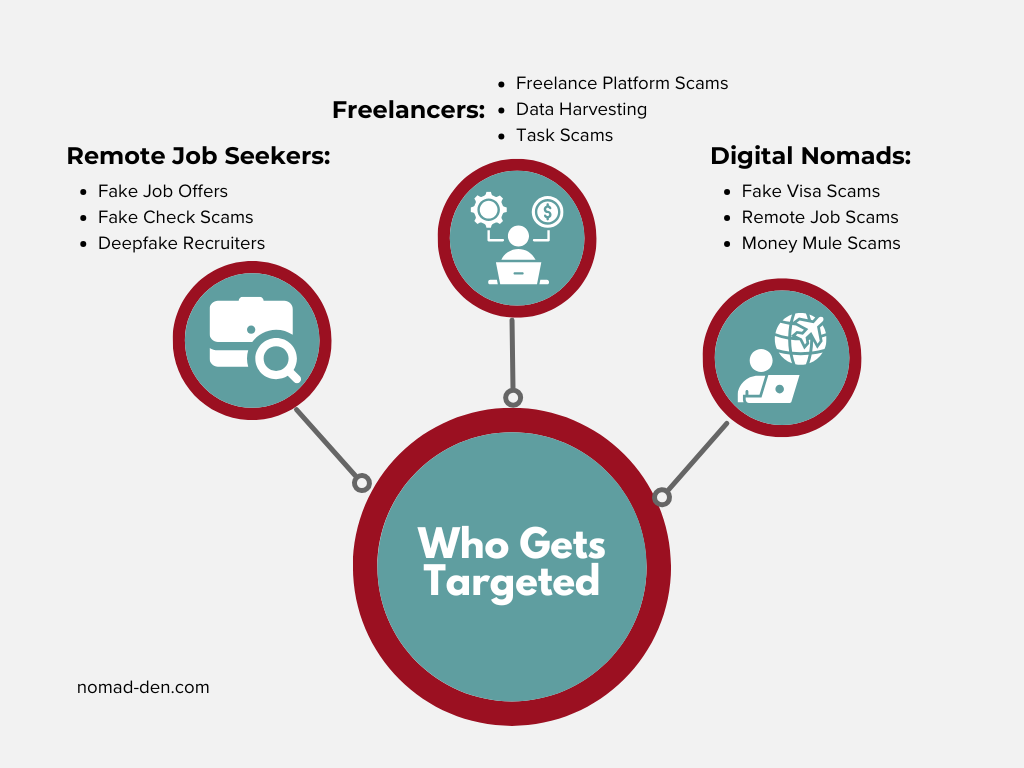
The Scams Most Likely to Target You
Not every remote worker is in the same position. A career professional applying for a salaried remote role faces different risks than a freelancer hunting clients on Upwork or Fiverr, and both face different risks than a digital nomad navigating visa requirements in a country they’ve never lived in.
This section breaks down the threat landscape by work type so you can focus on what’s actually relevant to your situation.
Remote Job Seekers (Traditional Employment)
If you’re applying for a conventional remote position (salaried, W-2, benefits, the works) your primary exposure is during the application and onboarding process. That is the window scammers exploit most aggressively, because it’s when you’re most motivated, most hopeful, and most likely to move quickly.
Verify before you engage — not after.
A five-minute check before you apply or respond to a recruiter can save you weeks of wasted time and potentially thousands of dollars. Here’s the workflow:
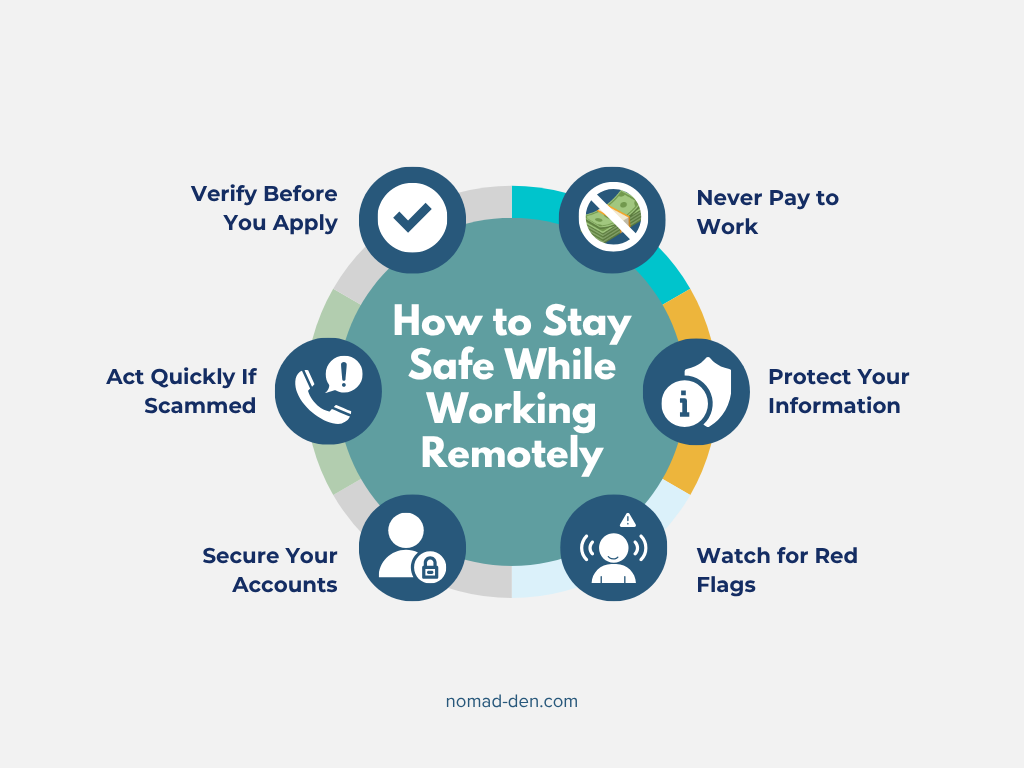
- Find the job on the company’s official careers page. Go directly to the company website (not the link provided in the message or posting). If the role doesn’t appear there, it doesn’t exist there.
- Search the recruiter independently. Find them on LinkedIn by searching their name directly, not through any link they sent you. Check their connection depth, employment history, and whether mutual connections exist.
- Verify the email domain. Cross-reference the address they’re contacting you from against the company’s official domain. No exceptions.
- Search the company name plus “scam,” “complaint,” and “review.” If you can’t find the company online at all, walk away.
- Talk to someone you trust before responding. Describing the offer to another person gives you time to think, which is exactly what scammers are trying to deny you.
Real recruiters have no problem with verification. Why would they? A recruiter who pushes back when you ask for time to confirm their identity or look up the company is telling you everything you need to know.
One last thing before moving on: a legitimate employer will eventually want to speak with you live, on a verifiable platform, with a confirmed email thread attached to a real domain. If the entire process happened over WhatsApp or personal email, it was never legitimate.
Freelancers (Upwork, Fiverr, Direct Clients)
Freelancers operate in a higher-risk environment by default. You’re actively soliciting work from strangers, often under financial pressure to say yes, and the barrier to posting a fake job on most platforms is low. The good news is that the major platforms have built-in protections, but only if you use them.
The single most important rule: stay on-platform.
Keeping communication within the platform provides a record of interactions that can be invaluable if issues arise. Platforms like Upwork and Fiverr offer secure payment processing, ensuring funds are held in escrow until both parties confirm work has been satisfactorily completed. The moment you move a conversation to personal messaging or accept payment outside the platform, every protection disappears — and so does your recourse.
For a broader look at building your remote work setup safely from the ground up, start here: Skills, Tools, and Security for Remote Workers.
Vet the client before you pitch.
Established clients typically have a history of past reviews, a verified payment method, and clear project descriptions. While newer clients may be legitimate, they carry more risk due to their lack of platform history. Check whether the client’s profile has been verified by the platform. A lack of verification isn’t definitive, but it’s a warning sign worth taking a closer look.
Watch for these freelance-specific patterns:
- Clients who send fake PDFs or files claiming to be contracts or briefs but which actually contain malware.
- Clients who offer more than the market rate for straightforward work (the premium is the hook).
- Requests to complete a significant amount of unpaid “test work” before any contract is signed.
- Any request for payment to process your application or access the job; starting a job shouldn’t cost you anything upfront.
If something feels off about a client interaction, report it to the platform before you disengage. Your report protects the next freelancer who would have encountered the same profile.
Digital Nomads
Digital nomads face a completely different category of scams than traditional remote workers. Navigating visa requirements, foreign banking and laws, and unfamiliar housing markets gives scammers significantly more to exploit.
Fake Visa and Work Permit Services
Scammers target digital nomads by offering fake visa and work permit services, promising quick and easy approvals online, particularly in countries with complicated visa requirements. They promise fast processing for high fees, claiming to expedite applications in exchange for significant payments. Victims frequently discover their applications were either never submitted or that invalid documents were issued, putting them at risk of legal trouble and financial loss.
Visa fraud and immigration scams cost applicants $1.2 billion globally in 2025, with U.S. applicants representing 38% of reported cases.
The rule is simple: always apply for visas directly through the destination country’s official government immigration portal. If you use a third-party service, verify their credentials independently and never pay before confirming they have a documented, verifiable track record. Official immigration officers never contact applicants directly to solicit payments, and no legitimate service can guarantee visa approval.
Fake Job Offers with Visa Sponsorship
A common trap involves fake employment promises: scammers pose as recruiters or employers, offer a job, and claim they’ll handle all the visa paperwork. Then comes the fee to process the application. However, the company never existed, and neither did the job.
Identity Fraud Risks at Borders
Eighty percent of businesses noticed a recent increase in identity fraud directly associated with the growth of international business and the digital nomad lifestyle. Moving between countries means repeatedly presenting identity documents, opening foreign bank accounts, and registering with local services, all of which create exposure points that don’t exist for stationary workers.
Keep physical copies of your documents separate from your devices. Use a password manager to ensure no account relies on a password that could be compromised in transit. Scammers deliberately target nomads during moves and transitions; your defenses are lower when you’re already overwhelmed.
A password manager is one of the simplest protections you can put in place. NordPass is worth considering for your account security.
Security Basics Every Remote Worker Needs
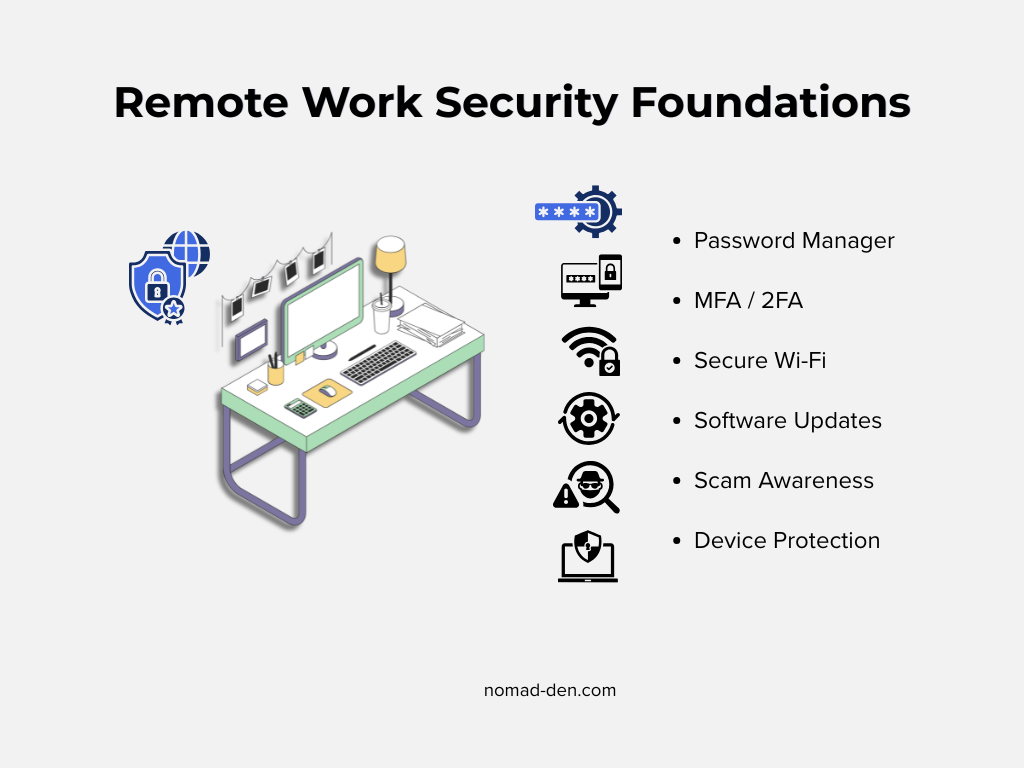
Landing a legitimate remote job is only half the equation. Keeping your work, your data, and your accounts safe is the other half. Remote work security goes deeper than simply using a VPN. It covers several foundational habits that are straightforward to implement and genuinely effective. Simple steps, consistently applied, that make a genuine difference, without requiring any technical background to implement.
Start With a Password Manager, Not a VPN
A password manager is the most critical tool for remote workers, and more fundamental than a VPN. If your credentials are weak, it doesn’t matter how secure your connection is. A password manager creates, remembers, and protects a unique, unguessable key for every single account.
Reusing passwords is the single most common way remote workers get compromised. A breach at one platform gives attackers credentials they’ll immediately test against your email, bank, and work accounts.. A password manager eliminates that domino effect entirely because no two passwords are the same.
For a full breakdown of the best options available, including free and paid tiers, check out my guide: Best Password Managers for Security-Conscious Users.
Multi-Factor Authentication: The Deadbolt
A strong password is the lock. MFA is the deadbolt. Enable MFA on all work and personal accounts — email, banking, freelance platforms, cloud storage, everything.
Even if a scammer or hacker obtains your password through a phishing attempt or a data breach, MFA stops them at the door. Authenticator apps like Google Authenticator or Authy are more secure than SMS-based codes, which can be intercepted through SIM-swapping attacks. Set it up once. It takes minutes and it works.
VPNs: What They Do and Don’t Protect Against
A VPN encrypts your connection, but it’s not a complete security solution. It won’t protect you from phishing, malware on your device, or weak passwords. It’s one important layer in a multi-layered defense strategy.
Where a VPN genuinely matters for remote workers: any time you’re on public Wi-Fi. Always connect via a VPN to encrypt your traffic. Alternatively, use your mobile device’s hotspot for a more secure connection.
Where a VPN doesn’t help: if you click a phishing link, download malware, or hand your credentials to a fake recruiter, the encryption on your connection is irrelevant. The threat already bypassed it.
For a full comparison of VPN options worth trusting, here’s my guide: Best VPNs for Online Security. My top recommendation is NordVPN. It’s what I cover most extensively and what I’d point most remote workers toward first.

Phishing Awareness: The Human Layer
AI-driven phishing is among the top threats for remote workers in 2025 and beyond. Remote workers who use personal devices or work in less structured environments are prime targets for convincing scam emails designed to steal credentials or deploy malware.
Modern phishing in a remote work context is designed to look legitimate: a message from a platform you use, a client you recognize, or a bank you trust. The logos are real. The domains are one character off. If a message you weren’t expecting asks you to click a link to access an account, don’t. Open your browser and go directly to the platform instead.
Home Network Security: The Overlooked Risk
Most home routers aren’t configured for business-grade security. Default passwords, outdated firmware, and open Wi-Fi make it easy for hackers to exploit weaknesses.
Three things to do today if you haven’t already: change your router’s default admin credentials, enable WPA3 encryption if your router supports it, and check for a firmware update in your router’s settings panel. None of this takes more than fifteen minutes and most people have never done any of it.
If you regularly work from locations outside your home, consider a dedicated travel router with a pre-configured VPN for an additional layer of protection in unfamiliar network environments.
Software Updates: The Easiest Thing Most People Skip
Outdated software contains vulnerabilities that malicious actors actively exploit. Enable automatic updates for your operating system, browser, and all work-related applications. Updates are not optional maintenance; they are security patches closing gaps that attackers are actively looking for.
This applies to your router firmware, your phone, your browser extensions, and any plugin running on your WordPress site. For a broader look at keeping your accounts protected, start here: Email Account Security — What You Need to Know.
What to Do If You’ve Already Been Scammed
Don’t feel embarrassed if you have. These schemes are sophisticated, psychologically engineered, and backed by organized criminal operations that have refined their tactics over years. Smart, careful, experienced people get caught by them, including people who write about them for a living. What matters now is moving quickly.
Step 1: Stop the leak immediately.
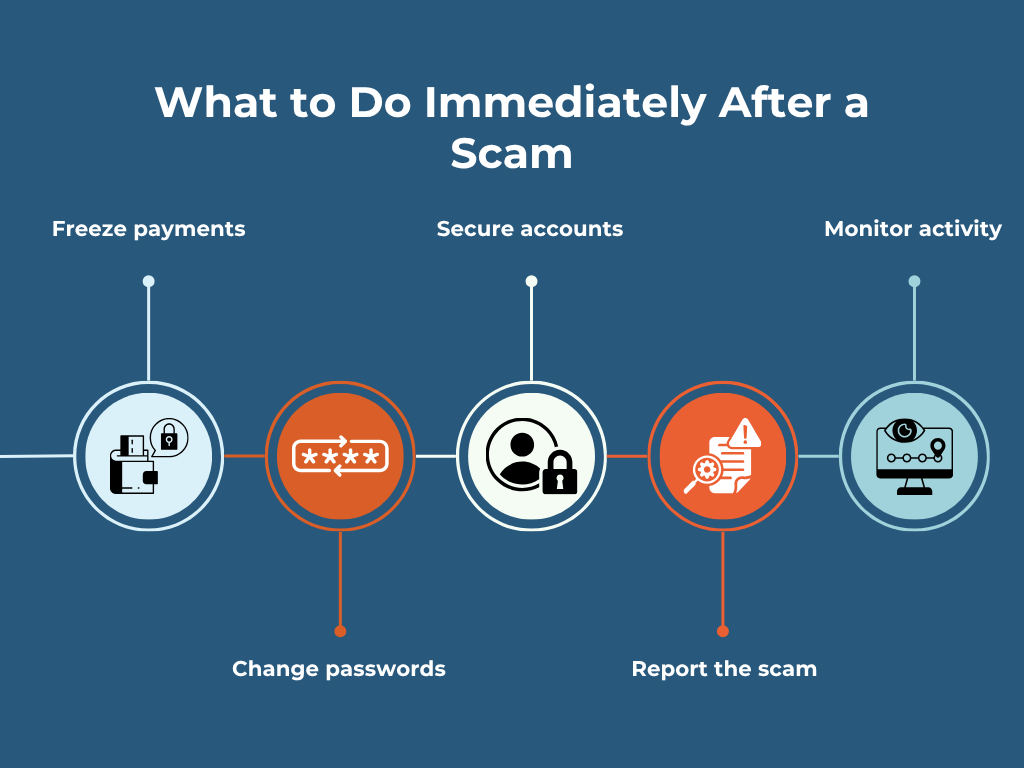
No matter how you paid, your first call is to the payment provider: your bank, card issuer, payment app, or wire service. Report the fraud immediately and request a reversal. The window is narrow and closes fast. Do this before anything else.
Note: cryptocurrency transactions are essentially irreversible once confirmed on the blockchain. If you paid via crypto, contact the exchange immediately. They may be able to flag the receiving wallet, but recovery is unlikely.
If you want to understand the broader picture, Ben McKenzie and Jacob Silverman’s Easy Money is worth your time.
Step 2: Freeze your credit if identity information was shared.
If you provided your Social Security number, driver’s license, passport, or banking details, assume the information is compromised and act accordingly. Place a credit freeze with all three major bureaus — Experian, Equifax, and TransUnion — immediately. A freeze is free, takes minutes online, and prevents anyone from opening new credit accounts in your name until you lift it. This is not an overreaction.
For ongoing identity monitoring after a scam, Coveron covers identity theft insurance, dark web monitoring, and credit alerts in one place.

Step 3: Change compromised credentials.
If you provided passwords, clicked unfamiliar links, or downloaded any files sent by the scammer, change your passwords across all accounts immediately, starting with your email and banking accounts. Run a malware scan on any device that interacted with links or attachments from the scam. If you don’t have antivirus software, Malwarebytes offers a free scanner that covers the basics.
Step 4: Tell someone.
Share your story on social media, Reddit, or wherever your community gathers online. This isn’t mandatory, but you might spare someone the financial and personal damage these schemes cause. Scam operations depend on their victims being too embarrassed to speak up. Breaking that silence is one of the most useful things you can do with the experience.
Some links in this post may be affiliate links. I may earn a commission at no extra cost to you. Learn more here.
Frequently Asked Questions
Conclusion
Remote work is not a scam. It is a legitimate, documented, and growing way that millions of people structure their careers and their lives. The scams covered in this post exist because the opportunity is real, and wherever real opportunity exists, bad actors follow.
What’s changed in the last two years is the sophistication of the threat. The fake check that arrived in my inbox looked legitimate. The task platform that took money from my mother looked like a side hustle. The deepfake recruiter conducting Zoom interviews looks, to most people, like a real human being. These aren’t amateur operations. They are engineered, scaled, and continuously refined.
But they all share the same fundamental weakness: they need you to act before you think. Every scam on this list depends on urgency overriding judgment, on the fear of missing an opportunity bypassing the instinct that something isn’t right.
The goal was never to make remote work feel dangerous. It’s to make sure you can pursue it with your eyes open — and your guard appropriately placed.
If this post helped you avoid one bad situation, share it with someone else who’s job hunting. That’s how this kind of information actually travels — person to person, before the next victim gets the message instead.
Found a scam not covered here? Encountered something new? The comments are open.
Continue Reading Related Posts
Best Free Tools for Content Creators (and What They Really Cost)
The best free tools for content creators cover four main jobs: planning what to make,…
Private Browsers and Search Engines Worth Switching To
Google Chrome accounts for roughly 69% of the world’s web page views, and Google handles…
When to Start Outsourcing: How to Vet Your First Virtual Assistant (or Freelancer)
Outsourcing makes sense the moment a task is both teachable and consistently the thing standing…

17 Cybersecurity Terms Every Online Business Should Know (Part 2)
Cybersecurity terms for online business owners cover the threats, compliance requirements, and protective habits that…

Affiliate Marketing Scams: How to Spot Them (and Protect Your Own)
Affiliate marketing is a legitimate, commission-based business model, not a scam, that predates the internet…
Digital Nomad Visas in 2026: Requirements, Costs, and How to Apply Safely
A digital nomad visa is a temporary residency permit that lets you legally live in…