Some links in this post may be affiliate links. I may earn a commission at no extra cost to you.
Table of Contents
- Types of Freelance Retainers
- Why Clients Keep Coming Back
- Signs a Client Is Ready for a Retainer
- How to Pitch a Retainer at Project Handoff
- Check the Platform Rules First
- What to Put in a Freelance Retainer Agreement
- Set Up Client Access the Safe Way
- Protect Recurring Payments From Fraud
- Plan the Exit Before Day One
- FAQs
- The Takeaway: Earn the Retainer, Then Protect It
- Continue Reading: Related Posts
A freelance retainer is an ongoing agreement where a client pays you a set amount each month for an agreed amount of work or availability. It turns a one-off project into income you can plan around, and it usually goes to a client who already knows the quality of your work. MBO Partners’ 2026 State of Independence study counts a record 74.9 million Americans working independently, and McKinsey’s American Opportunity Survey found the share of employed Americans doing independent work rose from 27% in 2016 to 36% in 2022.
Landing a first project is only half the job. Keeping that client is where steady income comes from. This guide covers how to tell when a client is ready, how to pitch, what Upwork and Fiverr allow, what to put in writing, and how to protect the access and payments a retainer brings with it.
A quick note before you read further: I’m not a lawyer, and this isn’t legal advice. What follows is a plain-language summary of publicly available guidance, meant to help you understand the basics, not to replace professional counsel for your specific situation. If you need advice tailored to your business, speak with a licensed attorney.
Types of Freelance Retainers
Most freelance retainers follow one of three models, depending on what the client is paying for: your time, specific results, or your availability. The client gets dependable access to your skills, and you get predictable income.
Hours-Block Retainers
The client buys a set number of hours each month, such as 10 hours of design support. Decide in writing whether unused hours roll over, expire, or carry forward for one month only.
Deliverables Retainers
The client pays for specific outputs each month, such as four blog posts or a weekly social media calendar. This is usually the easiest model for new freelancers, because both sides know exactly what “done” looks like.
Availability Retainers
The client pays for priority access, such as same-day fixes for a website. These suit experienced freelancers best, since you’re promising time you have to protect even when no work comes in.
Not every client should become a retainer client. If the client’s need truly ends with the project, or the first job came with warning signs like late payment, vague feedback, or pressure to bend the rules, finish the work and move on.
Why Clients Keep Coming Back
Clients come back to the people who make their work easier and more predictable. That holds across professions, and I saw it from both sides long before I started Nomad Den.
As an acquisition manager, I relied on two realtors who each submitted dozens of offers for me every month. I kept using them because they were reliable, kept their schedules open for me, responded quickly, and communicated clearly. When one started holding things up, I moved my business to the other.
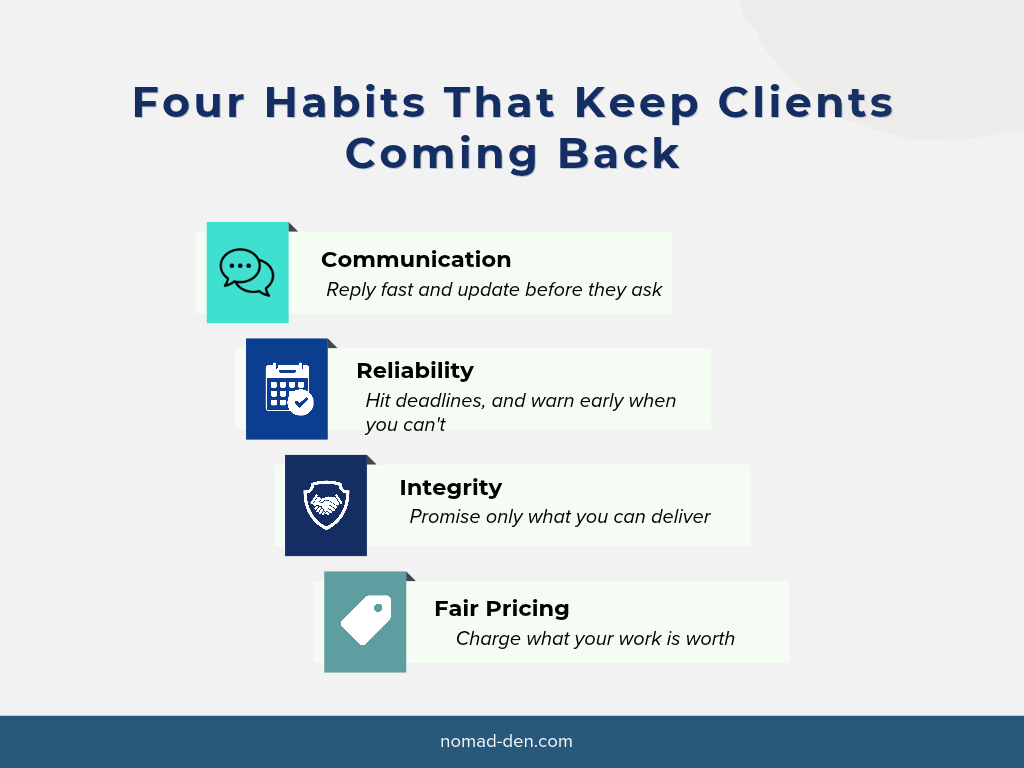
Earlier, when I was a real estate appraiser before 2009, access to consistent work sometimes required being approved by a panel. Approval told the clients using that panel you were a trusted, skilled, and competent appraiser (qualifications varied). Other clients had no such requirements, and good service and steady communication kept their orders coming. Approved or not, repeat work came down to the same four habits, and they apply to freelancing just as well.
Communication
Respond quickly, set clear expectations, and send updates before the client has to ask. Freelance platforms measure this too: Fiverr’s Top Rated review looks specifically at a seller’s responsiveness and expectation setting.
Reliability
Deliver on time, every time. If a deadline is at risk, tell the client early and offer a new date, rather than letting them discover the delay. One slipped deadline is forgivable; a pattern of them is how clients start looking elsewhere, which is exactly why I changed realtors.
Integrity Under Pressure
As an appraiser, I was sometimes pressured to hit a number before the job even started: “I need $500k for this house. Can you make it happen?” I’d explain that I couldn’t promise any value without inspecting the property in person. County records and online data help, but they never replace seeing the home, especially an older one with no recent photos or listing history.
Good clients understood that an appraiser can’t create value that isn’t there. Others went looking for someone who would give them their number, and appraisers who gave in to clients like that risked being removed from lender panels, or worse. Today, federal rules prohibit coercing an appraiser toward a specific value.
Freelancers face their own version. Clients may ask for a guaranteed first-page ranking, though Google states that no one can guarantee a #1 ranking. Others ask for reviews written to order, which the FTC’s 2024 rule on fake reviews bans, with civil penalties for violations.
Do this instead: before you accept the work, define the scope of work in writing, including what you can’t promise, then decline the rest. Be careful with free “quick look” requests too, since some are the paid work in disguise. The clients worth keeping respect that line.
Pricing That Matches the Value
This one is my opinion, from experience rather than data. Good clients pay for good service, and clients who shop only for the lowest rate tend to leave as soon as they find a lower one. Price your work at a level that matches what you deliver, and you’ll attract clients who value the same thing.
Signs a Client Is Ready for a Retainer
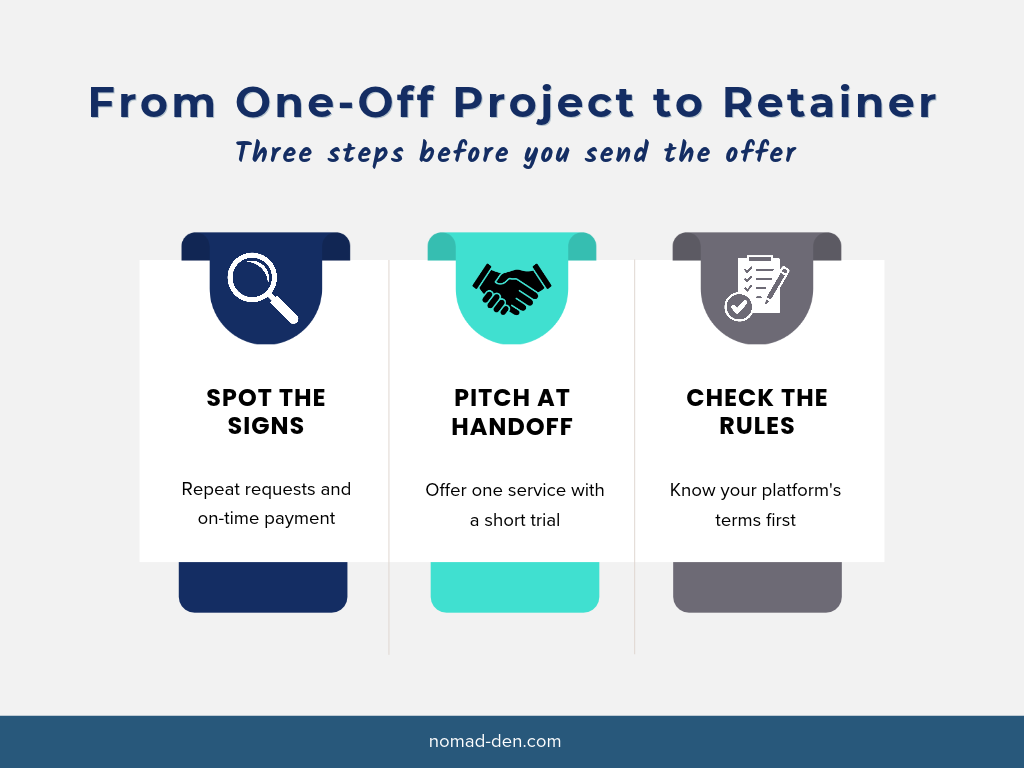
The clearest sign is a client who keeps coming back on their own. If you’re already doing repeat work without an agreement, a retainer simply formalizes it. Look for:
- Repeat small requests after the main project ends
- Questions like “What else could you help with?” or “What should we do next?”
- Mentions of upcoming launches, campaigns, or a recurring need
- On-time payment and clear, specific feedback
- A client who refers others to you
Before you expand the relationship, re-verify the client. Repeat clients can be impersonated too, so confirm any request for new access, new terms, or new payment details through a contact method you already know is real. To brush up on the warning signs, learn how to spot a fake client.
How to Pitch a Retainer at Project Handoff
The best time to pitch a retainer is when you deliver a finished project. Your results are fresh, and the client is already thinking about what comes next.
- Name the ongoing need you noticed. Point to something specific, like content that will go stale or a site that needs monthly updates.
- Offer one service with a monthly scope and price. Keep the first retainer simple.
- Suggest a short trial. A 60 to 90 day trial lowers the risk for both of you.
- Put it in writing. Send the terms as a short agreement, not just a chat message.
A simple version might sound like this:
“I’m glad the launch went well. I noticed your blog will need fresh posts to keep that momentum going. I could handle four posts a month for [price], starting with a 60-day trial. If it isn’t working for either of us, we can stop with two weeks’ notice. Want me to send over the details?”
Check the Platform Rules First
If you met the client on a freelance marketplace, that platform’s rules decide how a retainer can work. Breaking those rules can cost you your account, so check them before you pitch.
Upwork
Upwork requires work and payments to stay on the platform for the first two years of a client relationship. To move off-platform sooner, the client pays a Conversion Fee equal to 13.5% of your estimated annual earnings, and only the client can start that process, as Upwork’s contract conversion guide explains. Taking payment outside Upwork without it violates Upwork’s User Agreement, which prohibits contracting or paying outside the site with anyone you met through Upwork.
Staying on Upwork has a benefit: contracts with clients you’ve worked with longer than 90 days are automatically treated as successful in your Job Success Score. Keep in mind that a long client relationship no longer lowers Upwork’s freelancer service fee the way it once did.
Fiverr
Fiverr offers Subscriptions for eligible sellers: recurring orders on Gigs priced at $10 or more, over 3 or 6 months, with optional discounts starting on the second order. Unlike Upwork, Fiverr offers no paid way to move a client off the platform. Its off-platform policy prohibits taking payment outside Fiverr, and accounts that do risk permanent suspension.
Other Platforms and Direct Clients
Freelancer.com and PeoplePerHour set their own rules about moving clients off-platform, so read their terms before you offer a direct retainer. Clients you find through LinkedIn or FlexJobs are direct clients from day one, which means your written agreement is your main protection. For more on each platform, compare the top freelance platforms.
| Platform | Built-in recurring option | Can you go direct? | Risk of breaking the rules |
|---|---|---|---|
| Upwork | Hourly and ongoing contracts | Yes, after 2 years or with the client-paid Conversion Fee | Account suspension |
| Fiverr | Subscriptions (eligible sellers) | No | Permanent suspension |
| Freelancer.com, PeoplePerHour | Varies | Check each platform’s terms | Varies |
| LinkedIn, FlexJobs, referrals | Your own agreement | Already direct | Not applicable |
A client who pushes to move payments off-platform early is asking you to risk your account, and the same request is one of the most common openers in freelance scams. Stay on-platform until the rules allow otherwise.
What to Put in a Freelance Retainer Agreement
Put every retainer in writing, even with a client you trust. Several states require a written contract for freelance work above set dollar amounts, and they add up repeat work with the same client over 120 days.
| State | Written contract required at | Counts repeat work over | Payment due if the contract is silent |
|---|---|---|---|
| California | $250 or more | 120 days | 30 days after the work is completed |
| New York | $800 or more | 120 days | 30 days after the work is completed |
| Illinois | $500 or more | 120 days | 30 days after the work is completed |
That means a string of small jobs for one client can cross the threshold without anyone noticing. California’s Freelance Worker Protection Act also protects freelancers from retaliation for asking for a contract or for payment. New York’s Department of Labor offers a free model freelance contract, and Illinois publishes guidance on its freelance law. These are examples; other states and cities have their own rules, and readers outside the U.S. should check local law.
A clear retainer agreement covers:
- Services and the monthly scope
- Price, billing date, and payment terms (billing at the start of each period is common)
- What happens to unused hours or deliverables
- How requests outside the agreed scope are quoted and approved
- Notice period for ending the retainer
- Access and security terms (next section)
- How payment-detail changes are verified (covered below)
For templates, the freelance business tools guide includes the Freelancers Union contract template.
One caution: a long, exclusive retainer with set hours and close client control over how you work can start to look like employment. If that describes your arrangement, review the IRS guidance on independent contractors or speak with a professional.
Set Up Client Access the Safe Way
A retainer usually means ongoing access to a client’s accounts, and that access is a security responsibility. The FTC’s vendor security guidance tells small businesses to put security terms in vendor contracts, limit vendor access to what the job needs and only for as long as it needs it, and require multi-factor authentication.
On a retainer, you’re the vendor. Offering those protections before the client asks makes you easier to keep. Do this instead of accepting a shared password:
- Ask for your own named login rather than the owner’s credentials
- Request the lowest access level that gets the work done
- Turn on two-factor authentication for every account you use (set up 2FA on your accounts)
- Share credentials only through a password manager’s sharing feature, never by email or chat (choose a password manager)
- Review access together at each renewal and remove anything no longer needed
A password manager makes most of this list easier, since it lets you share access without exposing the password itself and revoke it when the work ends. Share client logins securely with NordPass.

Protect Recurring Payments From Fraud
Recurring invoices create a predictable payment pattern, and business email compromise (BEC) scams target exactly that. In a BEC scam, an email that appears to come from someone you work with asks for a payment to go to a new account. The FBI’s 2025 Internet Crime Report logged 24,768 BEC complaints and about $3.05 billion in reported losses.
The risk runs both ways. A scammer can pose as your client to redirect a payment, or pose as you and send the client “new bank details” for your next invoice. The FBI recommends verifying any payment change through contact information already on file, and setting up that verification process early in the relationship, outside of email. Your retainer agreement is the natural place for it. A plain-language clause might read:
“Neither party will act on a change to payment details received by email or chat. Changes are confirmed by a phone or video call using the contact details in this agreement.”
The same care applies to tax paperwork. Retainer clients usually ask for a W-9, which carries your taxpayer ID. Sole proprietors can use a free EIN instead of a Social Security number, which keeps your SSN out of every client’s files. If your details have already been exposed, see what to do next.
Plan the Exit Before Day One
Every retainer ends eventually, so agree on how it ends before it starts. A clean exit protects the relationship and leaves the door open for referrals or future work. Add these terms to your agreement:
- A notice period, such as two weeks or 30 days
- The final invoice date and what it covers
- Handover of files and work in progress
- Removal of your access, with the client changing any passwords you used
FAQs
The Takeaway: Earn the Retainer, Then Protect It
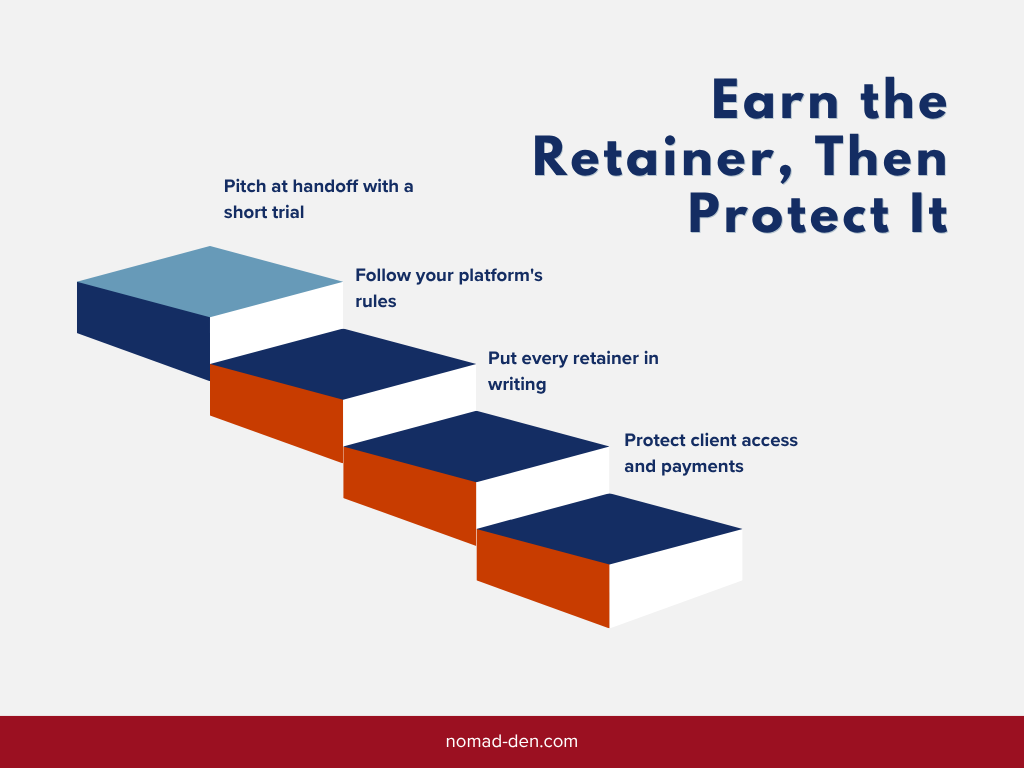
A retainer starts long before you pitch it. Clients come back to freelancers who communicate clearly, deliver on time, and won’t promise what they can’t deliver. When a client is ready, pitch one service at handoff, check your platform’s rules, and put the terms in writing.
The security side is what keeps a retainer from becoming a risk. Use your own login, verify every payment change outside email, and plan the exit before the work begins. Treat your client’s accounts and money as carefully as your own, and you give them one more reason to stay.
Retainers are one part of a stable freelance business. Build a steady income as a freelancer.
Some links in this post may be affiliate links. I may earn a commission at no extra cost to you. Learn more here.
Continue Reading: Related Posts

Freelance Scams: How to Spot a Fake Client Before It Costs You
A fake-client scam is when someone poses as a paying client to take your money,…

How to Build a Steady Income as a Freelancer: Protect What You Earn First
Steady freelance income starts with protecting what you’ve already earned, not just chasing more of…

When to Start Outsourcing: How to Vet Your First Virtual Assistant (or Freelancer)
Outsourcing makes sense the moment a task is both teachable and consistently the thing standing…

Freelancing vs. Remote Work: What’s the Difference?
Freelancing and remote work are not the same thing, even though people use the terms…
Freelance Business Tools: Getting Paid and Staying Protected
Most freelance tool summaries and comparison posts point you toward the same handful of project…
Best Antivirus Software for Small Business Owners and Freelancers (2026)
If you run your business off a single laptop, ‘I should probably get antivirus eventually’…
: