

Table of Contents
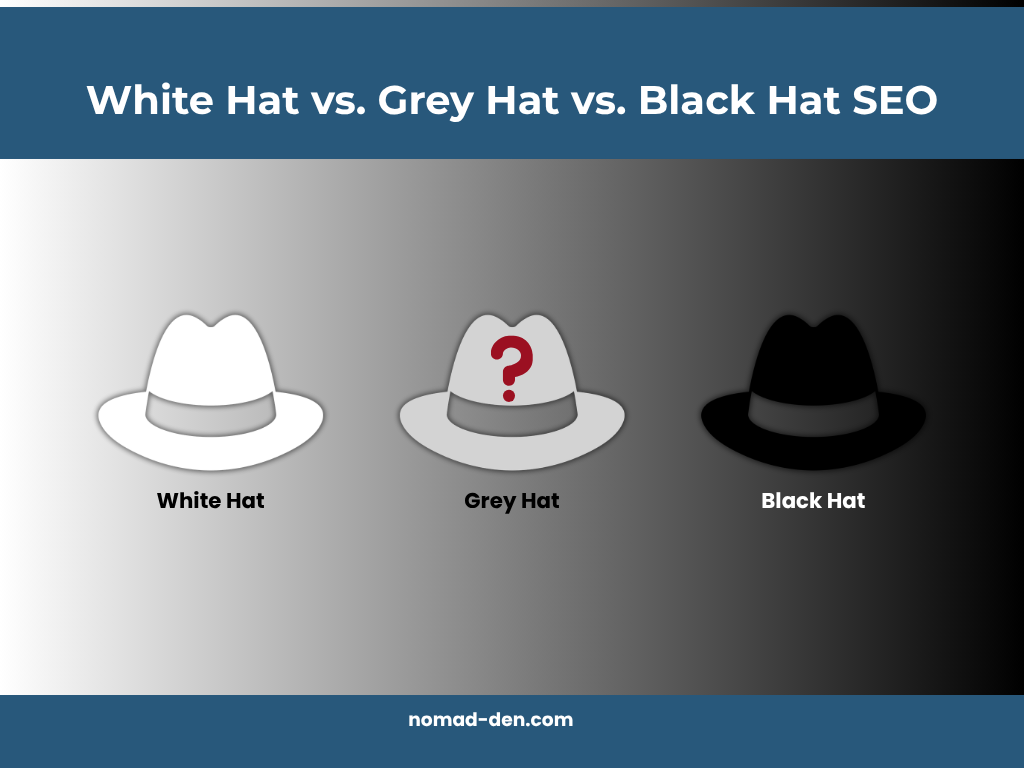
SEO tactics fall into three categories: white hat, black hat, and a shrinking grey area in between, and Google’s 2026 policy updates have made the line between them sharper than it’s been in years. White hat SEO follows Google’s Search Essentials on purpose. Black hat SEO tries to manipulate rankings and breaks those rules outright. Grey hat sits in the middle, technically not against the letter of the rules but built to exploit gaps that Google’s detection systems are closing faster every year.
That last part matters more in 2026 than it did when this framework was first popularized. Google’s own spam policies now explicitly cover attempts to manipulate “generative AI responses in Google Search,” not just traditional rankings, and a fair number of the tactics people still call grey hat get reclassified as black hat within a single algorithm update. If you want the full breakdown of how keyword strategy fits into all this, here’s a guide to keyword research that covers how to optimize for both traditional search and AEO.
What Is White Hat SEO?
White hat SEO means optimizing your site in ways Google’s Search Essentials explicitly endorse, prioritizing the person reading the page over the algorithm ranking it. Google’s own guidance is direct about the goal: create helpful, reliable, people-first content, and use the words people actually search for in the places that matter, like titles and headings. Common white hat practices include:
- Publishing original content based on real research, testing, or firsthand experience
- Earning backlinks by producing something worth linking to, rather than acquiring them
- Writing descriptive, accurate title tags and meta descriptions
- Building a logical site structure with genuine internal links, not link farms
- Improving site speed and mobile usability because it helps visitors, not just rankings
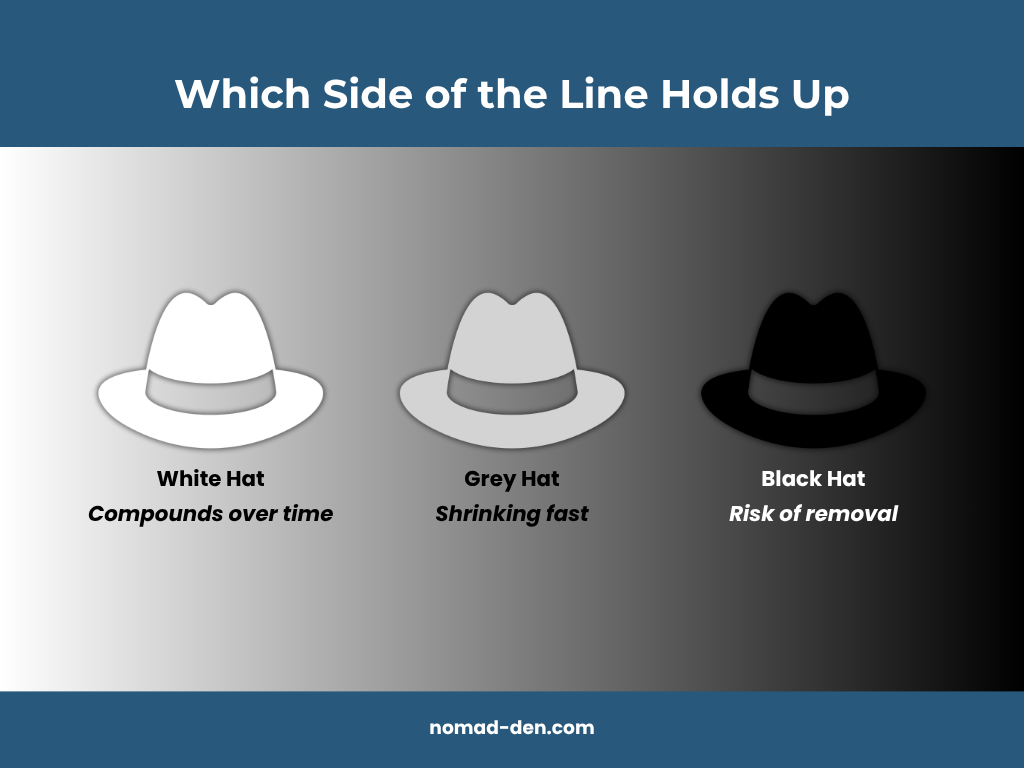
The tradeoff is that none of this is fast. White hat SEO compounds over months and years instead of producing a spike that disappears the next time Google’s systems catch up to it.
What Is Black Hat SEO?
Black hat SEO covers any tactic built to manipulate search rankings rather than genuinely help the person searching, and Google names these practices directly in its spam policies. These aren’t grey areas or interpretations. They’re documented violations that can trigger a manual action or get a site removed from search results entirely. The practices Google names explicitly include:
- Cloaking: showing search engines different content than what a human visitor sees
- Keyword stuffing: unnaturally repeating words or phrases to manipulate rankings
- Link spam: buying or selling links, excessive link exchanges, or using automated tools to generate backlinks
- Doorway abuse: creating near-duplicate pages that funnel visitors toward the real content instead of serving it directly
- Hidden text and links: white text on a white background, CSS positioned off-screen, or font size set to zero
- Sneaky redirects: sending search engines one page while redirecting actual visitors somewhere else
- Scraping: republishing another site’s content, sometimes with light synonym swaps, without adding anything original
- Thin affiliation: affiliate pages that copy product descriptions straight from the merchant with no original review, testing, or comparison added
If you run any kind of affiliate content, it is in your best interest to avoid the last one here, since it is the line between a genuinely useful review and a templated page that adds nothing a reader couldn’t get directly from the merchant.
Scaled content abuse: the newest named violation
Google formalized this policy in March 2024, and it’s become one of the most actively enforced categories in 2026. Scaled content abuse means generating large volumes of low-value pages for the primary purpose of manipulating rankings, and Google’s documentation calls out generative AI tools by name as one of the methods. The policy is explicit that this applies “no matter how it’s created,” meaning mass-produced human content and mass-produced AI content are held to the identical standard.
This is not a ban on AI-assisted writing. Google’s separate generative AI content guidance states plainly that AI can be genuinely useful for researching a topic and structuring original content. The violation isn’t the tool. It’s publishing pages that provide little or no value to a reader, produced at a volume that would have been impossible without automation.
What Is Grey Hat SEO, and Why Is It Shrinking?
Grey hat SEO describes tactics that don’t explicitly break Google’s written rules but are built to exploit gaps in how those rules get enforced, and in 2026 that gap is closing faster than most marketers realize. A technique that worked quietly for years, like buying a placement on a high-authority site and disguising it as editorial content, can flip from “risky but tolerated” to an outright violation the moment Google’s detection systems catch up to the pattern.
Private blog networks, large-scale link exchanges, and paid links dressed up as organic mentions are the three grey hat tactics still most commonly circulated in 2026. The reason they’re riskier now than they were even two years ago comes down to how Google’s SpamBrain system evaluates sites. Instead of flagging individual signals in isolation, it increasingly looks for the broader manipulation pattern those signals create together. A single grey hat tactic might look defensible on its own. However, a pattern of them rarely does.
The practical takeaway: if a tactic requires you to hope Google doesn’t notice, or explaining it out loud would make you pause, it’s not actually grey. It’s black hat with better marketing.
White Hat vs. Grey Hat vs. Black Hat Comparison
| White Hat | Grey Hat | Black Hat | |
|---|---|---|---|
| Follows Google’s rules? | Yes, by design | Technically, but exploits enforcement gaps | No |
| Risk level | Low | Moderate to high, and rising | High |
| Timeline of results | Slow, compounds over time | Fast, short-lived | Fast, until caught |
| Google’s response if caught | N/A — rewarded, not penalized | Devaluation or reclassification as black hat | Manual action, demotion, or removal |
| Examples | Original content, earned backlinks, fast/secure sites | PBNs, disguised paid placements, large-scale link exchanges | Cloaking, keyword stuffing, hidden text, scraping |
| 2026 outlook | Increasingly rewarded, especially for AI citation | Shrinking fast as detection improves | Actively targeted, including AI-specific tactics |
Google isn’t only tightening enforcement here, it’s also the company a federal court ruled had illegally maintained its search monopoly. In August 2024, a judge found Google violated antitrust law in search, and by December 2025 a judge had finalized behavioral remedies against the company, with both Google and the Department of Justice now appealing. None of that changes what happens to a site that ignores Google’s spam policies. It does mean “white hat” is really shorthand for playing by the rules of the one company that controls most of the gate you’re trying to walk through, not a universal code of internet ethics.
Does This Still Matter With AI Reshaping Search?
AI hasn’t made SEO ethics less relevant, it’s made the incentive to cut corners stronger, which is exactly why Google widened its enforcement. A randomized field experiment tracking real user behavior found AI Overviews cut outbound organic clicks by roughly 38% on the queries where they appeared, and Ahrefs’ analysis of 300,000 keywords found the compression reaches 58% for the top-ranking page, up from 34.5% just eight months earlier.
That’s real pressure on a site’s traffic, and pressure is exactly what pushes some marketers toward scaled content, manipulated citations, and other shortcuts that fall squarely under Google’s newest violations. Google responded by widening its own definition of spam. Its Search Essentials now state that spam includes attempts to manipulate generative AI responses in Search, not just traditional blue-link rankings. Scaled content abuse names AI tools directly. And in April 2026, Google added an entirely new malicious practice, back-button hijacking, aimed at sites that interfere with a visitor’s browser navigation to trap them on a page or funnel them toward ads. Enforcement began June 15, 2026.
There’s a flip side to this, too. Being cited inside an AI Overview isn’t neutral for traffic. Data from Seer Interactive shows cited brands earn meaningfully more organic clicks than uncited brands ranking on the same query. In other words, the sites getting rewarded in the AI era are the ones producing content that earns citations, not the ones gaming the system. That’s the white hat argument in a single data point.
Staying on the Right Side of the Line
A few practices keep most sites clear of both black and grey hat territory without slowing down legitimate growth:
- Disclose what needs disclosing. Paid links, affiliate links, and sponsored content all need proper
nofolloworsponsoredattributes. This overlaps directly with FTC compliance, not just Google’s link spam policy, so if you’re running affiliate content, this breakdown of writing a compliant affiliate disclosure covers the legal side of the same requirement. - Treat AI as a drafting tool, not a publishing pipeline. Use it to research and structure, then add the original testing, data, or firsthand experience that makes the page worth reading.
- Run quarterly backlink audits. Toxic links can land on your site without your involvement through negative SEO, and catching them early keeps them from becoming a pattern SpamBrain flags.
- Watch for security-adjacent black hat tactics. Hacked-content injection and back-button hijacking usually trace back to a compromised plugin or a shady script someone installed for a “quick SEO win.” The fix is the same one you’d use for any account security issue: audit what has access to your site, and remove anything you can’t account for.
None of the above requires constant vigilance, just a consistent check-in. A quarterly link audit and an occasional look at Search Console catches most of what matters (including negative SEO). The same discipline applies to how you’re showing up in AI answers, not just your backlink profile, which is where the next tool comes in.
Monitoring AI Visibility the White Hat Way
Staying ethical doesn’t mean flying blind on how you’re actually showing up in AI-generated answers. That’s a legitimate, measurable thing to track, it just has to be tracked instead of manipulated.
Mangools’ AI Search Watcher monitors whether your brand gets surfaced when someone asks an AI model a question related to what you cover, the same way SERPWatcher tracks traditional keyword rankings. It’s the white hat answer to the pressure AI Overviews put on organic traffic: instead of trying to game a citation, you find out where you’re already being cited or missed, and build content that earns the gap. If you want to check your current visibility before committing to anything paid, Mangools’ free AI Search Grader gives you a snapshot of where you stand right now.
Curious how the rest of Mangools’ toolkit fits into a white hat strategy? Here’s the full Mangools SEO guide.
FAQs
Conclusion
The strategies for SEO visibility change every year, but the underlying test doesn’t. Ask yourself if a post or piece of content you create still makes sense if Google, and every reader who lands on it, could see exactly how and why it was made. White hat SEO holds up to that test by design. Black hat never does. And grey hat, in 2026, is running out of room to hide in between. AI hasn’t changed which side of that line holds up over time, it’s just raised the stakes for picking the slower, sturdier one.
Related Posts
Keyword Research for Beginners: How to Find What People Are Searching For
Keyword research in 2026 isn’t about ranking on Google anymore. It’s about understanding what a…
Digital Marketing Analytics for Beginners: Stop Guessing, Start Tracking
When I first launched Nomad Den, I was publishing posts, building out a network of…
SEO Tools for Beginners (Free + Paid): The Only Stack You Need (2026)
As long as people are searching for information online, SEO (search engine optimization) will remain…
Remote Work Skills That Actually Pay (2026)
Working remotely isn’t a backup plan anymore. It’s not something people do when they can’t…
17 SEO Terms Every Beginner Should Know
If you’re new to SEO, the most important terms to understand include keywords, search intent,…
Digital Marketing Guide: Where to Start and How It Works
Digital marketing is the promotion of products or services using digital channels such as search…